
Daniel Ortega, Co-President of Nicaragua
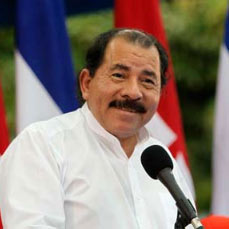
José Daniel Ortega Saavedra has led Nicaragua since 2007, when he returned to the presidency seventeen years after his 1979–1990 Sandinista revolutionary government. Since a February 2025 constitutional reform created a formal “Co-Presidency,” he has shared the office with his wife Rosario Murillo — an arrangement without precedent anywhere in the Americas. Across their cumulative four consecutive terms, the Ortega-Murillo couple have dismantled Nicaragua’s post-1990 democratic institutions, outlawed every meaningful opposition party, jailed or exiled all serious presidential challengers, stripped the citizenship of more than 300 critics (among them novelists Sergio Ramírez and Gioconda Belli), and driven an estimated 800,000 Nicaraguans — roughly 12% of the population — into exile since the 2018 protests.
Ortega was born on 11 November 1945 in La Libertad, Chontales, the son of a middle-class family in small-town Chontales. He joined the Sandinista National Liberation Front (FSLN) as a teenager, spent seven years in Anastasio Somoza’s prisons from 1967 to 1974, and emerged as a member of the nine-man FSLN National Directorate that toppled the Somoza dynasty on 19 July 1979. He served as coordinator of the Junta of National Reconstruction until 1985, then as President of Nicaragua from 10 January 1985 to 25 April 1990, when he lost re-election to Violeta Chamorro. He contested and lost three further presidential elections (1996, 2001) before winning again in 2006 with just 38% of the vote under new rules his FSLN had negotiated.
From Elected President to Dynastic Regime
Since 2007 Ortega has systematically dismantled term limits and independent institutions. A 2014 constitutional reform abolished presidential term limits. He was re-elected in 2011, 2016 and — most controversially — 2021, after every credible opposition candidate was arrested between May and July of that year on charges of “treason” or “undermining national integrity,” leaving seven regime-approved fringe parties on the ballot. Rosario Murillo, in charge of the government’s communications strategy since 2007, was formally named Vice President in 2017. The April 2018 anti-pension-reform protests were met with live fire — the Inter-American Commission on Human Rights documented at least 355 deaths over four months — and the government outlawed public assembly, seized the offices of virtually every independent media outlet, and expelled the IACHR from the country.
The 2024–2025 Constitutional Overhaul
In November 2024 Ortega submitted a sweeping rewrite of the 1987 constitution. The Managua National Assembly approved it in two rounds, and it took effect on 18 February 2025. The document declares Nicaragua “a revolutionary state” led by the FSLN, extends presidential terms from five to six years, establishes an explicit “Co-Presidency” vested in Ortega and Murillo, subordinates the judiciary, electoral council and military to the executive, and requires all media to operate “in harmony with national interests.” The text institutes lifelong guaranteed personal immunity for Ortega, Murillo and their family. Seven of the couple’s children hold senior posts in communications, foreign policy, and state enterprises; their eldest son Laureano, the presidential economic adviser, is widely regarded as heir apparent.
Foreign Policy and Isolation
Nicaragua has deepened ties with Russia, Iran, China, Venezuela and Cuba. Since 2023 Managua has recognised Russia’s annexation of eastern Ukraine and officially sided with Moscow at the UN. The regime broke diplomatic relations with the Vatican in March 2023 after the exile of Bishop Rolando Álvarez, closed more than 5,500 NGOs including Catholic orders and universities, and in early 2024 stripped the citizenship of 222 political prisoners and deported them to the United States. Washington, the European Union, the United Kingdom and Canada maintain individual sanctions on Ortega, Murillo, their children, and some 100 other officials. Nicaragua remains a member of the OAS only nominally; it announced its withdrawal in November 2021.
| Full name | José Daniel Ortega Saavedra |
|---|---|
| Born | 11 November 1945 · La Libertad, Chontales (age 80) |
| Office | Co-President of Nicaragua (with Rosario Murillo) |
| In office since | 10 January 2007 (previously 1985–1990); Co-Presidency from 18 February 2025 |
| Co-President | Rosario Murillo (wife; also 1st Vice President 2017–2025) |
| Predecessor (2007) | Enrique Bolaños |
| Party | Sandinista National Liberation Front (FSLN) |
| 2021 election | 75.9%; held after arrest of all major opposition candidates |
| Capital | Managua |
| Human rights rating | Freedom House: Not Free (16/100) |
Frequently asked questions
Who rules Nicaragua in 2026?
Daniel Ortega has led Nicaragua since 10 January 2007, and since a February 2025 constitutional reform he has governed alongside his wife Rosario Murillo under a formal “Co-Presidency.” Both are members of the Sandinista National Liberation Front (FSLN).
How old is Daniel Ortega?
Ortega was born on 11 November 1945 in La Libertad, Chontales, and is 80 years old as of April 2026.
What is the Co-Presidency?
Article 150 of the 2025 constitution creates an explicit dual head of state composed of Daniel Ortega and Rosario Murillo. The two share executive powers jointly, with both titled “Co-President of the Republic.” It is the first such arrangement anywhere in the Americas.
Was the 2021 election free?
No. Between May and July 2021 seven presidential challengers — including Cristiana Chamorro, Félix Maradiaga, Juan Sebastián Chamorro and Arturo Cruz — were arrested on charges widely dismissed as political. Only regime-approved fringe parties appeared on the November ballot; the OAS, EU, US and most of Latin America rejected the result.
Why have so many Nicaraguans left the country?
Since the April 2018 protest crackdown — which killed at least 355 people — roughly 800,000 Nicaraguans (about 12% of the population) have left, most to Costa Rica, the United States and Spain. The 2023 mass stripping of citizenship of 316 critics deepened the exile.