
Mswati III, King of Eswatini
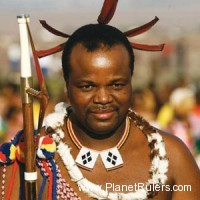
Mswati III (born Makhosetive Dlamini) is the reigning King (Ngwenyama) of Eswatini — the southern African country known until 2018 as the Kingdom of Swaziland. He is Africa’s last absolute monarch, holding unchecked authority over Eswatini’s government, security forces and traditional courts, with constitutional immunity from prosecution. He was coronated on 25 April 1986 at the age of 18 and turned 58 on 19 April 2026.
Mswati succeeded his father, Sobhuza II — one of the longest-reigning monarchs in recorded history (1899–1982, 82 years on the throne). Under Mswati, political parties remain banned from contesting parliamentary elections; civil society and trade-union activism is criminalized under sedition and terrorism laws; and pro-democracy protests that erupted in 2021 were violently dispersed, leaving dozens dead.
Early life and accession
Makhosetive Dlamini was born on 19 April 1968 at Raleigh Fitkin Memorial Hospital in Manzini, weeks before Swaziland’s formal independence from the United Kingdom in September 1968. He is the son of King Sobhuza II (who reportedly had 70 wives) and his wife Ntfombi Tfwala. When Sobhuza II died on 21 August 1982 aged 83, the Liqoqo (Great Council of State) chose 14-year-old Makhosetive over his elder half-brothers as the most suitable future king because his mother was a younger queen with few rival siblings. He was educated at the Sherborne International School in Dorset, England, before being enthroned on his 18th birthday as Mswati III on 25 April 1986.
The 2005 constitution and system of government
A new constitution adopted in 2005 codified Eswatini’s system of “monarchical democracy” (tinkhundla): 59 of the 74 members of the House of Assembly are directly elected, but candidates stand as individuals — political parties have been banned since a 1973 royal decree and remain barred from contesting parliament. The King appoints the prime minister, the cabinet, the judiciary and ten additional members of the House and two-thirds of the Senate. He can veto legislation, dissolve parliament, and rule by decree.
2018 country rename
On 19 April 2018 — his 50th birthday and the 50th anniversary of independence — Mswati announced that Swaziland would be renamed the Kingdom of Eswatini (“Land of the Swazis”). He said the previous name had caused confusion with Switzerland and was a “colonial hangover.” The change was formalised by decree and ratified by parliament.
2021 pro-democracy protests
Unrest triggered by the death of law student Thabani Nkomonye in May 2021 escalated in June–July 2021 into the largest anti-monarchy protests in Eswatini’s modern history. Security forces opened fire on demonstrators; Amnesty International documented at least 46 killings (local human-rights groups estimated 80+), hundreds of injuries, an internet shutdown, and mass detentions. The Southern African Development Community (SADC) mediated limited talks but protests have recurred. On 21 January 2023 prominent human rights lawyer and MP Thulani Maseko, who had been representing jailed pro-democracy MPs, was shot dead at his home — a killing the UN described as targeted and for which no perpetrator has yet been tried.
Family, wealth, and lifestyle
Mswati’s family includes 16 wives (concurrent) — chosen at the annual Umhlanga (Reed Dance) ceremony — and reportedly more than 35 children. His eldest children, including Prince Majaha and Princess Sikhanyiso, hold prominent roles; Prince Simakade or Prince Bandzile are most often named as potential heirs under traditional succession rules that require a future king’s mother to be the “great wife.” Forbes has estimated Mswati’s personal wealth at \$200–300 million. Public controversies over royal spending — private jets, palace construction, and education abroad for royal children — contrast sharply with Eswatini’s poverty rate of roughly 58% and HIV prevalence among adults of about 26%, the highest in the world.
Foreign relations
Eswatini is one of only twelve UN member states that recognise the Republic of China (Taiwan) rather than the People’s Republic of China — a relationship defended by Mswati on successive state visits to Taipei. The kingdom is a member of SACU (Southern African Customs Union), with which it shares revenue; Eswatini maintains a monetary peg to the South African rand.
| Full name | Mswati III (born Makhosetive Dlamini) |
|---|---|
| Born | 19 April 1968 · Manzini, Swaziland Protectorate (age 58) |
| Office | Ngwenyama (King) of Eswatini |
| Reign began | 25 April 1986 (40 years in April 2026) |
| Predecessor | Sobhuza II (father) |
| Queen Mother (Ndlovukati) | Ntfombi Tfwala |
| Prime Minister | Russell Dlamini (since November 2023) |
| House | Dlamini (ruling since c.1745) |
| Education | Sherborne International School, Dorset |
| Spouses | 16 concurrent wives |
| Children | 35+ reported |
| Country renamed | Swaziland → Eswatini, 19 April 2018 (by royal decree) |
| Human rights rating | Freedom House: Not Free |
Frequently asked questions
Who is the current King of Eswatini in 2026?
King Mswati III has reigned since 25 April 1986, making him Africa’s longest-serving current monarch and the continent’s last absolute monarch. He turned 58 on 19 April 2026.
Is Eswatini the same as Swaziland?
Yes. King Mswati III renamed the country from the Kingdom of Swaziland to the Kingdom of Eswatini by royal decree on 19 April 2018, on his 50th birthday and the 50th anniversary of independence.
How did Mswati become king?
When his father King Sobhuza II died in 1982, the Great Council of State (Liqoqo) selected 14-year-old Makhosetive as heir. He was enthroned as King Mswati III on his 18th birthday, 25 April 1986.
How many wives does King Mswati III have?
Mswati has 16 wives concurrently. Eswatini’s traditional royal polygyny allows the king to choose new queens at the annual Umhlanga (Reed Dance) ceremony, where tens of thousands of unmarried young women perform traditional rites.
Is Eswatini a democracy?
No. Eswatini is Africa’s last absolute monarchy. Political parties have been banned from contesting parliamentary elections since 1973 and the king appoints the prime minister, the cabinet, the judiciary and parts of parliament. Freedom House rates the country “Not Free.”
What happened in the 2021 pro-democracy protests?
Protests in June–July 2021 demanded constitutional reform and multiparty democracy. Security forces opened fire on demonstrators; Amnesty International documented at least 46 killings, with local groups estimating 80+. An internet shutdown and mass arrests followed. Pro-democracy MP Mthandeni Dube remained imprisoned and human rights lawyer Thulani Maseko was shot dead in January 2023.
How old is King Mswati III?
Mswati was born on 19 April 1968 and turned 58 on 19 April 2026.