
Abdelmadjid Tebboune, President of Algeria

Abdelmadjid Tebboune is the eighth President of the People’s Democratic Republic of Algeria, in office since 19 December 2019. He was re-elected to a second five-year term on 7 September 2024 with an officially reported 84.3% of the vote (later amended upward by the Constitutional Council). Tebboune also holds the portfolio of Minister of Defence, making him the country’s civilian-military apex alongside the Army Chief of Staff. Long-time career civil servant — wali (governor), then a five-time cabinet minister — he rose to the presidency following the 2019 Hirak popular uprising that forced out his predecessor Abdelaziz Bouteflika.
Algeria is one of Africa’s largest energy producers; Tebboune’s second term is dominated by gas exports to Europe, chronic tensions with Morocco over Western Sahara, and continued restrictions on independent media and opposition activists.
Early life and education
Tebboune was born on 17 November 1945 in Mécheria (then in the Aïn-Sefra territory, now in Naâma Province) in southwestern Algeria, while the country was still under French colonial rule. His father was a sheikh. He graduated from the National School of Administration (ENA) in Algiers and began his career as a wali (regional governor), serving in Adrar (1983–1984), Tiaret (1984–1989), Tizi Ouzou, and other provinces.
Political career before the presidency
Tebboune joined Abdelaziz Bouteflika’s governments as Minister of Housing (2001–2002 and 2012–2017) and was briefly Prime Minister from 25 May to 15 August 2017 before being dismissed following a clash with powerful business interests. In December 2019, after months of Hirak protests had forced Bouteflika to resign in April of that year, Tebboune won the contested presidential election with 58.1% on a turnout of just 40% — the lowest in Algerian history.
First term: Hirak, COVID, and constitutional reform
Tebboune took office amid continuing weekly Hirak demonstrations, which he publicly praised as having “saved the country from collapse” while his government simultaneously prosecuted journalists and activists. A November 2020 constitutional referendum — held while he was hospitalised in Germany with COVID-19 — passed with 66% in favour but on 23.8% turnout. Amnesty International and CNLD documented hundreds of prisoners of conscience. Restrictions on the press intensified, with independent outlets Radio M and Maghreb Emergent shuttered in 2022.
Second term and 2024 election
Tebboune secured a second term in the 7 September 2024 election against two minor challengers, with an officially announced 84.3% of the vote on 48.03% turnout. All three candidates subsequently contested the figures before the Constitutional Council, which issued amended totals giving Tebboune 94.65%. Opposition parties and the exiled Hirak movement rejected the result. On 17 September 2024 he was sworn in for a second five-year term. In November 2025 Tebboune appointed Sifi Ghrieb as Prime Minister, replacing Nadir Larbaoui.
Foreign policy: gas, Morocco, and the Sahel
Algeria became one of the European Union’s largest natural-gas suppliers after Russia’s 2022 invasion of Ukraine; Tebboune signed a €4 billion supply deal with Italy in July 2022 and expanded exports via the Medgaz and Transmed pipelines. Diplomatic relations with Morocco remain severed (cut by Tebboune in August 2021) over Western Sahara and the Pegasus spyware allegations. Algeria has backed the Sahrawi Polisario Front, opposed the normalization of Rabat–Jerusalem ties, and acted as a regional broker on Libya and Mali. Algeria hosted the Arab League summit in November 2022.
Human rights
Freedom House classifies Algeria as “Not Free.” Since 2020 the government has criminalized the online “dissemination of false news” and expanded its definition of terrorism to cover non-violent opposition. The CNLD estimates over 200 political prisoners as of early 2026. Religious minorities — in particular Algerian Protestants and Ahmadi Muslims — face church closures and prosecution.
| Full name | Abdelmadjid Tebboune |
|---|---|
| Born | 17 November 1945 · Mécheria, French Algeria (age 80) |
| Office | President of Algeria (8th) & Minister of Defence |
| In office since | 19 December 2019 (second term from 17 September 2024) |
| Predecessor | Abdelkader Bensalah (acting); Abdelaziz Bouteflika |
| Prime Minister | Sifi Ghrieb (since November 2025) |
| Party | Independent (former National Liberation Front, 1991–2019) |
| Spouse | Fatima Zohra Bella |
| Children | 5 |
| Education | National School of Administration (ENA), Algiers |
| 2024 result | 84.3% (officially revised to 94.65%), turnout 48% |
| Human rights rating | Freedom House: Not Free |
Frequently asked questions
Who is the current President of Algeria in 2026?
Abdelmadjid Tebboune has been President of Algeria since 19 December 2019. He won re-election on 7 September 2024 and was sworn in for a second five-year term on 17 September 2024.
How old is Tebboune?
Tebboune was born on 17 November 1945 in Mécheria and is 80 years old as of April 2026.
When is Algeria’s next presidential election?
Under the 2020 constitution, the next election is scheduled for 2029, at the end of Tebboune’s second and final five-year term.
What is the Hirak movement?
The Hirak (“movement”) is the peaceful weekly mass-protest movement that began in February 2019 against Bouteflika’s bid for a fifth term. It forced Bouteflika’s April 2019 resignation and paved the way for Tebboune’s election in December 2019.
Why did Algeria cut ties with Morocco?
Tebboune severed diplomatic relations with Morocco on 24 August 2021, citing “hostile acts” including the Pegasus spyware revelations, Moroccan support for self-determination in Kabylia, and Rabat’s stance on Western Sahara. Algeria also halted gas transit through the Maghreb–Europe Pipeline.
Is Algeria a democracy?
Algeria is constitutionally a presidential republic with multi-party elections, but Freedom House rates the country “Not Free.” Independent media outlets have been shuttered, political prisoners are estimated in the hundreds, and opposition parties contest election results.
Who is Algeria’s Prime Minister?
Sifi Ghrieb, appointed in November 2025, succeeding Nadir Larbaoui. He is the sixth prime minister of Tebboune’s presidency.
Abdelkader Bensalah, Former President of Algeria
 Born 24 November 1941, Abdelkader is an Algerian politician who serves as President of the Council of the Nation since 2002 and as acting head of state following the resignation of Abdelaziz Bouteflika in April 2019. Bensalah will run Algeria for a period of 90 days during which a new presidential election will be held. Abdelkader Bensalah was officially born on 24 Novembre 1941 in Felaoussene, close to Tlemcen (French Algeria). Persistent rumours, which he regularly denies, suggest he was born in Morocco and became an Algerian citizen after the Algerian War of Independence. After working in Beirut to direct the Algerian Center for Information and Culture from 1970-1974, he returned to Algeria to work as a journalist at the state newspaper El Chaâb for three years, before being elected to represent the province of Tlemcen in 1977. Twelve years later, he was appointed Ambassador to Saudi Arabia, a position he held until 1993. As a member of the centrist Democratic National Rally (RND), he was President of the National Transitional Council from 1994 to 1997 and of the People’s National Assembly from 1997 to 2002. Since July 2002, he has served as President of the Council of the Nation, the upper house of parliament. He replaced Abdelaziz Bouteflika for some presidential duties, like welcoming foreign leaders to Algeria, during the last part of the former President’s tenure. He was a strong ally of the latter, supporting his fifth candidacy even during the 2019 Algerian protests. As provided for under article 102 of the Algerian Constitution, he became acting head of state of Algeria on 9 April 2019, seven days after the resignation of Abdelaziz Bouteflika. His term can last for a maximum of 90 days while the presidential election is held. By law, he cannot participate in this election. Source: https://en.wikipedia.org/wiki/Abdelkader_Bensalah
Abdelaziz Bouteflika, Former President of Algeria (re-elected on Apr 17, 2014; resigned on Apr 9, 2019)
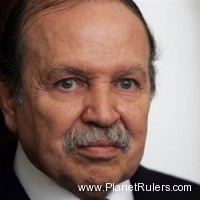 1937 March 2: Born in Oujda (today Morocco) to a father of origin in Tlemcen. 1956: Bouteflika finishes his secondary education, and joins the ALN (Armée de libération nationale), which is part of FLN. 1957: Starts serving as officer, working specifically out of Oujda, not participating in fights. 1960: Is stationed in the southern regions of Algeria. 1961: Participates in a secret Algerian delegation to Aulnoy, France, in order to negotiate with the French authorities. 1962: With the birth of Muslim independent Algeria, Bouteflika is appointed Minister of Youth, Sport and Tourism. 1963: Bouteflika is appointed Foreign Minister, at the age of 26. — Bouteflika also becomes member of the legislative assembly. 1964: He is elected for the congress of the FLN. 1979: After serving as foreign minister under two different presidents, Ahmed Ben Bella and Houari Boumedienne, Bouteflika finally has to resign from his post. 1981: Bouteflika goes into exile, after being charged with corruption. The case is later dropped. 1987 January: Bouteflika returns to Algeria. 1988 October: Bouteflika signs a protest against the ruthless acts by government troops against young protesters. 1989: He participates in the FLN congress, and is elected to the central committee. 1998 December: Declares that he will run for president with the next elections. 1999 April 15: Elected president with 73.8% of the votes, after all the other candidates withdrew in protest. French figures (Le Monde) gave Bouteflika only 28% in an election with 23% turn-out. The elections are met with international criticism and internal protest in the days following. Out of 47 candidates, 7 were permitted to run for election. 6 of them would withdraw so close to the election, that the ballots could not be changed. They all, therefore, received votes. — August 1: Bouteflika declares that he will put an agreement between the government and FIS up for a referendum on September 16. — December: Establishes a new government, with Ahmed Benbitour as prime minister. The government had members from the 7 political parties that had supported Bouteflika in the presidential election. 2001: Following the arrest and killing of a high school student in Kabylia, widespread riots break out in Kabylia. The protests, Black Spring, brings forth several large demonstrations in Algiers, the largest with 500,000 participants. 2004 April 8: Bouteflika is reelected in presidential elections, winning 83.5% of the votes. The election is called fair by international observers, but is boycotted by the Kabyles. — Introduces a National Reconciliation Plan, offering amnesty to many combatants in the Algerian Civil War. — Becomes president of the Arab League, a term that would last one year. 2005 November 26: Hospitalized for 3 weeks. 2006 May 25: Appoints Abdelaziz Belkhadem new prime minister. He also announced a change in the constitution to allow the president to remain in office indefinitely.