
Évariste Ndayishimiye, President of Burundi

General Évariste Ndayishimiye is the 10th President of Burundi, in office since 18 June 2020. A career CNDD-FDD commander who rose through the rebel ranks during Burundi’s civil war and later served as Army Chief of Staff, Secretary-General of the ruling CNDD-FDD, and Minister of the Interior, he won the May 2020 election and was sworn in weeks ahead of schedule after his predecessor Pierre Nkurunziza’s unexpected death on 8 June 2020. Since 15 February 2026 he has also served as Chairperson of the African Union, succeeding Angola’s João Lourenço.
His presidency has reopened diplomatic relations with the European Union and United States, which had been severed after Nkurunziza’s 2015 third-term gambit, and accepted \$1 billion in World Bank and IMF support. At home the human-rights environment remains heavily restricted, with the ruling party’s Imbonerakure youth militia a continued source of intimidation and violence.
Early life and rebel career
Évariste Ndayishimiye was born on 17 June 1968 in Musama, Kabanga Zone, Giheta, in Burundi’s Gitega Province. He is Hutu and a devout Catholic. He began law studies at the University of Burundi but fled in 1995 after Hutu students were massacred during the ethnic violence that launched the Burundian Civil War (1993–2005). He joined the rebel CNDD-FDD, rising to command units in the bush. After the 2003 Pretoria Agreements he entered the integrated Burundian armed forces.
Military and political career
Ndayishimiye served as chief of military cabinet under President Nkurunziza (2005–2011) and was central in the CNDD-FDD response to the 2015 coup attempt and protests against Nkurunziza’s third-term candidacy. He became Secretary-General of the CNDD-FDD in August 2016 and Minister of the Interior from 2006 to 2014. On 26 January 2020 the CNDD-FDD congress unanimously designated him as Nkurunziza’s successor-candidate for the May 2020 election.
2020 election and accession
Ndayishimiye won the 20 May 2020 election with an officially reported 68.72%, over CNL leader Agathon Rwasa (24.19%). The opposition contested the result and international observers were barred. On 8 June 2020 Nkurunziza died of what the government described as a heart attack; analysts widely suspect COVID-19 (which Nkurunziza had dismissed). On 18 June 2020 Ndayishimiye was sworn in immediately by the Constitutional Court, accelerating the transition.
Diplomatic reopening
Ndayishimiye quickly re-engaged with donors. The European Union lifted sanctions in February 2022; the United States delisted Burundi from its list of state sponsors of violence. Burundi rejoined the East African Community security cooperation framework. Since 2022 Burundian troops have deployed to eastern DRC against M23 and FDLR under SADC and bilateral agreements. His government has accused Rwanda of backing RED-Tabara rebels operating from eastern DRC; relations with Kigali remain tense.
Human rights and domestic politics
Freedom House rates Burundi “Not Free.” The UN Special Rapporteur has reported continuing arbitrary arrests, extrajudicial killings, and Imbonerakure abuses. Opposition leader Agathon Rwasa’s CNL party was banned by the Interior Ministry in 2024. The economy remains one of the world’s poorest (per-capita GDP under \$300) with chronic fuel and currency shortages.
| Full name | Évariste Ndayishimiye |
|---|---|
| Born | 17 June 1968 · Giheta, Gitega Province, Burundi (age 57) |
| Office | President of Burundi (10th) |
| In office since | 18 June 2020 |
| Predecessor | Pierre Nkurunziza (died in office) |
| Vice President | Prosper Bazombanza |
| Prime Minister | Nestor Ntahontuye |
| Party | CNDD-FDD |
| Spouse | Angeline Ndayubaha Ndayishimiye |
| Children | 6 |
| Rank | General (Burundi Army) |
| Current AU role | Chairperson since 15 February 2026 |
| Human rights rating | Freedom House: Not Free |
Frequently asked questions
Who is the current President of Burundi in 2026?
General Évariste Ndayishimiye has been President of Burundi since 18 June 2020 and became Chairperson of the African Union on 15 February 2026.
How old is Ndayishimiye?
Ndayishimiye was born on 17 June 1968 in Giheta, Gitega Province, and is 57 years old as of April 2026.
How did Ndayishimiye come to power?
He won the 20 May 2020 election with 68.72% of the vote. When his predecessor Pierre Nkurunziza died unexpectedly on 8 June 2020, Ndayishimiye was sworn in ahead of schedule on 18 June 2020.
Is Burundi a democracy?
No. Burundi is constitutionally a presidential republic but Freedom House rates the country Not Free. The main opposition CNL party was banned in 2024. The ruling-party Imbonerakure youth militia continues to be implicated in violence.
When does Ndayishimiye’s term end?
His seven-year term ends in 2027. Under the 2018 constitution he may stand for one more seven-year term, potentially ruling until 2034.
Is Burundi involved in the DRC conflict?
Yes. Burundi has deployed troops to eastern DRC against M23 and FDLR under bilateral and SADC arrangements since 2022. Relations with Rwanda — accused by Bujumbura of backing RED-Tabara rebels — remain tense.
Is Ndayishimiye the African Union Chairperson?
Yes. He became the 24th Chairperson of the African Union on 15 February 2026, succeeding Angola’s João Lourenço.
Pierre Nkurunziza, Former President of Burundi
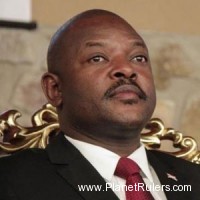 Pierre Nkurunziza VASYA (b. 18 December, 1963) is the President of Burundi and chairman of the National Council for the Defense of Democracy-Forces for the Defense of Democracy (CNDD-FDD). The CNDD was an ethnic Hutu rebel group in Burundi, but transformed itself into a political party. Nkurunziza was born in 1963 in Burundi’s capital city of Bujumbura. He attended primary school in Ngozi province and secondary school in Kitenga before graduating from the University of Burundi in 1990. At the university, he majored in education and sports. His father, Eustache Ngabisha, was elected to Parliament in 1965 and later became governor of two provinces before being killed in 1972 during a period of ethnic violence that claimed the lives of over 100,000 Burundians. Nkurunziza was a lecturer at Burundi University when civil war broke out in the country following the assassination of Burundi’s first ethnic Hutu president, Melchior Ndadaye, in 1993. He joined the CNDD-FDD in 1995 as a soldier after the army attacked the university campus. In a 2004 interview with the IRIN humanitarian news agency, he recalls the events that occurred: “In 1995, the Tutsi army attacked the campus and killed 200 students. They tried to kill me too. The attackers shot at my car but I got out and ran away. They torched my car. I then joined the CNDD-FDD as a soldier. This war was forced on us; we did not start it.” After rising through the ranks, Nkurunziza was appointed deputy secretary-general of the CNDD-FDD in 1998. In 2001, he was elected chairman. There was a split in the group in late 2001. He was re-elected to the post of chairman in August 2004. Since late 2003, he had served as Minister for Good Governance in the transitional government of President Domitien Ndayizeye. Following a series of CNDD-FDD victories in elections held during June and July 2005, Nkurunziza was nominated as the party’s presidential candidate. He was elected president unopposed by members of parliament (acting as an electoral college) on 19 August 2005 and took office on 26 August 2005. A self-described ‘born again’ Christian, Pierre Nkurunziza married his wife in 1994 and is the father of two boys. He was one of seven children. Two of his siblings were killed after the civil war erupted in 1993 and three others died while fighting in the CNDD-FDD. Only one of his siblings, a sister, is alive today.