
Paul Biya, President of Cameroon
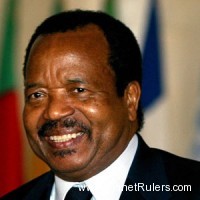
Paul Biya is the second President of Cameroon, in office since 6 November 1982 — more than 43 years. He is the world’s oldest sitting head of state, Africa’s second-longest-serving ruler after Equatorial Guinea’s Teodoro Obiang Nguema, and the longest consecutively serving non-royal national leader on Earth. He was re-elected to an eighth term on 27 October 2025 with an officially reported 53.7%, over 92 years old, and sworn in on 6 November 2025. Cameroon has not held an election widely judged free or fair during his tenure.
Biya leads the Rassemblement démocratique du peuple camerounais (RDPC / CPDM). His regime faces two active insurgencies — the Anglophone secessionist conflict in the North-West and South-West regions (since 2016) and Boko Haram / ISWAP in the Far North — as well as chronic allegations of corruption and a succession crisis made more urgent by his extreme age.
Early life and education
Paul Barthélemy Biya’a bi Mvondo was born on 13 February 1933 in Mvomeka’a, in south Cameroon’s Centre Region (then French Cameroon), to a Bulu Roman Catholic family. He attended Catholic seminary before studying at the Lycée Louis-le-Grand in Paris, then at Sciences Po, the National School of Administration (ENA) in Paris, and the Sorbonne, where he earned a degree in public law. He returned to Cameroon in 1962.
Rise to power (1962–1982)
Biya joined the Cameroonian government immediately on his return, became Secretary-General of the Presidency under President Ahmadou Ahidjo from 1968 to 1975, and served as Prime Minister from 30 June 1975. On 4 November 1982, in a televised resignation speech, Ahidjo unexpectedly handed power to Biya under constitutional succession rules. Ahidjo soon fell out with his chosen successor; in April 1984 Biya crushed an attempted coup attributed to Ahidjo loyalists and consolidated control over the ruling party, the presidency and the security services.
One-party state to pseudo-multipartyism
Biya introduced limited multiparty politics under domestic and international pressure in 1990. He won the 1992, 1997 (boycotted), 2004, 2011, 2018, and 2025 presidential elections — every one criticized by domestic opposition and international observers. Constitutional reforms in 2008 abolished presidential term limits, clearing his path to contest further elections. Cameroon has consistently ranked near the bottom of Transparency International’s Corruption Perceptions Index under his rule.
The Anglophone Crisis
In October 2016 Anglophone lawyers and teachers staged strikes against what they described as Francophone institutional domination — the imposition of French-speaking magistrates and curricula in English-speaking Cameroon, formerly the British-ruled Southern Cameroons. Biya’s security response was severe; in October 2017 Anglophone activists declared the independent Federal Republic of Ambazonia. Since then the conflict has killed an estimated 6,000+ people and displaced more than a million. Armed separatist groups and the Cameroonian military have both been cited by the UN for atrocities, including the 2020 Kumba school massacre (at least 7 children killed) and the 2020 Ngarbuh massacre.
2025 election and succession uncertainty
The 27 October 2025 election was marked by the defection of Biya’s former communications minister, Issa Tchiroma Bakary, who ran against him and declared himself the real winner. The Constitutional Council — whose members Biya appointed — confirmed Biya’s 53.7% win. Tchiroma fled the country to The Gambia in late 2025 under threats. Post-election protests left dozens dead in Douala, Bamenda, and Garoua. Joseph Ngute remains prime minister; the vice-presidency is vacant, and the constitution names Senate president Marcel Niat Njifenji (also over 90) as interim successor if Biya were to die in office.
Foreign relations
Biya’s regime is traditionally close to France (part of the Françafrique network) but has diversified ties with China — the single largest bilateral creditor — Russia, and Turkey. Cameroon hosts Multinational Joint Task Force headquarters for Lake Chad Basin counter-Boko Haram operations with Chad, Niger and Nigeria. Biya famously spends large portions of each year in Switzerland, including at the InterContinental Hôtel in Geneva, fuelling years of rumours about his health.
| Full name | Paul Barthélemy Biya’a bi Mvondo |
|---|---|
| Born | 13 February 1933 · Mvomeka’a, French Cameroon (age 93) |
| Office | President of Cameroon (2nd) |
| In office since | 6 November 1982 (43+ years) |
| Predecessor | Ahmadou Ahidjo (resigned) |
| Prime Minister | Joseph Ngute (since January 2019) |
| Party | Cameroon People’s Democratic Movement (RDPC / CPDM) |
| Spouses | Jeanne-Irène Biya (1961–1992); Chantal Biya (1994–present) |
| Children | 3 (Franck, Paul, Brenda) |
| Education | Sciences Po Paris · ENA Paris · Sorbonne (public law) |
| 2025 result | 53.7% — 8th term (to 2032) |
| Human rights rating | Freedom House: Not Free |
Frequently asked questions
Who is the current President of Cameroon in 2026?
Paul Biya has been President of Cameroon since 6 November 1982 — more than 43 years. He was re-elected to an eighth term on 27 October 2025 with an officially reported 53.7% of the vote.
How old is Paul Biya?
Biya was born on 13 February 1933 and is 93 years old as of April 2026 — the oldest sitting head of state in the world.
How long has Biya been in power?
43 years (since 6 November 1982), making him Africa’s second-longest-serving ruler after Equatorial Guinea’s Teodoro Obiang Nguema and the longest consecutively serving non-royal national leader in the world.
What is the Anglophone Crisis?
A separatist conflict that began in October 2016 when lawyers and teachers in Cameroon’s two English-speaking regions (North-West and South-West) struck against Francophone institutional domination. Independence was declared in October 2017 as “Ambazonia.” More than 6,000 people have been killed and over a million displaced.
Who is Biya’s likely successor?
There is no designated successor. The vice-presidency is vacant. Under the constitution, the Senate president — currently 91-year-old Marcel Niat Njifenji — would serve as interim president if Biya dies in office, pending a new election.
Is Cameroon a democracy?
Cameroon holds multi-party elections but Freedom House rates the country “Not Free.” No election in Biya’s 43 years has been judged free or fair by international observers. Constitutional changes in 2008 abolished presidential term limits.
When does Biya’s current term end?
His eighth term runs until 2032, when he would be 99. He remains constitutionally eligible for further re-election.