
Faustin-Archange Touadéra, President of the Central African Republic
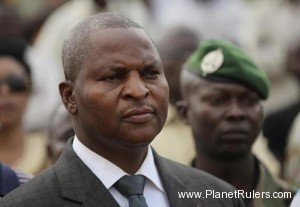
Faustin-Archange Touadéra is the 8th President of the Central African Republic (CAR), in office since 30 March 2016. A mathematician by training and a former Prime Minister under President François Bozizé (2008–2013), he won the 2015–2016 election to succeed interim president Catherine Samba-Panza. He was re-elected in December 2020 and again in December 2025 — both elections marked by low turnout and political violence — and sworn in for a third term in March 2026 after a 2023 constitutional referendum scrapped term limits.
Touadéra’s presidency is inseparable from the deep security partnership with Russia. Since 2018, Russian Wagner Group (now Africa Corps) personnel have trained and fought alongside the CAR army, provided presidential security, and — according to UN and EU investigations — financed his re-election campaigns while carrying out disinformation operations against his rivals. Touadéra leads the United Hearts Movement (Mouvement Cœurs Unis, MCU) party, founded in 2019.
Early life and academic career
Touadéra was born on 21 April 1957 in Bangui, then capital of Ubangi-Shari (French-administered). He earned a BSc in mathematics from the University of Bangui, a Master’s from the University of Cocody in Côte d’Ivoire, a doctorate from the University of Lille (1986), and a second doctorate in mathematics from the University of Yaoundé I in Cameroon (1994). He taught at and later served as Rector of the University of Bangui (2005–2008) before entering politics.
Prime Minister under Bozizé (2008–2013)
President François Bozizé appointed Touadéra prime minister on 22 January 2008. He served through five years of attempted economic stabilization and chronic armed-group violence in the countryside. The Séléka rebel alliance began its southward offensive in late 2012; on 17 January 2013 Touadéra was replaced by opposition leader Nicolas Tiangaye under the Libreville peace accords. Séléka nevertheless seized Bangui on 24 March 2013, triggering the 2012–2014 civil war and interim governance under Catherine Samba-Panza.
2016 election and 2020 re-election
Touadéra stood as an independent in the 2015–2016 general election and defeated former prime minister Anicet-Georges Dologuélé in the runoff on 14 February 2016 with 62.7%. He was re-elected on 27 December 2020 with 53.2% in a first round, boycotted by much of the opposition, against the backdrop of a new rebel offensive by the Coalition of Patriots for Change (CPC) that stopped short of Bangui only after Rwandan and Russian intervention.
Wagner/Africa Corps partnership
Russian military instructors and Wagner operators began arriving in December 2017 under a bilateral security agreement. By 2024 Russian personnel in CAR — rebranded as Africa Corps after Yevgeny Prigozhin’s death in August 2023 — numbered between 1,500 and 2,300. Russian security contractors provide the presidential guard, have supervised a franchise operation in CAR’s gold, diamond, and timber sectors, and have been implicated by the UN Panel of Experts in massacres at Boyo, Bossangoa, and Alindao. In return Touadéra has backed Moscow at the UN and permitted a CAR “Russian House” to operate as a cultural and propaganda outpost.
2023 referendum and the 2025 third term
On 30 July 2023 Touadéra held a constitutional referendum that passed with an officially reported 95.27% on 57% turnout; the new charter removed the two-term limit, extended the presidential term from five to seven years, and created a lifetime honorary title for former heads of state. On 28 December 2025 Touadéra was re-elected with an officially reported 96.5%. Most opposition parties boycotted. He was inaugurated for his third term on 30 March 2026. Constitutionally he may now stand again in 2032.
Human rights and security
Freedom House rates CAR “Not Free.” Roughly 40% of the country remains outside central government control. Armed-group fragmentation has produced a quasi-permanent humanitarian crisis: 2.3 million people — nearly half the population — need humanitarian aid; roughly 730,000 are internally displaced. MINUSCA, the UN peacekeeping mission of approximately 14,500 troops, has operated since 2014.
| Full name | Faustin-Archange Touadéra |
|---|---|
| Born | 21 April 1957 · Bangui, Ubangi-Shari (age 68) |
| Office | President of the Central African Republic (8th) |
| In office since | 30 March 2016 (third term from 30 March 2026) |
| Earlier role | Prime Minister under Bozizé, 22 January 2008 – 17 January 2013 |
| Predecessor (as president) | Catherine Samba-Panza (interim) |
| Prime Minister | Félix Moloua (since February 2022) |
| Party | United Hearts Movement (MCU, founded 2019) |
| Profession | Mathematician; former Rector, University of Bangui |
| Spouses | Brigitte Touadéra · Tina Touadéra |
| Education | University of Bangui (BSc) · University of Lille (PhD) · University of Yaoundé I (PhD mathematics) |
| Human rights rating | Freedom House: Not Free |
Frequently asked questions
Who is the current President of the Central African Republic in 2026?
Faustin-Archange Touadéra has been President of CAR since 30 March 2016 and was sworn in for a third seven-year term on 30 March 2026 after winning the December 2025 election with an officially reported 96.5%.
How old is Touadéra?
Touadéra was born on 21 April 1957 in Bangui and is 68 years old as of April 2026.
What was the 2023 constitutional referendum?
On 30 July 2023 a referendum replaced CAR’s 2016 constitution. The new charter removed the two-term presidential limit, extended the term from five to seven years, and created lifetime titles for former heads of state. Official turnout was 57%, approval 95.27%.
What is Wagner’s role in CAR?
Russian Wagner Group (now Africa Corps) personnel — roughly 1,500–2,300 operators — provide presidential security, train the army, and operate in CAR’s gold, diamond, and timber industries under contracts agreed since 2017. The UN Panel of Experts has linked them to massacres at Boyo, Bossangoa, and Alindao.
Is the Central African Republic a democracy?
CAR is constitutionally a republic with multi-party elections, but Freedom House rates the country “Not Free.” The main opposition boycotted the 2020 and 2025 elections and roughly 40% of the national territory remains outside government control.
Who was Touadéra’s predecessor?
Catherine Samba-Panza served as interim head of state (2014–2016) after the 2013–2014 Séléka–Anti-balaka civil war. Touadéra won the 2015–2016 runoff against former prime minister Anicet-Georges Dologuélé.
When is the next CAR election?
Under the 2023 constitution, Touadéra’s third term runs until 2032. He is constitutionally permitted to stand again at that election.
Catherine Samba-Panza, Interim President of the Central African Republic (Since Jan 23, 2014)
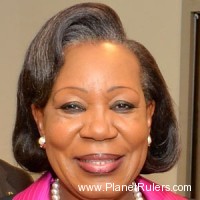 Catherine Samba-Panza (born 26 June 1954) is the interim president of the Central African Republic and the first woman to hold the post. Prior to becoming Head of state, she was appointed Mayor of Bangui from May 2013. Samba-Panza was born in Fort Lamy, French Equatorial Africa, to a mother from the Central African Republic (CAR) and a Cameroonian father. Prior to politics, she was a businesswoman and corporate lawyer. She moved to the CAR at the age of 18. She was trained in law at Panthéon-Assas University. Source: https://en.wikipedia.org/wiki/Catherine_Samba-Panza
François Bozizé Yangouvonda, Former President of the Central African Republic
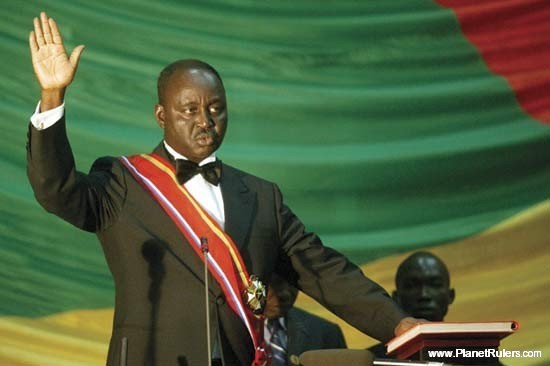 François Bozizé Yangouvonda (born October 14, 1946) is the President of the Central African Republic. He came to power in March 2003 after leading a rebellion against President Ange-Félix Patassé and ushered in a transitional period of government. He won the country’s 2005 presidential election; he received the most votes in the first round in March 2005, but less than a majority, requiring a second round, which he won in May 2005. Early life and Kolingba’s rule Bozizé was born in Gabon, a member of Gbaya people, and attended a military officers’ training college in the Central African province of Bouar, becoming a captain in 1975. He was appointed brigadier-general by Emperor Jean-Bédel Bokassa in 1978. After Bokassa was ousted by David Dacko in 1979, Bozizé was appointed defense minister. During the military rule of André Kolingba (1981–1993), Bozizé was appointed communications minister, but was subsequently accused of plotting a coup attempt. After being arrested in Cotonou, Benin in July 1989, Bozizé was imprisoned and tortured, but he was acquitted in December 1991. Kolingba held elections in 1993 and Bozizé became a presidential candidate. He took only 1.5% of the vote; Patassé was elected president in a run-off against Abel Goumba. Supporting Patassé For many years Bozizé was considered a supporter of Patassé and helped him suppress army mutinies in 1996 and 1997. Bozizé was then named the Armed Forces Chief of Staff. Bozizé showed no activity against Patassé and frequently crushed revolts against the president. Against Patassé On May 28 2001, a coup was attempted against Patassé and defeated with the help of Libyan troops and Congolese rebels of the Movement for the Liberation of Congo. Afterwards, Bozizé’s loyalty was questioned, and in late October 2001 he was dismissed as army chief of staff. Fighting erupted when the government tried to arrest Bozizé on November 3; after five days of this, government forces aided by Libyan troops captured the barracks where Bozizé was based, and Bozizé fled north to Chad. Fighting between government forces and Bozizé’s rebels continued during 2002. From October 25 to October 31, his forces unsuccessfully attacked on the capital, Bangui; the Congolese MLC, who again came to Patassé’s aid, were accused of looting and rape. This period was marked by tensions between Chad and Patassé’s government. Patassé’s ruling party accused Chadian president Idriss Déby of destabilizing the Central African Republic by supporting Bozizé with men and equipment. The final coup, transition period, and election as president On March 15, 2003, Bozizé finally succeeded in seizing power, with his forces entering Bangui unopposed. Patassé was returning from a meeting in Niger at the time, but could not land because Bozizé’s forces controlled the airport. Patassé took refuge in Cameroon and then Togo. Bozizé appointed Abel Goumba as Prime Minister soon after seizing power in March, later making him vice-president in December and appointing Célestin Gaombalet in his place as prime minister. Bozizé also suspended the country’s 1995 constitution after seizing power, and a new constitution, reportedly similar to the old one, was approved by voters in a referendum on December 5, 2004. After seizing power, Bozizé initially said he would not run in a planned future presidential election, but after the successful constitutional referendum, he announced his intention to stand as a candidate on December 11: After thinking thoroughly, and being deeply convinced and keeping in mind the nation’s interest, I grasped the deep sense of my people’s calls. As a citizen, I’ll take my responsibility. I’ll contest the election to achieve the task of rebuilding the country, which is dear to me and according to your wish. On December 30, 2004, Bozizé was one of five candidates approved to run in the presidential election scheduled for early 2005. On January 4, 2005, Bozizé announced that three initially excluded candidates would also be allowed to run, although former president Patassé was not included in either group. In late January, it was announced that more candidates would be permitted to run in the election, bringing the total to 11 and leaving only Patassé barred. The elections were also delayed by one month from the previously scheduled date of February 13 to March 13. Bozizé came in first in the March 13 election, taking just under 43% of the vote according to official results. He faced Patassé’s last prime minister, Martin Ziguélé, in a second round of voting; this was held on May 8 and according to official results announced on May 24, he won with 64.6% of the vote. He was sworn in on June 11. The parliament authorized Bozizé to rule by decree for three months, from January 1 to March 31 2006; his prime minister, Élie Doté, said that this period of rule by decree was successful, enabling Bozizé to take measures to streamline the civil service. In addition to being president, Bozizé has been defense minister since taking power. After the end of the transitional period, he remained in this post when Doté named a new cabinet in June 2005, and also kept it following a September 2006 cabinet reshuffle.