
Mahamat Déby, President of Chad

General Mahamat Idriss Déby Itno — widely known by his nickname “Kaka” — is the 7th President of Chad, in office since 23 May 2024. He first assumed power as head of the Transitional Military Council on 20 April 2021, the day after his father Idriss Déby Itno — who had ruled Chad for 30 years — was killed on the battlefield fighting FACT rebels. A three-year transition culminated in the 6 May 2024 presidential election, in which Mahamat was officially declared winner with 61.3% of the vote. He holds the rank of Marshal of Chad and leads the ruling Patriotic Salvation Movement (MPS).
His presidency is defined by Sahel security burdens, one of the world’s fastest-growing humanitarian crises along the Sudan border, a pivot away from long-standing French security cooperation, and the simultaneous sheltering of roughly 1.4 million refugees from conflicts in Sudan, Cameroon, Nigeria, and CAR.
Early life and military career
Mahamat was born on 4 April 1984 in N’Djamena to Idriss Déby and his first wife Hinda Déby Itno. He was educated in Chad and sent to France for military training. He first saw combat in 2006 and by 2013 was second-in-command of the Chadian special forces deployed to Mali (FATIM), where he led the army at the Battle of Ifoghas against AQIM. He rose to Four-Star General and commander of the presidential guard, the elite Directorate General of State Security Services for Institutions (DGSSIE).
Accession after his father’s death
On 19 April 2021 Idriss Déby was shot dead while commanding troops in a frontline engagement with the FACT (Front for Change and Concord in Chad) rebel column. On 20 April 2021 the Chadian Armed Forces announced the dissolution of the government and constitution and the formation of a Transitional Military Council (TMC) led by 37-year-old Mahamat Déby. The African Union expressed concern but accepted the TMC. Originally mandated for 18 months, the transition was extended in October 2022 for two further years, triggering protests in N’Djamena on 20 October 2022 that left at least 50 demonstrators dead.
2023 referendum and 2024 election
On 17 December 2023 a constitutional referendum approved a new charter with 86% support. It established a unitary (rather than federal) state and cleared Mahamat to stand for president. The election was held on 6 May 2024. Mahamat’s main rival, Prime Minister Succès Masra of the Transformers party — a former opponent who had joined the transitional government in January 2024 — claimed victory on Facebook shortly before the ANGE electoral commission announced Mahamat’s 61.3% win and Masra’s 18.53%. Masra later resigned and returned to opposition. On 23 May 2024 Déby was sworn in for a five-year term.
Pivot from France, wider realignments
In November 2024 Chad terminated its 1976 defence-cooperation treaty with France — a 48-year anchor of Françafrique — and the last 1,000 French troops withdrew from N’Djamena, Abéché and Faya-Largeau by January 2025. Déby has moved to diversify security partnerships with the United Arab Emirates (accused by UN experts of routing weapons to the RSF in Sudan through Chad), Hungary (a small EU military training mission), and Russia. The United States retains a small security cooperation presence.
Sudan spillover and humanitarian crisis
Chad shares a 1,360 km border with Sudan. Since the Sudanese civil war began in April 2023, more than 1 million Sudanese refugees — predominantly from Darfur — have crossed into eastern Chad, one of the fastest refugee inflows in recent African history. UN experts have accused the UAE of using Chadian airstrips at Amdjarass to supply the RSF; Chad has denied complicity. Internal allegations that members of the Déby family are involved in weapons trafficking have fuelled a persistent security dilemma.
Domestic politics and human rights
Freedom House rates Chad “Not Free.” Opposition activity, media and civil society face heavy restrictions. The 20 October 2022 “Black Thursday” crackdown on anti-transition protests left 50+ dead; the February 2024 killing of Yaya Dillo (Mahamat’s cousin and main opposition challenger) on the eve of the presidential campaign drew international condemnation. Succession debates focus on Mahamat’s half-brothers and powerful former interior minister Saleh Kebzabo.
| Full name | Mahamat Idriss Déby Itno (“Kaka”) |
|---|---|
| Born | 4 April 1984 · N’Djamena, Chad (age 42) |
| Office | President of Chad (7th) |
| In office since | 23 May 2024 (de facto since 20 April 2021) |
| Predecessor | Idriss Déby (father; killed in combat April 2021) |
| Prime Minister | Allamaye Halina (since May 2024) |
| Vice President | Djimadoum Tiraina |
| Party | Patriotic Salvation Movement (MPS) |
| Rank | Marshal (Maréchal du Tchad) |
| Spouses | 3 wives (including Dahabaya Oumar Souni) |
| Children | 5 |
| 2024 result | 61.3% (Masra 18.53%) |
| Human rights rating | Freedom House: Not Free |
Frequently asked questions
Who is the current President of Chad in 2026?
General Mahamat Idriss Déby Itno has been President of Chad since 23 May 2024, having previously led the Transitional Military Council from 20 April 2021 after his father’s death.
How old is Mahamat Déby?
Déby was born on 4 April 1984 in N’Djamena and is 42 years old as of April 2026.
How did Mahamat Déby come to power?
When his father Idriss Déby was killed fighting rebels on 19 April 2021, the army dissolved the constitution and installed Mahamat as head of a Transitional Military Council. A 2023 constitutional referendum cleared him to contest the 2024 election, which he won with 61.3%.
Is Chad still aligned with France?
No. In November 2024 Chad terminated its 1976 defence-cooperation treaty with France. French troops completed withdrawal in January 2025, ending a 48-year security partnership.
How is Chad affected by the Sudan war?
Since April 2023 more than a million Sudanese refugees — mostly from Darfur — have crossed into eastern Chad. UN experts have accused the UAE of using Chadian airstrips to supply the RSF; Chad denies complicity.
Is Chad a democracy?
Chad holds multi-party elections but Freedom House rates the country “Not Free.” Opposition candidate Yaya Dillo was killed by security forces in February 2024 and the 2022 protest crackdown killed at least 50 people.
When does Mahamat Déby’s term end?
His first five-year term runs until 2029. The new constitution permits him to stand for a second term, potentially extending his rule to 2034.
Idriss Déby, Former President of Chad (1990–2021)
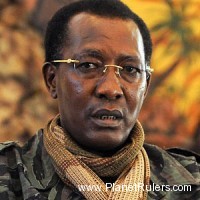 Born in 1952, in Fada, Ennedi, Chad; son of a shepherd; married, four wives; children: ten. Education: Military officers’ academy in Chad, attended; L’Institut Aeronautique Amaury de la Grange, pilot’s license, 1976. Politics: Patriotic Movement of Salvation. Religion: Muslim. Career Joined Chad’s armed forces as an officer, early 1970s; Forces Armées du Nord (FAN), second lieutenant, late 1970s; Forces Armées Nationales Tchadiennes (FANT), commander in chief, mid-1980s, advisor for security and defense; formed Patriotic Movement of Salvation (MPS) in Sudan, late 1980s; leader of invasion force that took capital, 1990; became head of state; president and chief of the armed forces, until 1996; elected president, 1996. Life’s Work Idriss Déby has served as president of Chad, one of the African continent’s most impoverished nations, since 1990. A former military commander, Déby led a military coup that brought him to power that year. He then permitted a series of political reforms that led to the 1996 free election in which Chadian voters chose to keep Déby as president for a five-year term. The son of a shepherd, Déby was born in 1952 in Fada, a village in the eastern Chad province of Ennedi. A Muslim and member of the Zughawa ethnic group, Déby’s childhood coincided with the last years of French colonial rule in Chad. The country became independent in 1960, but years of warfare and civil strife followed. Since independence, droughts and a series of corrupt governments have only weakened Chad’s economy, and it became heavily dependent on foreign aid. Spent Time in France Like many other Chadian men, Déby joined the military, one of the few career opportunities open to him. He attended an officers’ training school, and joined the Forces Armées du Nord (FAN) as a second lieutenant not long after Libya occupied a mineral-rich border region called the Aozou Strip. A 1975 coup resulted in the death of Chad’s first president, Francois Tombalbaye, and the following year Déby moved to France, where he earned his pilot’s license. In June of 1982, he took part in a military coup led by Hissene Habré and FAN, and Habré then named him commander in chief of the Forces Armées Nationales Tchadiennes (FANT). In the continuing skirmish with Libya, Déby led the FANT troops to victory twice, which made him a popular national figure. He was even hailed as the “cowboy of the desert” by the French, who still kept a small number of their own troops in Chad. Habré grew increasingly resentful about Déby’s celebrity, and sent him to France for further military training. He also replaced him as chief of armed forces with a cousin of Déby’s, Hassan Djamous. When Déby returned from France, he was named as an advisor for Chad’s security and defense forces. Meanwhile, Chadians were growing dissatisfied with the excesses of Habré’s rule, especially after he formed a security force comprised of members of his own ethnic group. They were outfitted with far better weaponry than soldiers in Chad’s regular army, which then rebelled in protest. Déby was accused of plotting a coup, and he and Djamous fled the country. In neighboring Sudan, they gathered other disgruntled military personnel to form a rebel force. Calling themselves the Patriotic Movement of Salvation (MPS) and equipped with 200 Toyota Land Cruisers from Libya installed with Russian-built cannons, Déby and his army invaded eastern Chad. Habré personally led the counterattack, but tacit support from French authorities helped Déby and the MPS emerge victorious. MPS troops entered N’Djamena in December of 1990 after a three-week war. Habré then fled the country, and was thought to have absconded with part of the national treasury. Led Chad into Democratic Era Déby’s installation as head of state improved relations with the former enemy to the north. He released Libyan prisoners, and Libyan leader Muammar Gaddafi sent a military plane to pick them up that also carried a gift for Déby, a Renault luxury sedan. Upon taking office, he promised to institute democratic rule, and political parties were recognized in 1991. He also established a commission to investigate human-rights abuses during the Habré regime, which eventually charged the former leader with 40,000 political murders. In 1992, Déby allowed the French Elf Aquitaine oil company to become part of oil consortium led by Esso, which hoped to build a pipeline to the Cameroonian port of Kribi. Such development promised a tremendous economic opportunity for Chad: oil had been discovered in the southern part of the country around 1970, but foreign companies deemed Chad too unstable to risk investment there to drill. After a conference in January of 1993 designed to plan the transition to democracy, Chadian delegates drafted a charter and elected a prime minister. Déby was expected to serve as president and chief of the armed forces for a year, then step down; there was a clause, however, for a one-year extension, which he invoked. In 1995, he established a national independent commission that then drafted a constitution. It was approved by voters in March of 1996, and Déby spent the next several months campaigning for the country’s first presidential election in several years. He was the MPS candidate, but also part of Republic Front coalition. After two rounds of voting and some stiff competition from candidates culled from Chad’s political and cultural elite, Déby took 69 percent in the runoff and was sworn in for a five-year term. Foreign Investment, Not Aid Déby won praise for naming members of the political opposition to government posts, and worked to restore peace through agreements with still-active rebel groups and amnesty programs. His predecessor, Habré, was living in Niger with his own rebel group, and the leader of the 1975 coup, Wadal Abdelkader Kamougue, was Déby’s biggest political rival. Kamougue was particularly popular in the south, where Islamic groups in the south agitated against the government. Déby moved to curb their power by a government decree in the summer of 1996 that banned all Islamic religious associations save for the official government ministry. Despite the improvements, Chad was still somewhat of an international pariah: its military was a forceful presence in the country, and it was bloated to the point of a 70-percent-strong officer class. In 2000, Déby and Chad celebrated the signing of a World Bank-supervised agreement to build a 650-mile pipeline through southern Chad to Cameroon and its Atlantic coast. Geologists estimated that Chad’s oil fields held around 1 billion barrels, and selling the rights to such resources promised a revolutionary economic windfall for the country–about $2-$3 billion in revenues for Chad over next 25 years. There was much opposition to the pipeline within Chad, however, as well as worries that some of the initial development funds might be misused. At a cost of $3.7 billion, the pipeline was the most expensive infrastructure project under construction on the African continent. The World Bank, however, had stipulated that Déby’s government must use oil profits to improve the standard of living in Chad, and not for military projects. After a first cash payment of $25 million in exchange for a tax break, the project’s partners and World Bank officials became when Chad military officials purchased $4 million worth of weapons. But Déby defended the acquisition. “It is patently obvious that without security there can be no development programs,” the Washington Post quoted him as saying. Déby has four wives, one of which was once his father’s wife, as is Zughawa custom, and he has ten children.