
 Milos Zeman, Former President of Czech Republic (since Mar 8, 2013; re-elected on Jan 26, 2018)
 Milos Zeman, Former President of Czech Republic (since Mar 8, 2013; re-elected on Jan 26, 2018)
Petr Pavel is a Czech politician and retired army general who has served as the 4th President of the Czech Republic since 9 March 2023. Born on 1 November 1961 in Planá, then part of Czechoslovakia, he comes from a military family and spent most of his professional life in the armed forces before entering politics. He is the first Czech president without prior elected political experience and the second with a military background.
Military career
Pavel joined the Czechoslovak People’s Army in 1979 and later served in the Czech Army after the fall of communism. In the 1980s he was a member of the Communist Party of Czechoslovakia, a decision he later described as a mistake. After 1989, he aligned himself with democratic reforms and continued his military career in the newly established Czech Republic.
He gained international recognition during the 1993 UNPROFOR mission in the former Yugoslavia, where he played a key role in the evacuation of the besieged Karin Base, rescuing French soldiers under fire. He later held senior posts in military intelligence, diplomacy, and NATO structures.
From 2012 to 2015, Pavel served as Chief of the General Staff of the Czech Armed Forces. Between 2015 and 2018, he was Chair of the NATO Military Committee, becoming the first officer from a former Eastern Bloc country to hold the position. During this period, he dealt with NATO’s response to Russia’s annexation of Crimea, operations in Afghanistan, the fight against ISIS, and growing concerns about China’s global influence. He retired from the military in 2018 with the rank of Army General.
Path to the presidency
After retiring, Pavel became a security analyst, lecturer, and civic activist. During the COVID-19 pandemic, he co launched initiatives aimed at crisis preparedness and public support, which raised his public profile.
In 2021, he announced his candidacy for the 2023 presidential election, running on a strongly pro NATO, pro EU, and pro Western platform. He emphasized support for Ukraine, democratic values, and restoring dignity to the presidency. Pavel won the first round of the election and decisively defeated former Prime Minister Andrej Babiš in the runoff with about 58 percent of the vote. He succeeded Miloš Zeman and was inaugurated on 9 March 2023.
Presidency
As president, Pavel has focused on restoring trust in the office, opening Prague Castle to the public, and maintaining calm, consensus oriented communication. He has appointed Constitutional Court judges, strengthened ties with neighboring countries, and pursued an active foreign policy.
Internationally, he is a strong supporter of Ukraine against Russian aggression and has called for sustained military and humanitarian assistance. He has taken a firmer stance toward Russia and China, while promoting closer relations with Taiwan. He has also spoken at major international forums including the United Nations and the European Parliament.
On domestic and social issues, Pavel is generally described as right of center with strong social elements. He supports same sex marriage and adoption, backs euthanasia legislation, opposes the death penalty, and has advocated for ratifying the Istanbul Convention on preventing violence against women.
Personal life
Petr Pavel is married to Eva Pavlová, an officer in the Czech Army who holds the rank of lieutenant colonel. He has two sons from his first marriage. The couple live in Černouček, a village in Central Bohemia.
He speaks Czech, English, French, and Russian, and is openly atheist. Outside politics, Pavel is widely known for his passion for motorcycling and motorsport. He follows the Dakar Rally, attends racing events, and has personally participated in automotive and motorcycle demonstrations. In 2024, he sustained minor injuries in a motorcycle accident and later returned to riding.
Pavel holds a firearms license, reflecting his long military background, and is often portrayed as disciplined, calm, and physically active. His personal style and reserved demeanor have shaped a presidential image centered on professionalism, stability, and moral authority rather than populism.
Source: https://en.wikipedia.org/wiki/President_of_the_Czech_Republic

Milos Zeman, Former President of Czech Republic (since Mar 8, 2013; re-elected on Jan 26, 2018)
Miloš Zeman (born 28 September 1944) is the third and current President of the Czech Republic, in office since 8 March 2013. Previously he served as the Prime Minister of the Czech Republic from 1998 to 2002. As leader of the Czech Social Democratic Party during the 1990s, he transformed it into one of the country’s major parties. He was Chairman of the Chamber of Deputies, the lower house of the Czech parliament, from 1996 to 1998.
In January 2013, Zeman was elected as President of the Czech Republic. He is the first directly elected President in Czech history; both of his predecessors, Václav Havel and Václav Klaus, were elected by the Parliament.
Early years (Communist Czechoslovakia)
Zeman was born in Kolín; his parents divorced when he was two years old, and he was raised by his mother, who was a teacher. He studied at a high school in Kolín; from 1965 he continued his studies at the University of Economics in Prague, graduating in 1969.
In 1968, during the Prague Spring, he became a member of the Communist Party of Czechoslovakia; however, he was expelled in 1970, due to his disagreement with the Warsaw Pact invasion of Czechoslovakia. He was dismissed from his job and spent more than a decade as an employee of the sports organisation Sportpropag (1971–84). Since 1984, he worked in the company Agrodat. However, he was dismissed again in 1989, this time due to his critical article “Prognostika a přestavba” (Prognostics and Reconstruction).
Activities since 1989
In summer 1989, he appeared on Czechoslovak Television with a critical commentary about the unsatisfactory state of the Czechoslovak economy. His speech caused a scandal. However, the same opinions helped him to join the leaders of the Civic Forum few months later, during the Velvet Revolution.
In 1990, Zeman became a member of the Chamber of the Nations of the Czechoslovak Federal Assembly. In 1992, he successfully ran for the Chamber of the People of the Federal Assembly, already as a member of the Czech Social Democratic Party (ČSSD), which he joined the same year. In 1993, he was elected the chairman of the party, and in the following years he transformed it into one of the country’s major parties.
Miloš Zeman and Vladimir Putin in April 2002
The success of ČSSD in the 1996 legislative election allowed him to prevent his rival Václav Klaus and his Civic Democratic Party (ODS) from creating majority government. Zeman became the Chair of the Chamber of Deputies of the Parliament of the Czech Republic and held this post until the early election in 1998.
In 1998, the ČSSD won the election and Zeman became the Prime Minister of his own minority government, which he led throughout the next four years.
In April 2001, he was replaced by Vladimír Špidla as the party leader. Zeman then retired and moved to live in the countryside (Vysočina Region). His nomination for Czech president failed at the 2003 presidential election (to Václav Klaus), due to the party disunity. Zeman became an outspoken critic of his former party’s leaders.
He left the Czech Social Democratic Party on 21 March 2007, due to conflicts with the leader and chairman of the Czech Social Democratic Party, Jiří Paroubek.
In October 2009, he founded a new party, Party of Civic Rights – Zemanovci. The party did not win any seats in the 2010 legislative election.
Presidency
Miloš Zeman announced his comeback and the intention to run in the first direct presidential election in the Czech Republic in February 2012. Together with Jan Fischer, polling showed him to be one of the two strongest candidates in the election. Zeman narrowly won the first round of the elections and went into the second round to face Karel Schwarzenberg, winning by a clearer margin. His term began in March 2013.
Personal Views
Zeman has a similar view on global warming as his former opponent Klaus. According to his opinion, human activity probably could not influence global warming.
In June 2011, Zeman, referring to Islam, said “The enemy is the anti-civilisation spreading from North Africa to Indonesia. Two billion people live in it.” He likened Muslims who believe in the Qur’an to antisemitic and racist Nazis. A complaint was lodged against him following the comments.
In November 2012, during a speech at the University of Economics in Prague, he explained the dislike that he has for Madeleine Albright, former US Secretary of State. Zeman stated that Albright had promised that there would be no bombardment of civilians during the 1999 NATO bombing of Serbia. “And Madeleine Albright made a promise, and Madeleine Albright didn’t keep the promise. Since that, I don’t like her.”
Zeman has said that he will not let the Czech Republic send any ambassador to Kosovo. He has expressed that he is against the recognition of Kosovo as a state, and views it as a terror regime financed by the narcotics mafia.
He describes himself as a “tolerant atheist”.
Personal life
In the 1970s, Zeman was married to Blanka Zemanová; the couple divorced in 1978. In 1993, he married his assistant Ivana Bednarčíková[30] (born 29 April 1965). He has an adult son named David from the first marriage. His daughter from the second, Kateřina Zemanová (born 1 January 1994), was one of the most visible faces in Zeman’s presidential election team. In a post-election speech, Zeman informally asked her to be his “informal first lady”, as his wife is allegedly shy and doesn’t like the attention of media.
Source: http://en.wikipedia.org/wiki/Milo%C5%A1_Zeman
Vaclav Klaus, Former President of Czech Republic
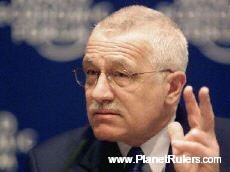
Vaclav Klaus was born in the Vinohrady district of Prague on June 19, 1941. He spent his childhood and youth in the neighbourhood of Tylovo namesti square.
He obtained his university education at the University of Economics, Prague (majoring in the Foreign Trade Economics and graduating in 1963), and economics thus became his specialist field for his entire life. He took advantage of the relative liberalisation in the then Czechoslovakia in order to study in Italy (1966) and the USA (1969). As a research worker at the Institute of Economics of the Czech Academy of Sciences he completed his postgraduate scientific studies and in 1968 was awarded the title of app. PhD. in Economics.
In 1970 he was forced to abandon his research career for political reasons, and left to work at the Czechoslovak State Bank for many years. In 1987 he returned from the bank to his academic work at the Prognostic Institute of the Czech Academy of Sciences at the end of 1987.
Immediately after the events of November 17, 1989 he entered politics, but did not lose contact with the world of economic science. He continued to lecture and publish occasionally, and in 1991 he was engaged as a lecturer at Charles University in the field of economics. In 1995 he was appointed professor for the field of finances at the University of Economics, Prague.
He embarked on his political career in December 1989, when he became Federal Minister of Finance. Later, in October 1991 he was appointed vice chairman of the government of the Czechoslovak Federal Republic. At the end of 1990 he became the chairman of the then strongest political entity – the Civic Forum. Following its demise in April 1991 he co-founded the Civic Democratic Party, of which he was chairman from its inception until December 2002. He won a parliamentary election with this party in June 1992 and became Prime Minister of the Czech Republic. In this role he shared in the “Velvet Divorce” of the Czechoslovak Federation and the foundation of an independent Czech Republic. In 1996 he successfully defended his post as Prime Minister in election to the Chamber of Deputies. Following the collapse of the governing coalition he tendered his resignation in November 1997. Following a forced general election in 1998 he became chairman of the Chamber of Deputies of the Czech parliament for a four-year period.
On February 28, 2003 he was elected President of the Czech Republic. On February 15, 2008 he was elected President of the Czech Republic.
Vaclav Klaus is married to the economist Livia Klausova and has two sons and five grandchildren. His son Vaclav is the headmaster of a private grammar school in Prague, and his son Jan works as a financial analyst.
For many years in his youth Vaclav Klaus was top sportsman, playing basketball and volleyball, and also enjoys skiing and playing tennis. In his free time he enjoys reading fictitious literature and listening to music, in particular jazz.
He has published over 20 books on general social, political and economic themes, and has been awarded a number of international prizes and honorary doctorates from universities all over the world.
Source: http://www.hrad.cz/en/president-of-the-cr/current-president-of-the-cr-vaclav-klaus/curriculum-vitae.shtml