
Teodoro Obiang Nguema Mbasogo, President of Equatorial Guinea
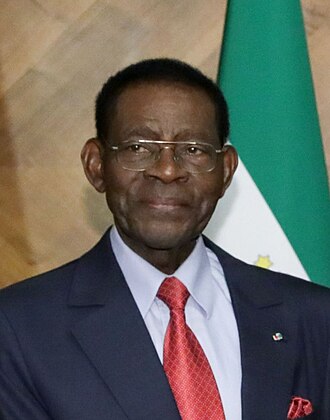
Teodoro Obiang Nguema Mbasogo is the 2nd President of the Republic of Equatorial Guinea, in office since 3 August 1979 — a span of more than 46 years that makes him the longest-serving non-royal national leader in the world. He ousted his uncle, Francisco Macías Nguema, in a military coup on 3 August 1979 and has ruled the small, oil-rich central African country continuously since. His son and First Vice-President, Teodoro Nguema Obiang Mangue (“Teodorín”), has served as heir apparent since his 2016 promotion.
Obiang won his most recent election on 20 November 2022 with an officially reported 94.9% of the vote; his ruling Democratic Party of Equatorial Guinea (PDGE) holds every seat in the Chamber of Deputies and every but one in the Senate. The country produces roughly 90,000 barrels of oil per day, making it on a per-capita basis one of sub-Saharan Africa’s wealthiest nations — though most of the population lives in poverty.
Early life and military rise
Obiang was born on 5 June 1942 in Acoacán, Mongomo district, in then-Spanish Guinea, to an ethnic Fang (Esangui clan) family. He graduated from the Zaragoza General Military Academy in Franco-era Spain and returned to his homeland after Equatorial Guinea’s 1968 independence from Spain. He served his uncle Francisco Macías — who turned the new nation into one of the 20th century’s most brutal dictatorships — as military governor of Fernando Pó (later Bioko Island) and as director of the notorious Black Beach prison.
The 1979 coup
Macías’s reign of terror killed or exiled roughly a third of Equatorial Guinea’s population. On 3 August 1979 Obiang led a military coup — tried and executed Macías on 29 September 1979 — and established the Supreme Military Council, which he chaired until 12 October 1982 when he formally assumed the presidency under a new constitution. He founded the Democratic Party of Equatorial Guinea (PDGE) in 1987, which has governed unopposed ever since.
Oil boom and kleptocracy
Large offshore oil reserves were discovered in the mid-1990s, with the Zafiro field coming on stream in 1996. By 2006 Equatorial Guinea had the fastest-growing GDP in the world. The oil windfall did not reach most Equatoguineans — UN Human Development Index rankings remain low despite one of the highest per-capita GDPs in Africa. The Obiang family’s wealth has been the subject of French, U.S., and Swiss prosecutions. In July 2021, a Paris court found Teodorín guilty of “biens mal acquis” embezzlement and ordered seizure of his €150 million Paris mansion and other assets. The U.S. Department of Justice has returned over \$30 million in seized Teodorín assets.
Succession
Obiang formally appointed his son Teodoro Nguema Obiang Mangue (“Teodorín”) as Second Vice-President in 2012 and First Vice-President in June 2016, a move widely interpreted as confirming Teodorín as heir. Teodorín, known for his collections of supercars and art, has been sanctioned for corruption by the US, UK, Canada, and Switzerland. Obiang’s younger brother Armengol Ondó Nguema has simultaneously headed the feared internal security service, and the broader Esangui clan dominates the security apparatus.
Human rights and political system
Freedom House rates Equatorial Guinea 5 out of 100 — among the lowest in the world. There are no genuinely independent media; political parties other than the PDGE coalition are heavily restricted. Human Rights Watch and Amnesty International have documented systematic torture, extrajudicial killings, and the imprisonment of opposition figures, including sentences handed down to Convergence for Social Democracy (CPDS) members in 2024 and 2025.
Foreign relations
Equatorial Guinea maintains close ties with China (infrastructure and oil partnerships, ExImBank loans), Morocco, and increasingly Russia. In 2024 Chinese media reported plans for a Chinese-built military facility at Bata on Equatorial Guinea’s mainland coast, which if confirmed would give the People’s Liberation Army Navy its first permanent Atlantic Ocean base — a development of concern to the U.S. AFRICOM.
| Full name | Teodoro Obiang Nguema Mbasogo |
|---|---|
| Born | 5 June 1942 · Acoacán, Spanish Guinea (age 83) |
| Office | President of Equatorial Guinea (2nd) |
| In office since | 3 August 1979 (formally president since 12 October 1982) — 46 years |
| Predecessor | Francisco Macías Nguema (uncle; overthrown and executed 1979) |
| First VP / Heir apparent | Teodoro Nguema Obiang Mangue “Teodorín” (son, since June 2016) |
| Prime Minister | Manuela Roka Botey (since January 2023) |
| Party | Democratic Party of Equatorial Guinea (PDGE, founded 1987) |
| Ethnicity | Fang (Esangui clan) |
| Spouses | Constancia Mangue (First Lady); multiple others |
| Education | Zaragoza General Military Academy, Spain |
| 2022 election | 94.9% — 6th term (to 2029) |
| Human rights rating | Freedom House: Not Free (5/100) |
Frequently asked questions
Who is the current President of Equatorial Guinea in 2026?
Teodoro Obiang Nguema Mbasogo has been President of Equatorial Guinea since 3 August 1979 — over 46 years — making him the world’s longest-serving non-royal national leader.
How old is Obiang?
Obiang was born on 5 June 1942 in Acoacán and is 83 years old as of April 2026.
How did Obiang come to power?
Obiang ousted his uncle Francisco Macías Nguema in a military coup on 3 August 1979. Macías was tried by a military tribunal and executed on 29 September 1979.
Who will succeed Obiang?
His son Teodoro Nguema Obiang Mangue (“Teodorín”) has served as First Vice-President since June 2016 and is widely considered the heir apparent despite convictions and sanctions for corruption in France, the US, and several other jurisdictions.
Is Equatorial Guinea a democracy?
No. Equatorial Guinea is effectively a one-party state under the PDGE. Freedom House rates the country 5 out of 100 — among the lowest scores in the world. No election under Obiang has been judged free or fair.
Why is Equatorial Guinea economically important?
It is sub-Saharan Africa’s fourth-largest oil producer at roughly 90,000 barrels per day. Offshore gas reserves have made Equatorial Guinea an LNG exporter since 2007. Oil accounts for over 80% of government revenue.
When does Obiang’s term end?
His current seven-year term runs until 2029. The 2011 constitution’s two-term limit was declared not retroactive, meaning Obiang may contest further elections.