
Isaias Afwerki, President of Eritrea
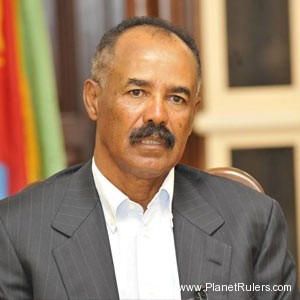
Isaias Afwerki is the first and only President of Eritrea, in office continuously since independence on 24 May 1993. In more than three decades of rule he has presided over a one-party state ranked at the bottom of every global index of press freedom, political rights and human development — consistently grouped with North Korea as the world’s most repressive country. Eritrea has held no national elections, no legislative sessions since 2002, and no implementation of the 1997 constitution that nominally governs it. Afwerki rules through the People’s Front for Democracy and Justice (PFDJ), the transformed vanguard of the guerrilla army he led to victory against Ethiopia in 1991.
Afwerki was born on 2 February 1946 in Asmara during the British Military Administration of Eritrea. He studied engineering briefly at the University of Addis Ababa before joining the Eritrean Liberation Front (ELF) in 1966. After ideological splits he co-founded the Marxist-Leninist Eritrean People’s Liberation Front (EPLF) in 1970, trained in Maoist China in 1967, and rose to become deputy secretary-general. Following the 1987 EPLF congress he was elected secretary-general, leading the 30-year independence war to victory when EPLF forces took Asmara on 24 May 1991. In the 1993 referendum, 99.8% of Eritreans voted for independence; Afwerki was confirmed president by the transitional National Assembly and has never faced a competitive election.
Permanent State of Emergency and National Service
The 1997 constitution — drafted in a broadly participatory process — was never implemented, and scheduled 1997 and 2001 elections were cancelled. In September 2001, after a group of senior EPLF veterans known as the G-15 published an open letter calling for democratic reforms, Afwerki arrested eleven of them and shut down every independent newspaper in the country. None of those detainees has been heard from since; most are presumed dead in the Eiraeiro secret prison. National Service, nominally an 18-month rotation, is in practice indefinite: conscripts as young as 17 can be held in uniform for decades at subsistence wages, working in state farms, mines and construction. The UN Commission of Inquiry in 2015 and 2016 concluded that Eritrea’s system of forced labour, arbitrary detention and extrajudicial killings constituted crimes against humanity. An estimated 500,000 Eritreans — roughly one in seven of the population — have fled the country, many towards Europe via Libya.
Border War, “No War No Peace” and the Tigray Alliance
Relations with Ethiopia, Afwerki’s former EPLF ally turned post-1998 enemy, defined Eritrean foreign policy for two decades. The 1998–2000 Ethio-Eritrean war left some 100,000 dead; a boundary ruling at The Hague in 2002 assigned the contested town of Badme to Eritrea, but Ethiopia refused to implement it until Abiy Ahmed came to power. In July 2018 Abiy and Afwerki signed a peace declaration; Afwerki was then decisive in the November 2020 Tigray War, deploying Eritrean Defence Forces alongside the Ethiopian federal army against the Tigray People’s Liberation Front. UN, Amnesty International and Human Rights Watch investigations documented massacres at Axum, Mai Kadra and elsewhere by Eritrean troops, and mass rape used as a weapon of war. The November 2022 Pretoria agreement between Addis Ababa and the TPLF excluded Eritrea; Afwerki never formally withdrew, and tensions with Abiy Ahmed over access to Red Sea ports have since worsened. As of 2026 Eritrean forces remain deployed in parts of the Tigray–Eritrea border zone.
International Sanctions and Isolation
Eritrea faced UN Security Council sanctions from 2009 to 2018 over support for Somali militants. The United States, European Union and United Kingdom maintain targeted sanctions against senior Eritrean officials, including Afwerki’s adviser Yemane Ghebreab, over the country’s role in Tigray. Eritrea is a member of the UN, the African Union and — since January 2024 — a formal partner of the BRICS+ framework via Russia and Iran. It remains outside all meaningful human-rights mechanisms and does not accept UN Human Rights Council visits.
| Full name | Isaias Afwerki |
|---|---|
| Born | 2 February 1946 · Asmara (age 80) |
| Office | President of Eritrea (1st) |
| In office since | 24 May 1993 |
| Predecessor | Office established at independence |
| Party | People’s Front for Democracy and Justice (PFDJ) — sole legal party |
| Last election | None since independence; 1997 constitution never implemented |
| Capital | Asmara |
| Human rights rating | Freedom House: Not Free (3/100) — tied lowest globally |
| Press freedom | RSF World Press Freedom Index: 180/180 (2024) |
Frequently asked questions
Who is the current president of Eritrea in 2026?
Isaias Afwerki has been the sole president of Eritrea since independence on 24 May 1993, a continuous tenure of more than 32 years. He has never faced an election and turned 80 on 2 February 2026.
Has Eritrea ever held an election?
No. The 1997 constitution provided for multiparty elections but was never put into effect. Planned 1997 and 2001 national votes were cancelled, and the National Assembly has not met since 2002. The PFDJ is the only legal political party.
What happened to the G-15 dissidents?
In September 2001, eleven senior EPLF veterans who signed an open letter calling for democratic reforms were arrested by Afwerki’s security services. None has been seen since; most are believed to have died in detention at the Eiraeiro secret prison.
What was Eritrea’s role in the Tigray War?
Eritrean Defence Forces fought alongside Ethiopia’s federal army against the TPLF from November 2020 to November 2022. UN investigators and human-rights groups documented systematic massacres, sexual violence and looting by Eritrean troops, notably at Axum. Eritrea was not a party to the Pretoria peace agreement.
Why do so many Eritreans flee the country?
National military service is indefinite in practice, with conscripts held for years or decades at subsistence pay. UN investigators have described it as forced labour amounting to a crime against humanity. Roughly 500,000 Eritreans — about 14% of the population — have left, making Eritrea one of the world’s largest per-capita refugee producers.