
Emmanuel Macron, President of France
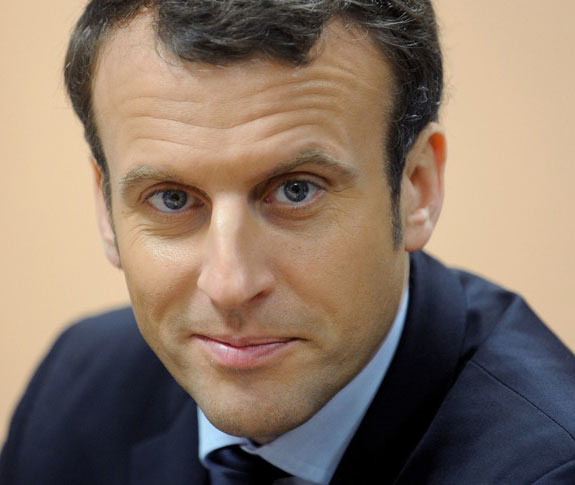
Emmanuel Jean-Michel Frédéric Macron is the 25th President of the French Republic, in office since 14 May 2017, and the first French president to be re-elected since Jacques Chirac in 2002. His second term began on 13 May 2022 after he defeated Marine Le Pen in the presidential run-off with 58.5% to 41.5%. Under Article 6 of the Fifth Republic constitution, as amended in 2008, he is barred from a third consecutive term and must leave office no later than May 2027. The second term has been defined by the evaporation of his parliamentary majority in the June 2022 legislatives, the January 2023 pension-reform crisis, a historic June 2024 snap election called after his party’s rout in the European Parliament vote, and four prime ministers in eighteen months.
Macron was born on 21 December 1977 in Amiens, Somme, to two medical doctors. A graduate of Sciences Po, ENA (Promotion Senghor, 2004) and a former investment banker at Rothschild, he served as deputy secretary-general of the Élysée from 2012 and Minister of the Economy under François Hollande from August 2014 until his resignation on 30 August 2016 to launch the movement En Marche! (now Renaissance). At 39 he became the youngest head of state France has had since Napoleon.
The 2024 Dissolution and Revolving Prime Ministers
On 9 June 2024, minutes after Jordan Bardella’s Rassemblement National (RN) came first in the European Parliament election with 31.4%, Macron dissolved the National Assembly and called snap parliamentary elections for 30 June and 7 July. The result produced a tripartite deadlock: the left-wing Nouveau Front Populaire (NFP) came first with 182 seats, the Ensemble presidential bloc second with 168, and the RN third with 143 — the largest far-right parliamentary group since 1945. After a two-month stalemate, Macron appointed conservative former EU Brexit negotiator Michel Barnier as prime minister on 5 September 2024. Barnier’s minority government fell on 4 December 2024 to a successful censure motion — the first in France since 1962 — after invoking Article 49.3 on the 2025 budget. François Bayrou (MoDem) replaced him on 13 December 2024 and governed through a series of budget deals until Bayrou himself lost a confidence vote on 8 September 2025. Macron then appointed former Defence Minister Sébastien Lecornu on 9 September 2025; Lecornu briefly resigned on 6 October 2025 amid a rift with Les Républicains but was reappointed on 10 October 2025 and remains prime minister.
Foreign Policy and Europe
Macron has positioned France as the leading military supporter of Ukraine in continental Europe. He signed a Franco-Ukrainian bilateral security agreement in February 2024, hosted multiple Paris “coalition of the willing” summits in 2025, and has repeatedly declined to rule out deploying French troops to Ukraine in the event of a settlement. He co-chaired an International Summit on the Strait of Hormuz with UK Prime Minister Keir Starmer on 17 April 2026. France recognised the State of Palestine at the UN General Assembly in September 2025, the first G7 nation to do so. Relations with Germany’s chancellor Friedrich Merz, in office since May 2025, have been warm; Paris–Rome relations with Giorgia Meloni remain complex but workable.
Economy and 2027 Succession
French GDP growth has hovered around 0.9–1.1% through 2025 and into 2026 against a 3.2% inflation backdrop; unemployment has edged up to 7.6%. The July 2025 “Year Zero” austerity package proposed by Bayrou — with €44 billion of spending cuts — was substantially watered down in parliament. Public debt reached 117% of GDP by end-2025. On the political horizon, polls for the April 2027 presidential election consistently show RN’s Jordan Bardella and Marine Le Pen’s designated successor Louis Aliot in strong positions; on the centre Édouard Philippe leads Horizons, on the left Jean-Luc Mélenchon and Raphaël Glucksmann divide the vote, and Gabriel Attal is the most-mentioned heir to Macronism.
| Full name | Emmanuel Jean-Michel Frédéric Macron |
|---|---|
| Born | 21 December 1977 · Amiens (age 48) |
| Office | President of the French Republic (25th) |
| In office since | 14 May 2017; re-elected 24 April 2022 (58.5%) |
| Prime Minister | Sébastien Lecornu (since 9 September 2025; reappointed 10 Oct 2025) |
| Predecessor | François Hollande (2012–2017) |
| Party | Renaissance (formerly La République En Marche) |
| Term ends | May 2027; constitutionally barred from 3rd consecutive term |
| Capital | Paris |
| Human rights rating | Freedom House: Free (89/100) |
Frequently asked questions
Who is the current president of France in 2026?
Emmanuel Macron has been President of the French Republic since 14 May 2017 and is serving his second and constitutionally final term, which ends in May 2027. He is the 25th president of the Fifth Republic.
How old is Emmanuel Macron?
Macron was born on 21 December 1977 in Amiens and is 48 years old as of April 2026 — making him France’s youngest-ever post-war president at election in 2017, and still one of the youngest serving heads of state in the G20.
Who is the current prime minister of France?
Sébastien Lecornu has served as prime minister since 9 September 2025 (with a brief resignation and reappointment on 10 October 2025). He is Macron’s fourth PM in 18 months, following Gabriel Attal, Michel Barnier and François Bayrou.
Why are French governments falling so often?
The June 2024 snap legislative election produced no majority. The left NFP (182 seats), Ensemble (168) and RN (143) are all below the 289-seat majority threshold, leaving any prime minister dependent on ad-hoc cross-bench deals. The Barnier government fell in December 2024 and the Bayrou government in September 2025 — both on budget confidence votes.
Can Macron run for a third term?
No. Article 6 of the 1958 constitution, as amended in 2008, limits presidents to two consecutive terms. Macron could theoretically return after a gap, but must leave the Élysée in May 2027.