
Friedrich Merz, Chancellor of Germany
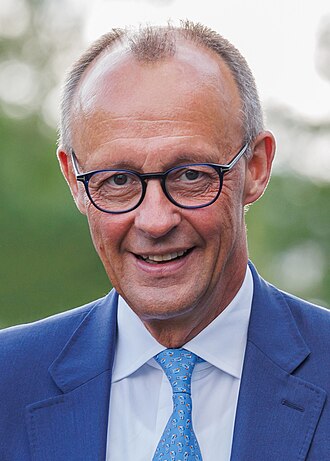
Joachim-Friedrich Martin Josef Merz is the tenth Chancellor of the Federal Republic of Germany, in office since 6 May 2025. He leads a CDU/CSU–SPD grand coalition (GroKo) formed after the 23 February 2025 early federal election, which was triggered by the November 2024 collapse of the Scholz “traffic-light” coalition over the 2025 federal budget. Merz’s confirmation vote in the Bundestag on 6 May 2025 was unusually dramatic: he failed to secure a majority on the first ballot — the first time in the Federal Republic’s history that a designated chancellor had done so — but won the second round the same day with 325 of 630 votes. He succeeded Olaf Scholz, who had been in office since December 2021.
Merz was born on 11 November 1955 in Brilon, Sauerland, into a Westphalian Catholic legal family. He read law at Bonn and Marburg, served briefly as a judge, and worked as a corporate lawyer before entering politics. A member of the European Parliament from 1989 to 1994 and of the Bundestag from 1994, he led the CDU/CSU parliamentary group from 2000 to 2002 before Angela Merkel replaced him in a famous rivalry that defined German centre-right politics for two decades. He left politics in 2009 and worked at the law firm Mayer Brown and as chairman of BlackRock Germany (2016–2020) before returning to lead the CDU in January 2022 on his third attempt.
The 2025 Election and Coalition
The February 2025 federal election returned the CDU/CSU to first place on 28.5% of the vote, the AfD to its best-ever second place with 20.8%, the SPD to 16.4% (its worst result since 1887), the Greens to 11.6%, Die Linke unexpectedly returning with 8.8%, and the FDP and BSW both below the 5% threshold. With the AfD excluded by the CDU’s “firewall” policy, a CDU/CSU–SPD grand coalition was the only mathematically viable two-party option. The 146-page coalition agreement, signed on 9 April 2025, combined CDU tax cuts and migration tightening with SPD social-policy protections. Lars Klingbeil (SPD) is Vice Chancellor and Finance Minister; Johann Wadephul (CDU) is Foreign Minister; Boris Pistorius (SPD) retains the Defence ministry.
Constitutional Debt Reform and Defence Spending
Merz’s signature early achievement was the March 2025 amendment to the constitutional debt brake, approved by two-thirds majorities in the outgoing Bundestag and Bundesrat. The reform exempts defence spending above 1% of GDP from the debt brake, creates a €500 billion special infrastructure fund over twelve years, and allows the Länder a combined 0.35%-of-GDP structural deficit. Germany has subsequently committed to NATO’s revised 5% of GDP defence target (3.5% hard military plus 1.5% related spending) by 2035. The Bundeswehr’s €100 billion 2022 special fund is being supplemented with further procurement for air defence, long-range fires and cyber.
Foreign Policy and Ukraine
Merz has significantly tightened Germany’s line on Russia, lifting the Scholz-era range restriction on Taurus cruise missiles in May 2025 and chairing a July 2025 Berlin summit on long-range Ukrainian capabilities. Germany remains the second-largest bilateral military backer of Ukraine after the United States. Relations with Donald Trump’s second administration have been publicly correct but substantively strained over tariffs and the Alaska Accords framework; Merz hosted a contentious Trump visit in February 2026. He has strongly supported deepened EU integration in defence procurement and the single capital market.
Migration, AfD and Domestic Politics
A CDU “migration turnaround” package of January 2025 — controversially passed with Bundestag votes supplied by the AfD during the election campaign — broke the CDU’s longstanding firewall convention and triggered nationwide protests. As chancellor, Merz has pushed through a tightening of asylum procedures at German borders (May 2025), a suspension of the Merkel-era family reunification scheme for subsidiary-protection refugees, and an EU border-return cooperation with North African states. Polls for the next Bundestag election — not due until 2029 — have shown the AfD maintaining second place and briefly touching first place in mid-2025; the CDU has held 26–30%.
| Full name | Joachim-Friedrich Martin Josef Merz |
|---|---|
| Born | 11 November 1955 · Brilon, North Rhine-Westphalia (age 70) |
| Office | Chancellor of Germany (10th of the Federal Republic) |
| In office since | 6 May 2025 |
| Predecessor | Olaf Scholz (2021–2025) |
| Vice Chancellor | Lars Klingbeil (SPD; also Finance Minister) |
| Party | Christian Democratic Union (CDU); leader since 31 January 2022 |
| 2025 election | CDU/CSU 28.5% · AfD 20.8% · SPD 16.4% |
| President (head of state) | Frank-Walter Steinmeier (since 2017) |
| Capital | Berlin |
| Human rights rating | Freedom House: Free (93/100) |
Frequently asked questions
Who is the current chancellor of Germany in 2026?
Friedrich Merz (CDU) has been Chancellor of the Federal Republic of Germany since 6 May 2025, leading a CDU/CSU–SPD grand coalition formed after the 23 February 2025 federal election. He is the tenth chancellor of the Federal Republic.
How old is Friedrich Merz?
Merz was born on 11 November 1955 in Brilon and is 70 years old as of April 2026 — making him the oldest person to take office as German chancellor.
Who is Germany’s head of state?
Germany’s head of state is President Frank-Walter Steinmeier, in office since 2017 and re-elected in February 2022 for a second five-year term. The presidency is largely ceremonial; executive power rests with the chancellor and cabinet.
Why did the Scholz government collapse?
Olaf Scholz’s SPD–Green–FDP “traffic-light” coalition broke up on 6 November 2024 when Scholz dismissed Finance Minister Christian Lindner over the 2025 budget. A confidence vote on 16 December 2024 failed, triggering the 23 February 2025 snap election.
What was the constitutional debt-brake reform?
In March 2025, the outgoing Bundestag and Bundesrat amended the constitution to exempt defence spending above 1% of GDP from the debt brake, create a €500 billion special infrastructure fund over twelve years, and permit the Länder a combined 0.35%-of-GDP structural deficit — the largest structural fiscal reform in Germany since reunification.