
Sanae Takaichi, Prime Minister of Japan (since Oct 21, 2025)

Fumio Kishida, Former Prime Minister of Japan (since Oct 4, 2021)
 Fumio Kishida (born 29 July 1957) is a Japanese politician serving as the Prime Minister of Japan and president of the Liberal Democratic Party (LDP) since 2021. A member of the House of Representatives, he previously served as Minister for Foreign Affairs from 2012 to 2017 and as acting Minister of Defense in 2017. From 2017 to 2020, he also chaired the LDP Policy Research Council.
Born into a political family, Kishida spent part of his childhood in the United States where he attended elementary school in New York City. After beginning his career in finance, Kishida entered politics and was elected to the House of Representatives in 1993 as a member of the LDP. Kishida was appointed to various posts in the cabinets of Prime Ministers Shinzo Abe and Yasuo Fukuda from 2007 to 2008, and was appointed Minister for Foreign Affairs in 2012 after Abe regained the premiereship following the 2012 general election, serving for five years and becoming the longest-serving Foreign Affairs Minister in Japanese history. Kishida later resigned from the Abe cabinet in 2017 in order to head the LDP’s Policy Research Council. Kishida also assumed control of the LDP’s Kōchikai faction in 2012 following the death of former faction boss Makoto Koga.
Long considered a potential future prime minister, Kishida ran in the 2020 LDP leadership election, however he lost to Yoshihide Suga. He ran again for the party leadership in 2021, this time winning in a second round run-off against opponent Taro Kono. Kishida was confirmed as Prime Minister by the National Diet four days later on 4 October 2021 and led the LDP to victory in the 2021 general election later that same month. Kishida has been described as an ideological moderate within the LDP and has stated that his premiership will focus on a “new model of capitalism”, by seeking to implement redistributive policies to expand the middle class. On foreign policy he plans to continue strengthening the Quad Security Dialogue in pursuit of the Free and Open Indo-Pacific strategy.
Kishida is fond of Hiroshima-style okonomiyaki as prepared by his wife Yuko Kishida, a daughter of a real estate businessman. They wed in an arranged marriage in 1988, and have three sons. In one presentation, Yuko was featured in the LDP messaging immediately after he became the de facto PM-designate. He has pledged to financially support the Japanese animation industry during his premiership. He is also a fan of the Hiroshima Toyo Carp baseball team, and is 5 ft 10 in (178 cm) tall.
Source: https://en.wikipedia.org/wiki/Fumio_Kishida
Yoshihide Suga, Former Prime Minister of Japan (since Sept 14, 2020)
 Yoshihide Suga (born 6 December 1948) is a Japanese politician who has been Prime Minister of Japan since September 2020. He was Chief Cabinet Secretary under Prime Minister Shinzo Abe from 2012 to 2020 and Minister for Internal Affairs and Communications from 2006 to 2007.
Born to a family of strawberry farmers in rural Akita Prefecture, Suga moved to Tokyo after graduating from high school, where he enrolled in Hosei University.[1] Shortly after graduating with a Bachelor of Laws, Suga became an aide to Representative Hikosaburo Okonogi in 1975 before entering politics himself when he was elected to the Yokohama Municipal Assembly in 1987.[2] In the 1996 election, Suga was elected to the House of Representatives, representing Kanagawa’s 2nd District as a member of the Liberal Democratic Party (LDP).
During his time in the Diet, Suga became a close ally of Chief Cabinet Secretary Shinzo Abe. When Abe first became Prime Minister in 2006, he appointed Suga to the cabinet as Minister for Internal Affairs and Communications. After the LDP won the 2012 general election, Suga was appointed Chief Cabinet Secretary, a role Suga would hold throughout Abe’s second tenure as Prime Minister.[3] He is the longest-serving Chief Cabinet Secretary in Japanese history. In September 2020, after Abe announced his second resignation, Suga declared his candidacy in the LDP leadership election. Widely considered the frontrunner, Suga comfortably won the election on 14 September with 70% of the vote. Two days later, he was formally elected Prime Minister by the Diet and appointed by Emperor Naruhito, making him the first new Prime Minister of the Reiwa era.[4]
Suga has stated that his premiership will focus on continuing the policies and goals of the Abe administration, including the Abenomics suite of economics policies, the revision of Article 9 of the Japanese Constitution, and securing the release of Japanese abductees from North Korea
Shinzō Abe, Former Prime Minister of Japan (since Dec 26, 2012)
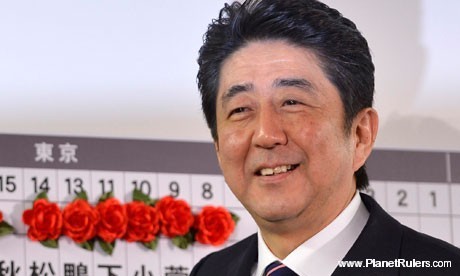 Shinzō Abe (born 21 September, 1954) is a Japanese politician and the current President of the Liberal Democratic Party (LDP) and the chairman of the Oyagaku propulsion parliamentary group. Abe was the 90th Prime Minister of Japan, elected by a special session of the National Diet on 26 September 2006. He was then Japan’s youngest post–World War II prime minister and the first born after the war. He served as prime minister for less than a year, resigning on 12 September 2007. He was replaced by Yasuo Fukuda, beginning a string of Prime Ministers who did not maintain the position for more than one year. On 26 September 2012, Abe defeated former Minister of Defense Shigeru Ishiba in a run-off vote to win the LDP presidential election. Abe became the Prime Minister again following the LDP’s landslide victory in the 2012 general election with a government on 26 December 2012.
Source: http://en.wikipedia.org/wiki/Shinz%C5%8D_Abe
Yoshihiko Noda, Former Prime Minister of Japan (since Sept 2, 2011)
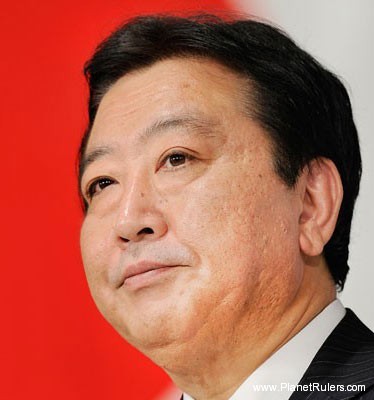
Yoshihiko Noda (born 20 May 1957) is a Japanese politician of the Democratic Party of Japan (DPJ), a member of the House of Representatives (lower house) in the Diet (national legislature). Formally appointed as the Prime Minister of Japan by the Emperor of Japan on 2 September 2011.
Noda was born in Funabashi, Chiba, as a son of a member of the Japan Self-Defense Forces and a grandson of local farmers. Unlike many prominent Japanese politicians, Noda has no family connections to Nagatachō. His parents were too poor to pay for a wedding reception.
Noda graduated from Waseda University in 1980 and was later accepted into the prestigious Matsushita Institute of Government and Management, an institution founded by Panasonic founder Konosuke Matsushita that grooms future civic leaders of Japan. While attending the Matsushita Institute, Noda read household gas meters as a part-time job in his native Chiba Prefecture, partially in order to get to know his future constituents better in preparation for a run for office. He was elected to the assembly of Chiba Prefecture for the first time in 1987 at the age of 29.
In 1993 he was elected to the Diet for first time representing Chiba’s Lower House District #4 as a member of the now-defunct Japan New Party. He later joined the DPJ and served as its Diet affairs chief as well as head of the party’s public relations office. Noda acted as senior vice finance minister when the DPJ won control of the Diet in September 2009.
In June 2010, Noda was appointed as Minister of Finance by Prime Minister Naoto Kan, who was also the previous Minister of Finance. Noda is known as a reformist and has led a DPJ intraparty group critical of ex-DPJ Secretary General Ichirō Ozawa.
Upon assuming the post of finance minister, Noda, a fiscal conservative, expressed his determination to slash Japan’s deficit and rein in gross public debt. In January 2011, for the first time in six years, Noda’s finance ministry intervened in the foreign exchange market and spent 2.13 trillion yen to purchase dollars in order to rein in the yen’s spiraling appreciation.
Noda is said to have close relations with the United States, but has a troubled relationship with China, particularly for his refusal to identify Japanese Class A war criminals during World War II as “war criminals”. He has also said that “China’s rapid military buildup pose a serious regional risk, and stressed the importance of the US-Japan security alliance.”
After Kan’s resignation in August 2011, Noda stood as a candidate in the party election to replace him. He won the runoff vote against Banri Kaieda in the leadership election, meaning he would almost certainly become the next prime minister and inherit the challenge of rebuilding from the 2011 Tōhoku earthquake and tsunami.
In October 2005, Noda criticized Prime Minister Junichiro Koizumi for his position on Japanese class A war criminals as “war criminals”. However, Noda supported Koizumi’s visit to Yasukuni Shrine. On 15 August 2011—the anniversary of the year for the Surrender of Japan in World War II, he said that Japan’s class A war criminals convicted by the Allies were not legally war criminals under his view.
Noda is married with two children. He is a fan of martial arts and professional wrestling. He has a black belt in judo. During his campaign for the DPJ Presidency in August 2011, Noda compared himself to a dojo loach. “I’ll never be a goldfish in a scarlet robe, but like a loach in muddy waters. I’ll work hard for the people, to move politics forward,” Noda said.
Naoto Kan, Former Prime Minister of Japan (resigned on Aug 26, 2011)
Born on October 10, 1946 in Ube, Yamaguchi. Okayama domicile. Metropolitan Koyamadai high school. Graduated from Faculty of Applied Physics and Technology. House of Representatives. Attorney. Living in Musashino, Tokyo.
1965 in Metropolitan Koyamadai high school.
1970 Graduated from Department of Applied Physics, Faculty of Science and Technology.
In 1971 a patent attorney exam.
1974 Upper House election, Mr.担Gi出Shi Itikawa Husae, served as campaign chairman, to win.
In 1976 he ran unsuccessfully as an independent in the House of Representatives election. Thereafter,in 1977House of Councillors election,1979election and continued lost.
1980 elected House of Representatives. Since then, belong to the Social Democratic Federation, aims to create a force that can compete with the LDP.
1993 elected for five-term election, participate in the governing coalition. He became chairman of the House of Representatives Foreign Affairs.
In 1994 joined the New Party Sakigake, became chairman of the party’s policy research. The government seeks to build自社Sa ruling policy.
1996 January, with Prime Minister Ryutaro Hashimoto became Minister of Health. Uncover the HIV problem, apologized to the victim as the Minister of Health. September, they formed the Democratic Party with Yukio Hatoyama said, he became party leader.
In April 1998, the Democratic Justice Party (President: Tsutomu Hata), New Fraternity Party (DSP old) and joined, such as The Chairman of the Democratic Party again. July, the ruling party put on過半数割Re election.
In September 1999, he became chairman of the Democratic Party Policy Research.
September 2000, he became secretary general of the Democratic Party.
In December 2002, the top Democrat comeback (~ May 2004).
In September 2003, Liberal Party (leader: Ichiro Ozawa) and merged.November, greatly extending臨Nda seats in the election as a representative to the verge of regime change.
In September 2005, the nine-term election victory of the Democrats to defeat in front of Koizumi’s whirlwind.
In April 2006, he became the Democratic Party acting leader. Ozawa, Secretary General Yukio Hatoyama and support the party.
In July 2007, the Democratic victory in upper house election, the ruling party put on過半数割Re.
2008 was 12Mon, House of Representatives Budget Committee chief director (~09years7month), became president with the Democratic Party in Tokyo.
2009 was 08Monat election10election of the first, historic victory for the Democratic Party finally realize a regime change.09Extraordinary Minister at the Cabinet Office vice minister in charge of the national strategy Hatoyama Cabinet Moon (Science and Technology Policy Economic and Fiscal Policy) officer.
2010 1Mon, Extraordinary Minister of Finance Deputy Prime Minister, Cabinet Office (Economic and Fiscal Policy) officer.