
Kassym-Jomart Tokayev, President of Kazakhstan
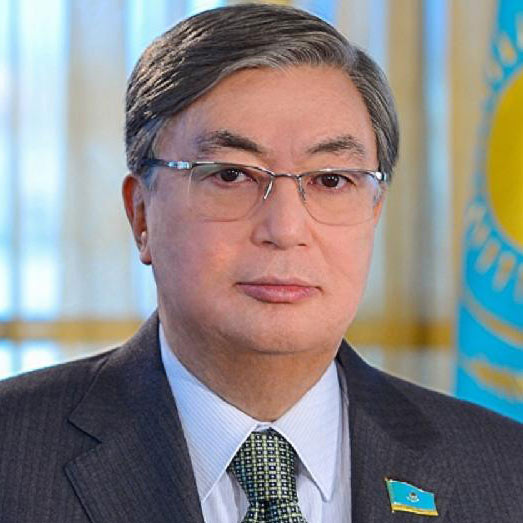
Kassym-Jomart Kemelevich Tokayev is the second President of Kazakhstan, in office since 20 March 2019 — initially as acting president after Nursultan Nazarbayev’s surprise resignation and then, after a snap election on 9 June 2019, in his own right with 70.9% of the vote. A career Soviet-trained diplomat who spent most of his adult life outside domestic politics, Tokayev was widely seen in 2019 as a placeholder for the Nazarbayev clan. The January 2022 Qandy Qantar (“Bloody January”) protests and their violent resolution transformed him into the unambiguous centre of power, and a November 2022 constitutional overhaul replaced renewable five-year terms with a single, non-renewable seven-year term — allowing Tokayev to reset the clock and stand once more, winning 81.3% on 20 November 2022 for a mandate that runs to 2029.
Tokayev was born on 17 May 1953 in Alma-Ata (now Almaty) to Kemel Tokayev, a Kazakh writer and World War II veteran. He graduated from the elite Moscow State Institute of International Relations (MGIMO) in 1975 and joined the Soviet foreign service, serving in Singapore and the Chinese section of the USSR foreign ministry, where he became fluent in Mandarin and English. After independence he rose rapidly in Kazakhstan’s diplomatic corps: Foreign Minister (1994–1999, 2002–2007), Prime Minister (1 October 1999 – 28 January 2002), Senate Speaker (2007–2011 and 2013–2019), and UN Under-Secretary-General heading the Geneva office (2011–2013).
Qandy Qantar — January 2022
The defining event of Tokayev’s presidency began on 2 January 2022, when a doubling of the state-regulated price of liquefied petroleum gas in the western oil town of Zhanaozen triggered rolling protests that spread to Almaty within three days. On 5 January protesters torched the Almaty city hall and the presidential residence; the entire cabinet resigned. Tokayev sacked Nazarbayev as chair of the powerful Security Council — the old leader’s main lever of continuing influence — and invoked the Collective Security Treaty Organization (CSTO), which deployed roughly 2,500 Russian-led troops for eight days. He publicly authorised security forces to “fire without warning.” At least 238 people were killed, thousands were detained, and senior Nazarbayev relatives, including his nephew Samat Abish (former deputy head of the KNB intelligence service), were later prosecuted. The official narrative framed the unrest as an attempted coup by the Nazarbayev clan plus foreign terrorists; human-rights groups documented widespread torture of detainees and extrajudicial shootings.
“New Kazakhstan” and the 2022 Term Reset
Branding the post-January period “New Kazakhstan,” Tokayev pushed through a June 2022 constitutional referendum (77.2% yes) that curtailed some presidential powers, banned close presidential relatives from senior state posts, and stripped Nazarbayev of his “Elbasy” (Leader of the Nation) privileges. A March 2023 parliamentary election introduced single-mandate districts and allowed independents for the first time in two decades, though the ruling Amanat party retained a dominant 53% share. The November 2022 presidential vote itself was criticised by OSCE monitors for lacking genuine competition — the other five candidates were all regime-approved — and delivered Tokayev an uncontested 7-year mandate.
Foreign Policy and Ukraine Neutrality
Tokayev has pursued a “multi-vector” foreign policy, refusing to recognise Russia’s annexation of eastern Ukrainian territories and declining Vladimir Putin’s requests for military support, while maintaining the Eurasian Economic Union and CSTO memberships. Kazakhstan has absorbed an estimated 200,000 Russian draft-dodgers since September 2022 and become a key conduit for parallel-import trade to Russia. Relations with China remain strong through Belt and Road investment in the Khorgos trans-border hub and a 2023 upgrade to a “permanent comprehensive strategic partnership.” In 2024 Astana deepened ties with the EU on critical minerals and hosted visits from Xi Jinping, Olaf Scholz and Emmanuel Macron.
| Full name | Kassym-Jomart Kemelevich Tokayev |
|---|---|
| Born | 17 May 1953 · Alma-Ata (now Almaty) (age 72) |
| Office | President of Kazakhstan (2nd) |
| In office since | 20 March 2019 (acting); elected 12 June 2019; re-elected 20 November 2022 |
| Predecessor | Nursultan Nazarbayev (1990–2019) |
| Prime Minister | Oljas Bektenov (since 6 February 2024) |
| Party | Amanat (formerly Nur Otan) |
| 2022 election | 81.3%; single 7-year term to 2029 |
| Capital | Astana |
| Human rights rating | Freedom House: Not Free (23/100) |
Frequently asked questions
Who is the current president of Kazakhstan in 2026?
Kassym-Jomart Tokayev has been president since 20 March 2019. He was re-elected on 20 November 2022 with 81.3% of the vote for a single seven-year term ending in 2029.
How old is Tokayev?
Tokayev was born on 17 May 1953 in Alma-Ata (today Almaty) and is 72 years old as of April 2026.
What was Qandy Qantar?
The January 2022 “Bloody January” protests began over fuel prices in Zhanaozen and spread nationwide. Tokayev authorised a shoot-to-kill response, sacked Nazarbayev from the Security Council, and called in CSTO troops. At least 238 people were killed, and senior Nazarbayev relatives were later prosecuted for their role.
Can Tokayev run for re-election?
No. The 2022 constitutional amendment replaced renewable five-year terms with a single, non-renewable seven-year term. Tokayev is constitutionally required to step down when his current mandate ends in 2029.
Is Kazakhstan aligned with Russia over Ukraine?
Officially no. Astana has refused to recognise Russia’s annexation of eastern Ukrainian territories, declined to send troops and publicly restated its commitment to the UN Charter. In practice, Kazakhstan remains in the CSTO and Eurasian Economic Union and has become a major conduit for parallel-import trade to Russia.