
Assimi Goïta, President of Mali

General Assimi Goïta is the sixth President of Mali, in office since 8 July 2025. He ruled Mali as interim president from 28 May 2021 through two army-led transitions that ultimately extended his rule well beyond the original 18-month road-map agreed with ECOWAS. Goïta led two coups d’état in rapid succession — the 18 August 2020 overthrow of elected President Ibrahim Boubacar Keïta (IBK) and the 24 May 2021 palace coup that removed interim civilians Bah Ndaw and Moctar Ouane. He served as the rotating President of the Confederation of Sahel States (AES) from its founding in July 2024 to December 2025, when he handed off to Burkina Faso’s Ibrahim Traoré.
Goïta is independent of all political parties, holds the rank of Général d’Armée (5-star general), and runs a government that has ended France’s 9-year Barkhane counter-terrorism operation, withdrawn Mali from ECOWAS, and partnered with Russian Wagner / Africa Corps mercenaries across the country’s north.
Early life and military career
Assimi Goïta was born on 9 November 1983 in Bamako to a military family. He attended the Prytanée militaire de Kati and graduated from Mali’s Joint Military School in 2002. He was assigned to the 134th Reconnaissance Squadron in Gao, northern Mali, during the country’s spiraling jihadist insurgency. He received advanced training in Germany, Gabon, France and the United States — including U.S. special-forces training through AFRICOM. He commanded Mali’s Autonomous Special Forces Battalion (Forces Spéciales) in counter-terrorism operations against AQIM and JNIM in the Mopti and Gao regions.
The August 2020 and May 2021 coups
Following mass protests against IBK led by the M5-RFP coalition, Goïta headed the military group that detained IBK and Prime Minister Boubou Cissé on 18 August 2020. IBK dissolved the government and resigned on live television. Goïta chaired the National Committee for the Salvation of the People (CNSP) and, under ECOWAS pressure, accepted a civilian-led transition under interim President Bah Ndaw, in which he served as vice-president. On 24 May 2021, after Ndaw reshuffled the cabinet to remove Goïta’s allies, Goïta detained Ndaw and PM Ouane and dissolved their government. The Constitutional Court named him interim president on 28 May 2021.
Break with France, alliance with Russia
Relations with Paris collapsed over 2021–2022. Mali suspended France’s Operation Barkhane and ordered the withdrawal of French troops by August 2022; the Takuba European special-forces task force also folded. In January 2022 ECOWAS imposed sweeping sanctions; Goïta responded by deepening ties with Russia. The Wagner Group — later rebranded Africa Corps — deployed from December 2021. UN experts and Human Rights Watch documented the March 2022 Moura massacre, in which Malian forces together with “white foreign soldiers” killed at least 500 civilians, according to HRW, and more than 300 according to the UN.
2023 constitutional referendum and new transition
On 18 June 2023 Mali held a constitutional referendum approved by 97% of voters on 39% turnout. The new constitution created a stronger presidency, allowed the junta chief to stand in future elections, and removed a clause prohibiting military personnel from holding the presidency. MINUSMA, the UN peacekeeping mission, was expelled and withdrew by December 2023. On 16 September 2023 Mali, Burkina Faso and Niger founded the Alliance of Sahel States (later Confederation, AES). On 28 January 2024 the three nations jointly announced withdrawal from ECOWAS, formalised 29 January 2025.
2025 formal presidency
On 8 July 2025 the National Transitional Council formally swore in Goïta as the 6th President of Mali under the new constitution, ending the “interim” designation. The move extended his rule for up to five additional years. Opposition parties were dissolved by decree in May 2025; political activity is effectively suspended.
Security and human rights
Mali remains one of the deadliest jihadist battlegrounds in the world. ACLED places conflict fatalities in Mali among the highest globally in 2024–2025. Northern rebel groups of the Tuareg-led CMA resumed fighting after the collapse of the Algiers peace accord; the November 2023 battle for Kidal gave Bamako and Russian forces control of the Azawad stronghold for the first time since 2012. Freedom House rates Mali “Not Free.” Opposition voices inside Mali face imprisonment; exiled dissidents have been targeted abroad.
| Full name | Assimi Goïta |
|---|---|
| Born | 9 November 1983 · Bamako, Mali (age 42) |
| Office | President of Mali (6th) |
| In office since | 8 July 2025 (interim from 28 May 2021) |
| Predecessor | Bah Ndaw (interim); Ibrahim Boubacar Keïta (last elected) |
| Prime Minister | Abdoulaye Maïga (since November 2024) |
| Party | Independent |
| Rank | Général d’Armée (5-star) |
| Spouse | Lala Diallo |
| Education | Prytanée militaire de Kati · Joint Military School (2002) · US/French/German advanced training |
| Coups led | 2 (18 August 2020; 24 May 2021) |
| AES role | Founding President of Confederation (Jul 2024 – Dec 2025) |
| Human rights rating | Freedom House: Not Free |
Frequently asked questions
Who is the current President of Mali in 2026?
General Assimi Goïta has been President of Mali since 8 July 2025, previously serving as interim president from 28 May 2021.
How old is Assimi Goïta?
Goïta was born on 9 November 1983 in Bamako and is 42 years old as of April 2026.
How did Goïta come to power?
Goïta led the 18 August 2020 coup that overthrew elected President Ibrahim Boubacar Keïta, and the 24 May 2021 palace coup that removed interim civilians Bah Ndaw and Moctar Ouane. He was named interim president by the Constitutional Court on 28 May 2021.
Is Mali still partnered with France?
No. Mali suspended Operation Barkhane in 2022 and French troops completed withdrawal by August 2022. Wagner Group/Africa Corps personnel have deployed since December 2021 as Mali’s main foreign security partner.
What is the Alliance of Sahel States?
The AES is a defence-and-political alliance founded on 16 September 2023 by Mali, Burkina Faso and Niger. It became the Confederation of Sahel States in July 2024. Goïta served as its first rotating president.
Has Mali left ECOWAS?
Yes. Mali, Burkina Faso and Niger jointly announced withdrawal on 28 January 2024 and formalised exit on 29 January 2025.
Is Mali a democracy?
No. Political parties were dissolved by decree in May 2025. Freedom House rates Mali “Not Free.” The 2023 constitution allows the junta chief to stand in future elections.
Ibrahim Boubacar Keita, Former President of Mali (since Sept 4, 2013)
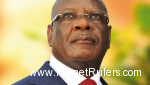 Ibrahim Boubacar Keïta (born January 29, 1945), or as he is often known IBK, is a Malian politician who has been President of Mali since 2013. Previously he was Prime Minister of Mali from 1994 to 2000 and President of the National Assembly of Mali from 2002 to 2007. He founded a political party, Rally for Mali (RPM), in 2001, and he has led the party since then. He was elected as President in the July–August 2013 presidential election and sworn in on 4 September 2013. Early life Keïta was born in Koutiala, Mali. He studied at the Lycée Janson-de-Sailly in Paris and Lycée Askia-Mohamed in Bamako, continuing his education at the University of Dakar, the University of Paris I and the Institut d’Histoire des Relations Internationales Contemporaines (IHRIC; Institute of the Modern History of International Relations). He has a Master’s degree in History and an additional graduate degree in Political Science and International Relations. After his studies, he was a researcher at the CNRS and taught courses on Third World politics at the University of Paris I. Returning to Mali, he became a technical consultant for the European Development Fund, putting together the first small-scale development program for the European Union’s aid activities in Mali. He went on to become Mali director for the French chapter of Terre des Hommes, an international NGO aiding children in the developing world. More info: http://en.wikipedia.org/wiki/Ibrahim_Boubacar_Ke%C3%AFta
Amadou Toumani Touré, Former President of Mali (Deposed in a military coup on Mar 22, 2012. Capt. Dioncounda Traoré becomes Interim President)
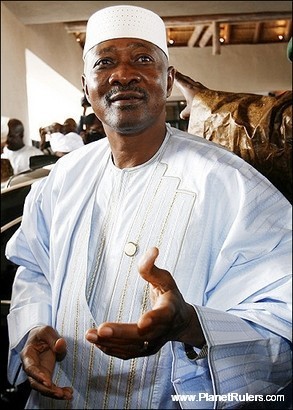 Born Amadou Toumani Toure c. 1948 in Mpoti, Mali. Education: Received training as history and geography teacher in Bamako, graduated 1969; attended Ecole Militaire Interarmes, 1969-72; received further military training in Riazan, Soviet Union and Pau, France; attended Ecole Superieur de Guerre, Paris, 1990. Politics: Supporter of constitutional democracy. Career Armed forces of Mali, lieutenant, 1972-78; 33rd parachute battalion, captain, 1978-84, became commander of battalion, 1985-90; promoted to lieutenant colonel, 1986; served as commander of the presidential guard for eight years, c. 1978-86; acting Head of State, Transition Committee for the Salvation of the People, 1991-92; oversaw Mali’s Guinea Worm Eradication Program, 1992; member of facilitators to regional initiative on Rwanda and Burundi, 1996; head of International Follow-Up Committee on peace in the Central African Republic, 1997; head of Inter-African Mission to Monitor the Implementation of the Bangui Agreements, 1997-. Life’s Work Approachable, modest, soft-spoken, and avuncular are not terms that usually describe the leaders of military coups. However, these words are often associated with Amadou Toure, an officer in the West African nation of Mali who led a rebellion that ousted longtime dictator Moussa Traore in 1991. Known affectionately as “ATT,” Toure was popular as a revolutionary, popular as an interim president, and remains popular as a regional diplomat on a mission of peace throughout central Africa. Toure was born in either 1943 or 1948 in Mpoti, Mali. After receiving his early education at local schools, he moved to Mali’s capital, Bamako, to receive training as a history and geography teacher. After graduating in 1969, Toure decided to embark on a military career rather than become a schoolteacher. He entered the Ecole Militaire Interarmes, a military academy in Kati, from which he graduated in 1972 as a lieutenant. Toure became a parachute instructor. Following further specialized training in Riazan in the former Soviet Union and in Pau, France, he was promoted to captain of the 33rd Parachute Battalion in 1978. Toure’s rise through the ranks of the Malian military continued into the 1980s. He served for eight years as commander of the Presidential Guard. In 1986, he was promoted to the rank of lieutenant colonel. In April of 1990, Toure was sent for advanced military training to the Ecole Superieur de Guerre, a special war school in Paris, and remained there until December. Expecting a better job upon his return, Toure was disappointed when he was not immediately offered a promotion. After a few months, he was called upon to command his former battalion. This treatment embittered Toure and contributed to his growing dissatisfaction with the Malian government. In the meantime, the Malian people were also tiring of dictator Moussa Traore’s oppressive regime. What began as peaceful protests throughout the country began to erupt into violent clashes between civilians and members of the armed forces. These clashes resulted in the deaths of hundreds of protesters. By early 1991, Toure’s loyalties had shifted away from Traore completely. He was quoted in Who’s Who in Africa: Leaders for the 1990s as saying that he was “really ashamed of being an army officer.” Toure also explained that “Moussa no longer served the interests of the country. He was opportunist, a total nepotist, a flatterer who made huge mistakes.” In January of 1991, Toure began planning a coup to overthrow Traore, taking advantage of a major protest march in Bamako to begin organizing a strike force. With popular sentiment on his side, Toure was able to convince other senior officers to join him. Following several days of rioting in Bamako by trade unionists, students, and masses of unemployed people, Toure led an uprising that brought down Traore and his government on March 26, 1991. Traore was arrested, and Toure became head of the transitional government of Mali. Toure’s coup was enthusiastically supported by most Malians. Sensing that the people of Mali did not want another military dictatorship, Toure quickly promised that power would be handed over to a democratically-elected civilian government within one year. A Council of National Reconciliation was formed, comprised of 16 senior officers who had participated in the coup, with Toure as its leader. The Council immediately opened a dialog with the leaders of Mali’s pro-democracy opposition. As Toure told the Reuters news service, “We can’t talk about opposition–we’re working amongst brother Malians. We want everyone to participate in this work of national importance.” Upon assuming control of the government, Toure moved quickly to address Mali’s many problems, including severe poverty and an ongoing revolt by the Tuareg people in northern Mali. In April of 1992, after months of negotiations, Toure and the Tuareg leaders signed a National Pact that effectively ended the rebellion. In addition, Toure began preparations for turning power over to a civilian government. His transitional government approved a new constitution on January 12, 1992, and within a week, municipal elections were held. Legislative elections took place over the next two months. A presidential election followed in April of 1992, with Alpha Oumar Konare of the Alliance for Democracy in Mali (ADEMA) emerging as the winner. Toure left office on June 8, 1992. Mali’s transition from a military to a civilian government was astonishingly smooth. Konare, a well-known and charismatic figure, was able to follow Toure into the presidency without a significant loss of public support. Toure, meanwhile, was promoted to the rank of general. Shortly after stepping down as president, he took command of Mali’s Guinea Worm Eradication Program, securing $1 million for the project from the U.S. Agency for International Development. In addition to his work in Mali, Toure has established himself as an important regional diplomat, taking part in peacemaking efforts throughout Africa. In 1996, he served on a facilitating team created to address a number of regional problems, particularly the ethnic conflicts in Rwanda and Burundi. The team included such high-profile figures as former U.S. President Jimmy Carter and Archbishop Desmond Tutu of South Africa. As a member of the Carter Foundation, Toure spearheaded the organization of a peace summit in Tunisia aimed at forging an international solution to the many land disputes within Africa. In 1997, Toure turned his attention to the Central African Republic, where he led the International Follow-Up Committee that successfully negotiated a cease-fire between government and rebel factions there. His work on these “Bangui Agreements” continued into 1998, as he lobbied the United Nations for financial aid that would improve conditions within the Central African Republic. As interim leader of Mali, Toure proved to be a man of his word and faithfully steered Mali on the path to democracy. His continued efforts to bring peace and stability to Africa’s volatile political landscape are greatly appreciated by Malians and all people of goodwill.