
Bola Tinubu, President of Nigeria
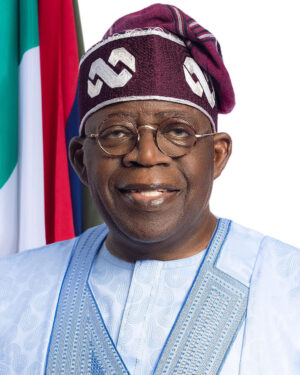
Asiwaju Bola Ahmed Adekunle Tinubu is the 16th President of the Federal Republic of Nigeria, in office since 29 May 2023. A former Governor of Lagos State (1999–2007) and long-time pro-democracy activist who helped engineer the 2015 merger that created the All Progressives Congress (APC), Tinubu won the February 2023 election with 36.6% of the vote — a plurality in Nigeria’s first-ever three-way national contest with Peter Obi (Labour, 25.4%) and Atiku Abubakar (PDP, 29.1%). Kashim Shettima, former governor of Borno State, serves as Vice-President.
His presidency is defined by the most aggressive economic reforms Nigeria has seen in a generation: the Day-One removal of fuel subsidies on 29 May 2023 and the June 2023 floating of the naira unified the foreign-exchange market and eliminated a long-standing drain on federal revenue, at the cost of a 34% inflation spike and sharp short-term hardship. Insecurity — Boko Haram / ISWAP in the north-east, “bandit” mass kidnappings in the north-west, separatist unrest in the south-east — remains unresolved.
Early life and education
Tinubu was born on 29 March 1952 in Lagos, then part of British Nigeria, to a prominent Muslim Yoruba family. His mother, Abibatu Mogaji, was a market-trader leader and the first President-General of the Association of Nigerian Market Men and Women. He attended Children’s Home School, Ibadan, and St. John’s Primary School, Aroloya, Lagos. In the early 1970s he moved to the United States, studying accounting at Richard J. Daley College in Chicago and Chicago State University, where he graduated in 1979 with a BSc. He worked as an accountant at Arthur Andersen, Deloitte, and GTE Services before joining Mobil Nigeria as a treasurer upon return to Nigeria in the early 1980s.
NADECO and return to democracy
Tinubu was elected Senator for Lagos West in the Social Democratic Party (SDP) in 1992. After the military dictatorship of Sani Abacha dissolved the senate in 1993, he went into exile in the U.K. and U.S. and co-founded the National Democratic Coalition (NADECO), a pro-democracy movement that campaigned against Abacha’s rule until Abacha’s death in 1998.
Governor of Lagos (1999–2007)
Tinubu returned to Nigeria after the 1999 democratic transition and won the Lagos State governorship in 1999 on the Alliance for Democracy ticket, re-elected in 2003. As governor he built a professionalised civil service, expanded Lagos’s tax base (internally generated revenue rose from ₦600 million to ₦8 billion a month), and created a political machine that has dominated Lagos politics ever since — earning him the informal title of “Godfather of Lagos.”
2023 election and legal challenges
Tinubu won the APC presidential primary in June 2022 over Vice-President Yemi Osinbajo and Rotimi Amaechi. His choice of fellow Muslim Kashim Shettima as running mate — breaking Nigeria’s unwritten Muslim-Christian ticket convention — triggered criticism but mobilised the APC’s northern base. The 25 February 2023 election was marred by operational failures of the Bimodal Voter Accreditation System (BVAS). Tinubu was declared winner on 1 March 2023 with 36.6%. Atiku Abubakar and Peter Obi challenged the outcome; the Presidential Election Petition Court and Supreme Court upheld Tinubu’s victory on 6 September and 26 October 2023 respectively. He was inaugurated on 29 May 2023.
Economic reforms and cost-of-living crisis
Tinubu’s inauguration speech on 29 May 2023 announced the immediate end of the fuel subsidy — a measure that had cost Nigeria up to \$10 billion annually. Within hours, petrol prices tripled. In June 2023 the Central Bank unified the multiple official exchange rates, effectively devaluing the naira by roughly 70% against the dollar over the following year. Inflation peaked at 34.6% in November 2024 before beginning to ease in 2025. GDP growth reached 3.4% in 2024 and 3.9% in 2025 per IMF figures; the 2024 Oronsaye Report implementation consolidated 36 federal agencies. Strikes by the Nigeria Labour Congress (NLC) through 2023 and 2024 produced compromises on minimum-wage increases (to ₦70,000/month) and transport subsidies.
Security and human rights
Freedom House rates Nigeria “Partly Free.” The security picture is severe: Boko Haram / ISWAP attacks persist in the Lake Chad Basin; “bandit” groups in Zamfara, Kaduna, and Katsina conduct mass-abduction-for-ransom operations; IPOB / ESN separatists in the south-east maintain a low-intensity insurgency. Human Rights Watch and Amnesty have documented extrajudicial killings and arbitrary detention by the military and police, including the #EndSARS legacy and the #EndBadGovernance protests of August 2024, which left at least 21 demonstrators killed.
| Full name | Bola Ahmed Adekunle Tinubu |
|---|---|
| Born | 29 March 1952 · Lagos, British Nigeria (age 74) |
| Office | President of Nigeria (16th) |
| In office since | 29 May 2023 |
| Predecessor | Muhammadu Buhari |
| Vice President | Kashim Shettima |
| Party | All Progressives Congress (APC) |
| Spouse | Oluremi Tinubu (Senator, First Lady) |
| Children | 6 |
| Education | Richard J. Daley College · Chicago State University (BS accounting, 1979) |
| Earlier role | Governor of Lagos State, 1999–2007 |
| 2023 result | 36.6% vs Atiku (29.1%) and Peter Obi (25.4%) |
| Human rights rating | Freedom House: Partly Free |
Frequently asked questions
Who is the current President of Nigeria in 2026?
Bola Ahmed Tinubu has been President of Nigeria since 29 May 2023, serving his first four-year term on an APC ticket. His running mate Kashim Shettima is Vice-President.
How old is Bola Tinubu?
Tinubu was born on 29 March 1952 in Lagos and is 74 years old as of April 2026.
What happened to Nigeria’s fuel subsidy?
In his 29 May 2023 inaugural address, Tinubu declared the fuel subsidy “gone.” Petrol prices roughly tripled overnight. The subsidy had cost Nigeria up to \$10 billion per year. Its removal was welcomed by the IMF and World Bank but triggered a cost-of-living crisis.
Who did Tinubu defeat in 2023?
Tinubu received 36.6% of the vote, ahead of Atiku Abubakar (PDP, 29.1%) and Peter Obi (Labour Party, 25.4%). It was Nigeria’s first three-way presidential contest. Both challengers unsuccessfully sought to overturn the result at the Presidential Election Petition Court and Supreme Court in 2023.
Is Nigeria a democracy?
Nigeria is the world’s fourth-largest democracy by population. Freedom House rates the country “Partly Free” owing to election irregularities, security-force abuses, and restrictions on assembly. The Nigerian federation has held seven competitive multi-party elections since 1999.
What is Tinubu’s economic plan?
His “Renewed Hope Agenda” centres on removing the fuel subsidy, unifying the foreign-exchange rate (the naira was effectively devalued by ~70% in 2023–24), streamlining federal agencies, and increasing tax-to-GDP ratio. GDP growth was 3.4% in 2024 and 3.9% in 2025 per IMF estimates.
When is Nigeria’s next presidential election?
February 2027. Tinubu is eligible for one further four-year term.
Mohamed Bazoum, Former President of Nigeria (since Apr 2, 2021)
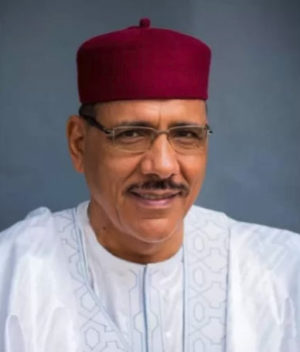 Mohamed Bazoum is a Nigerien politician who is the current president of the Republic of Niger. He has been in office since 2 April 2021. Before becoming a President, he served as the President of the Nigerien Party for Democracy and Socialism (PNDS-Tarayya). He also served in as a Minister of Foreign Affairs from 1995 to 1996 and again from 2011 to 2015. He was Minister of State at the Presidency from 2015 to 2016, and was Minister of State for the Interior between 2016 and the summer of 2020, when he resigned to focus on running for the 2020–21 presidential election. Bazoum won the second round of the presidential election with 55.67% of the vote against former president Mahamane Ousmane. Bazoum is a Sunni Muslim and the first Diffa Arab president of Niger. As a high-ranking member of the Nigerien government, Bazoum was named the successor to Issoufou as the presidential candidate for the PNDS in the 2020–21 Nigerien general election. Bazoum’s presidential campaign focused on ideas such as resolving demographic problems within Niger by limiting family size and increasing literacy and gender equality through more education for girls. Bazoum has also promised to target the ISIS insurgency in Niger, assisting the neighboring country of Mali in the process, reinforce Nigerien defence and security, and tackle corruption in the country. Bazoum did not win the first round of the election, held on 27 December 2020, obtaining only 39.30% of the vote. However, he won the runoff election in February 2021 with 55.67% of the vote and was sworn in as President on 2 April, his victory being confirmed on 21 March. Source: https://en.wikipedia.org/wiki/Mohamed_Bazoum
Muhammadu Buhari, President of Nigeria (since May 29, 2015; re-elected on Feb 23, 2019)
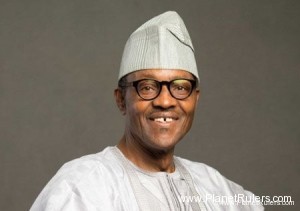 Muhammadu Buhari GCFR (born 17 December 1942) is the President of Nigeria, in office since 29 May 2015. He is a retired Nigerian Army Major General and was Head of State of Nigeria from 31 December 1983 to 27 August 1985, after taking power in a military coup d’état. The term Buharism is ascribed to the Buhari military government. He ran unsuccessfully for the office of President in the 2003, 2007 and 2011 elections. In December 2014, he emerged as the presidential candidate of the All Progressives Congress for the March 2015 elections. Buhari won the 2015 general election, defeating the incumbent President Goodluck Jonathan and marking the first time in Nigeria’s history that an incumbent President was defeated in an election by the opposition. Buhari has stated that he takes responsibility for whatever happened under his watch during his military rule, saying that he cannot change the past. He has described himself as a “converted democrat”. In 1971, Buhari married his first wife, Safinatu (née Yusuf) Buhari (First lady of Nigeria December 1983-August 1985). They had five children together, four girls and one boy. Their first daughter, Zulaihat (Zulai) was named after Buhari’s mother. Their other children are Fatima, Musa (deceased), Hadiza, and Safinatu. In 1988, Buhari and his first wife Safinatu were divorced. In December 1989, Buhari married his second and current wife Aisha (née Halilu) Buhari. They also have five children together, a boy and four girls. They are Aisha, Halima, Yusuf, Zarah and Amina. On 14 January 2006, Safinatu Buhari, the former first lady, died from complications of diabetes. She was buried at Unguwar Rimi cemetery in accordance with Islamic rites. In November 2012, Buhari’s first daughter, Zulaihat (née Buhari) Junaid died from sickle cell anaemia, two days after having a baby at a hospital in Kaduna. Source: https://en.wikipedia.org/wiki/Muhammadu_Buhari Goodluck Jonathan, Former President of Nigeria (since May 6, 2010. reelected on Apr 16, 2011)
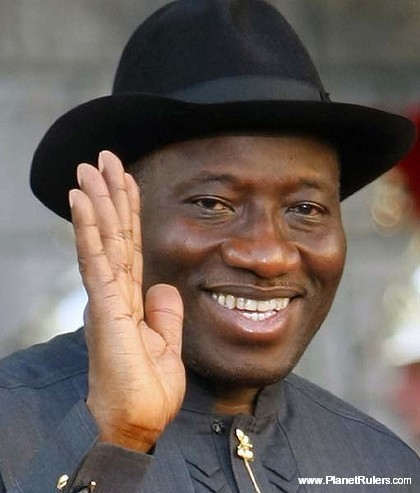
Goodluck Ebele Jonathan (born 20 November 1957) is a Nigerian politician and currently the President of Nigeria. He was Governor of Bayelsa State from 9 December 2005 to 28 May 2007, and was sworn in as Vice President of the Federal Republic of Nigeria on 29 May 2007. Jonathan is a member of the ruling People’s Democratic Party (PDP). On 13 January 2010, a federal court handed him the power to carry out state affairs while President Umaru Yar’Adua received medical treatment in a Saudi Arabian hospital. A motion from the Nigerian Senate on 9 February 2010 confirmed these powers to act as President. On 24 February 2010 Yar’Adua returned to Nigeria, but Jonathan continued as acting president. Following Yar’Adua’s death, Jonathan was sworn in as President on May 6 2010. Early life, education and personal life Jonathan was born in Otueke in Ogbia Local Government Area of the then Eastern Region, later Rivers State, now Bayelsa State. He holds a Bachelor of Science (B.Sc.) degree in Zoology in which he attained Second Class Honours, Upper Division. He also holds an M.Sc. in Hydrobiology/Fisheries biology, and a Doctor of Philosophy (Ph.D.) in Zoology from the University of Port Harcourt. After obtaining his degree, he worked as an education inspector, lecturer, and environmental-protection officer, until he decided to enter politics in 1998. He is married to Patience and has two children. Jonathan is an Ijaw. Political career Jonathan, previously the Deputy Governor of Bayelsa State, succeeded Governor Diepreye Alamieyeseigha, who was impeached by the Bayelsa State Assembly after being charged with money laundering in the United Kingdom. In September 2006, Jonathan’s wife was indicted by the nation’s anti-crime agency, the Economic and Financial Crimes Commission (EFCC), for money laundering related offences. Yar’Adua died on 5 May 2010. Jonathan was sworn in as Yar’Adua’s replacement on 6 May 2010, becoming Nigeria’s 14th President. He will serve as President until the next election. Upon taking office, Jonathan cited anti-corruption and electoral reform as likely focuses of his administration. He stated that he came to office under “very sad and unusual circumstances”.