
📅 Latest Update — Peru:
Keiko Fujimori became President of Peru on July 28, 2026, succeeding interim president José María Balcázar. She won the June 7, 2026 runoff against Roberto Sánchez by 50.1% to 49.9% on her fourth presidential bid.
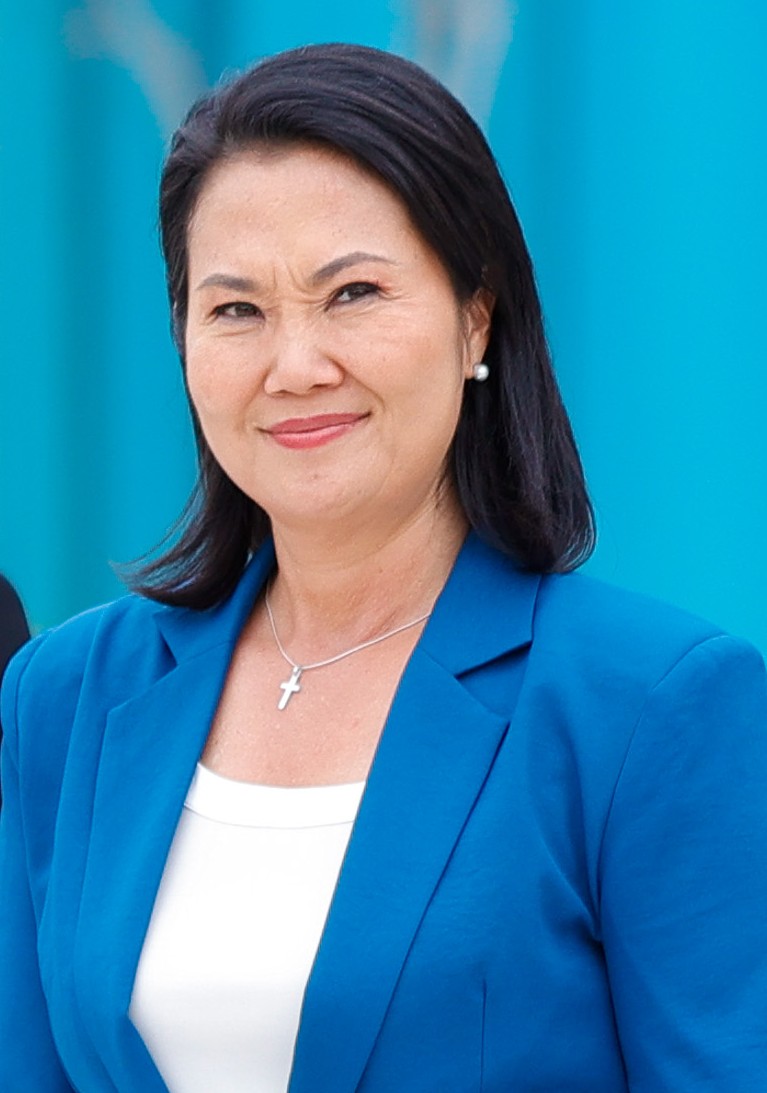
About Keiko Fujimori
Keiko Sofía Fujimori Higuchi (born 25 May 1975) is a Peruvian politician who has served as President of Peru since 28 July 2026. She is the eldest daughter of former president Alberto Fujimori and Susana Higuchi, and the leading figure of Fujimorism, the conservative political movement associated with her father. She has led its party, Fuerza Popular (Popular Force), since 2009.
Fujimori became First Lady of Peru at the age of 19 in 1994, after her father removed her mother from the role during the couple’s separation, and held the position until the collapse of his government in 2000. She studied business administration at Stony Brook University and Boston University in the United States and later earned an MBA from Columbia University.
She entered electoral politics in 2006, winning a congressional seat with a record number of votes, and in 2010 took over the Force 2011 party, later renamed Popular Force. She ran for the presidency three times and lost each time in narrow, polarizing runoffs: to Ollanta Humala in 2011, Pedro Pablo Kuczynski in 2016, and Pedro Castillo in 2021. From 2018 she was prosecuted in connection with the Odebrecht corruption scandal, spending more than a year in pretrial detention, but was not convicted. After the 2021 defeat she alleged electoral fraud, claims that international observers did not substantiate.
Her fourth bid succeeded amid the extraordinary instability that saw Peru cycle through Dina Boluarte, José Jerí and José María Balcázar in less than a year. Fujimori led the April 2026 first round and won the 7 June runoff against Roberto Sánchez by 50.1% to 49.9%. She was inaugurated on 28 July 2026, naming First Vice President Luis Galarreta as prime minister, Carlos Espá as foreign minister and Elmer Cuba as finance minister. Her agenda emphasizes a hard line on crime and organized extortion, pro-investment economic policy, and restoring the authority of the executive after years of congressional-presidential conflict.
Fujimori was married to American businessman Mark Vito Villanella, with whom she has two daughters. She is the first woman elected President of Peru by popular vote and the second woman to hold the office after Dina Boluarte.
📅 Latest Update — Peru:
Dina Boluarte was removed from office by Congress on October 10, 2025. José Jerí served briefly as president until February 17, 2026. José María Balcázar has been President of Peru since February 18, 2026.
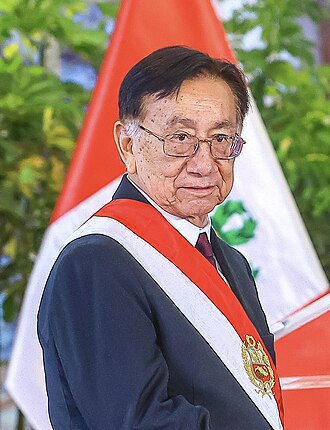
About José María Balcázar
José María Balcázar Zelada (born 17 January 1943) is a Peruvian politician and lawyer who has served as President of Peru since 18 February 2026. At 83 years of age, he is among the oldest individuals to hold the Peruvian presidency. His ascent to the office was the result of Peru’s extraordinary political instability rather than a planned political campaign: he was elected by Congress as an interim president following the removal of two successive presidents in the space of a few months.
Balcázar was born in Peru’s northern Andean region and pursued a career in law before entering politics. He was first elected to the Congress of Peru in 2021 as a member of Peru Libre, the left-wing party of then-President Pedro Castillo. He subsequently broke with Peru Libre in 2022 following Castillo’s increasingly erratic governance, and helped found Bicentennial Peru, a parliamentary bloc made up of dissident legislators who sought a centrist, institutionalist alternative within the fractured congress.
His path to the presidency traces a cascade of political crises. President Dina Boluarte, who had taken office in December 2022 following Castillo’s failed self-coup, was impeached and removed from office by Congress on 10 October 2025. Her successor, José Jerí — who had been president of Congress and therefore next in the constitutional line — assumed the presidency but was himself impeached and removed over corruption allegations on 17 February 2026, just four months into his tenure. Congress then held an internal vote to choose a new president, electing Balcázar with a majority of the 130-seat legislature.
His presidency was designated as transitional from the outset, bridging the gap until Peru’s April 2026 general elections could produce a newly elected government. The Constitutional Tribunal and international observers monitored the succession closely to ensure it complied with Peruvian constitutional norms, which it did — though the speed and frequency of presidential changes drew widespread concern about the structural fragility of Peru’s democratic institutions.
Balcázar’s brief tenure came during a period of profound challenges for Peru, including persistent rural poverty, informal labour markets, weak judicial independence, social unrest in mining regions, and the long-running damage caused by years of political turmoil to investor confidence. As an elderly transitional figure with no personal electoral ambitions, he was seen by congressional factions as a consensus caretaker whose advanced age and lack of political ambition made him acceptable across the divided legislature — a symbol of institutional continuity rather than a driver of new policy.
Dina Boluarte, President of Peru
 Dina Boluarte is a Peruvian lawyer and civil servant who became the first woman to serve as President of Peru in December 2022 after Congress removed Pedro Castillo. Before entering the presidency she served as Vice President and as Minister of Development and Social Inclusion, following a long career at the national civil registry RENIEC. Her tenure has focused on restoring institutional stability while navigating intense political polarization and investigations linked to protest-related violence.
Boluarte was born in 1962 in the Andean region of Apurímac and is proud of her Quechua roots. She has two sons and has often spoken about the influence of her upbringing on her public service ethos.
Source: https://en.wikipedia.org/wiki/Dina_Boluarte
Pedro Castillo, Former President of Peru (Elected on Jun 6, 2021 with 50.1% of the vote. Turnout is 74.6%)
 José Pedro Castillo Terrones (born 19 October 1969), sometimes referred to as “El Profe” (‘The Teacher’), is a Peruvian schoolteacher, union leader and politician serving as the 130th president of Peru since 28 July 2021, following the 2021 general election.
Born to a peasant family in Puña, Cajamarca, Castillo began working in Peru’s informal economy as a teenager to earn funds for his studies in education and later returned to his hometown to become a primary school teacher. He attained political prominence as a leading figure in a school teachers’ strike in 2017 and ran in the 2021 presidential election as the candidate of the Marxist Free Peru party. Castillo announced his presidential candidacy after seeing his students undergo hardships from the lack of resources in rural Peru, with the election occurring amidst the COVID-19 pandemic and a period of democratic deterioration in the nation. With the support of individuals living in rural and outlying provinces, he placed first in the initial round of the presidential vote and advanced to the second round where he won against his opponent Keiko Fujimori. Castillo’s victory was confirmed on 19 July 2021, and he was inaugurated on 28 July.
Since taking office, Castillo has distanced himself from Free Peru, adopted more moderate left-wing cabinets and was later described as holding conservative or right-wing political positions. Going through four cabinets in a little over six months and his choice of appointing close acquaintances as officials led to his government facing the most unstable beginning in more than twenty years, with questions arising about his apparent inexperience for office. He has already faced two impeachment proceedings in the Peruvian Congress, although both failed to reach the necessary votes to remove him from office.
Castillo is married to Lilia Paredes, a teacher, and they have two children together. Castillo says he is Catholic while his wife and children are evangelical. He is a teetotaler, practicing abstinence from consuming alcohol. His family lives in a nine-room home in the Chugur District tending a farm with cows, pigs, corn, and sweet potatoes. Castillo often wears a straw hat called a chotano, a poncho, and sandals constructed from old tires.
Source: https://en.wikipedia.org/wiki/Pedro_Castillo
Pedro Pablo Kuczynski, Former President of Peru (Elected on Jun 5, 2016 with 50.1% of the vote. Turnout is 80.1%)
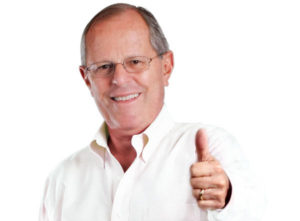 He previously served as Prime Minister of Peru from 2005 to 2006.
Kuczynski worked in the United States before entering Peruvian politics. He held positions at both the World Bank and the International Monetary Fund before being designated as general manager of Peru’s Central Reserve Bank. He later served as Minister of Energy and Mines in the early 1980s under President Fernando Belaúnde Terry, and as Minister of Economy and Finance and Prime Minister under President Alejandro Toledo in the 2000s.
Kuczynski was a presidential candidate in the 2011 presidential election, placing third. His opponents Ollanta Humala and Keiko Fujimori went on to the June 5, 2011 runoff election, in which Humala was elected. Kuczynski went on to stand in the 2016 election, where he defeated Fujimori in the second round.
His father, Maxime Hans Kuczynski, born in Poznań, today in Poland and part of Germany at that time after partition of Poland in the 18th century, was a bacteriologist who served in the German army during World War I on the Balkan front. He was a renowned pathologist and tropical disease specialist, in particular expert on Verruga peruana or Carrion’s disease. He trained at the Universities of Rostock and Berlin, where he was professor of pathology. An officer in the German army on the Eastern and Turkish fronts in the First World War, he travelled widely in Russia, China, West Africa, and Brazil. Leaving Germany in 1933 because of his Jewish roots, he was invited to Peru in 1936 by President Óscar R. Benavides to set up the public health service in the interior of the country. Maxime Hans Kuczynski reformed the San Pablo leprosarium on the Amazon at the Brazilian frontier, set up a public health colony on the Perene river, and was later professor of tropical medicine at National University of San Marcos in Lima.
Pedro Pablo Kuczynski Godard has been married twice, first to Jane Dudley Casey (daughter of Joseph E. Casey, member of the U.S. House for the 3rd district of Massachusetts), their offspring being corporate executive and technology entrepreneur Carolina Madeleine Kuczynski, the journalist Alex Kuczynski,and John-Michael Kuczynski. His current wife is Nancy Lange, with whom he has had a daughter. Contrary to false information spread during Mr. Kuczynski’s second presidential race, Nancy Lange is not a cousin of the actress Jessica Lange: they are only very distantly related and do not know each other. Kuczynski’s younger brother Miguel Jorge is a fellow of Pembroke College, Cambridge; and their first cousin is Jean-Luc Godard, the renowned French-Swiss film director. Kuczynski’s brother-in-law Harold Varmus received the Nobel Prize for cancer research in 1989.
Source: https://en.wikipedia.org/wiki/Pedro_Pablo_Kuczynski
Ollanta Humala, Former President of Peru (since Jul 28, 2011)
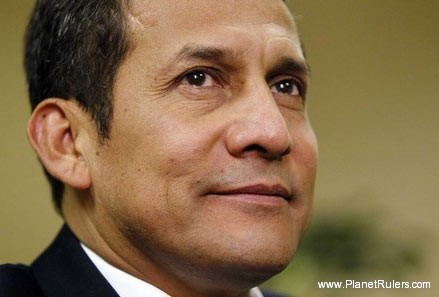
Ollanta Moisés Humala Tasso (born June 26, 1962) is a Peruvian politician and the President-elect of Peru. Humala, who previously served as an army officer, lost the presidential election in 2006 but won the 2011 presidential election in a run-off vote. He was elected as President of Peru in the second round, defeating Keiko Fujimori.
The son of Isaac Humala, a labour lawyer, Humala enlisted in the Peruvian Army in 1982. In the military he achieved the rank of Lieutenant Colonel; in 1992 he fought in the internal conflict against the Shining Path and three years later he participated in the Cenepa War against Ecuador. In October 2000, Humala led an unsuccessful military revolt by 39 soldiers in the southern city of Tacna against President Alberto Fujimori; he was pardoned by the Peruvian Congress after the downfall of the Fujimori regime.
In 2005 he founded the Peruvian Nationalist Party and registered to run in the 2006 presidential election. The nomination was made under the Union for Peru ticket as the Nationalist party did not achieve its electoral inscription on time. He passed the first round of the elections, held on April 9, 2006, with 30.62% of the valid votes. A runoff was held on June 4 between Humala and Alan García of the Peruvian Aprista Party. Humala lost this round with 47.47% of the valid votes versus 52.62% for García. After his defeat, Humala remained as an important figure within Peruvian politics.
In 2011, Humala campaigned as a center-left leader with the desire to help to create a more equitable framework for distributing the wealth from the country’s key natural resources, with the goal of maintaining foreign investment and economic growth in the country while working to improve the condition of an impoverished majority.
Source: http://en.wikipedia.org/wiki/Ollanta_Humala
Alan Gabriel Ludwig Garcia Perez, Former President of Peru
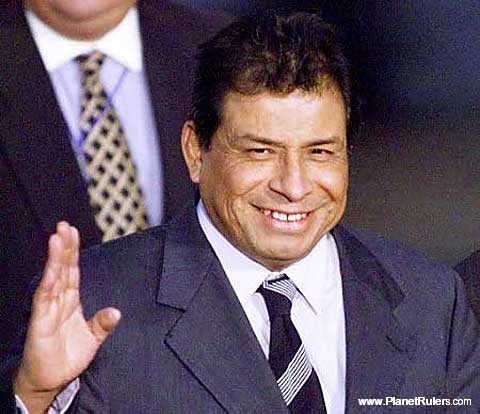
Alan Gabriel Ludwig Garcia Perez was born on May 23, 1949 in the city of Lima. He went on to university studies at the Pontificia Universidad Católica and later earned his law degree at the National University of San Marcos in 1971. Afterwards, he moved to Europe, attending the Universidad Complutense in Madrid, where he studied and completed his thesis on constitutional law, earning him a doctorate in political science.In 1973, he went on to the Sorbonne University of Paris, where he obtained a degree in sociology.
Between 1977 and 1980 was elected Organization Secretary of the Peruvian Aprista party. In 1979 was elected as a member of the Constituency Assembly. Between 1980 and 1985 was National Deputy. Between the years 1982 and 1985 was General Secretary of the Aprista Party of Peru.
In 1985, at the age of thirty-five, was elected president of the Republic of Peru for the 1985 –1990 period, function that was democraticly excersised during his term.
On April 1992, due to the coup d’etat perpetrated by Mr. Alberto Fujimori, was granted political asylum in Colombia and France until January 2001, when he returned back to Peru.
President Garcia was candidate for the presidency of the Republic of Peru, representing the Peruvian Aprista Party, obtaining 47% of the votes on the presidential elections on June 2001.
In 2004 was elected president of the Peruvian Aprista Party.
He holds the honorary position of President of the Socialist International.
He also was Director of the Institute of Government of the University San Martin de Porres.
On the presidential elections taken place on June 2006, Mr. Garcia was elected President with the 52.6% of the votes.
President García is the author of several books, among them:
Sierra Exportadora (2005)
Para Comprender el Siglo XXI (2004)
Mi Gobierno hizo la Regionalización (1998)
La Falsa Modernidad (1997)