

Vladimir Putin, President of Russia
Vladimir Vladimirovich Putin (born 7 October 1952) is a Russian politician and former intelligence officer who has served as President of Russia since 2012, having previously held the office from 2000 to 2008 and served as Prime Minister between those terms. He has been the de facto leader of Russia for more than 25 years, making him the longest-serving Russian or Soviet leader since Joseph Stalin. Putin was re-elected in the presidential election held from 15–17 March 2024 with an officially reported 87.3% of the vote. The election was widely criticised by Western governments, the OSCE, and independent observers as neither free nor fair, and took place during Russia’s ongoing invasion of Ukraine and with all credible opposition candidates barred, imprisoned, or in exile. Under constitutional amendments passed in 2020, Putin is eligible to stand for a further presidential term and could remain in office until 2036.
Early life and KGB career
 Putin was born in Leningrad (now Saint Petersburg) into a working-class family. He graduated in law from Leningrad State University in 1975 and joined the KGB the same year, serving for 16 years as a foreign intelligence officer. He rose to the rank of lieutenant colonel and spent the late 1980s stationed in Dresden, East Germany. He resigned from the KGB in 1991, officially to protest the attempted coup against Mikhail Gorbachev.
Rise to power
After the collapse of the Soviet Union, Putin entered politics in Saint Petersburg as deputy to Mayor Anatoly Sobchak. In 1996 he moved to Moscow to work in President Boris Yeltsin’s administration, and in July 1998 he was appointed Director of the Federal Security Service (FSB), the KGB’s domestic successor. Yeltsin appointed him Prime Minister in August 1999 and named him acting President when Yeltsin resigned on 31 December 1999. Putin won his first full presidential election in March 2000.
Domestic record
Putin’s early years in office coincided with a fivefold rise in oil and gas prices, driving average annual GDP growth of roughly 7% and an expansion of the middle class. Over time, however, his rule has been characterised by the systematic dismantling of independent media, the jailing or exile of opposition politicians (most prominently Alexei Navalny, who died in a Russian penal colony in February 2024), and a concentration of power in the presidency and the security services. Russia consistently ranks near the bottom of international indices for press freedom, democracy, and corruption, and Freedom House classifies it as “Not Free”.
Foreign policy and wars
Putin’s foreign policy has combined assertions of Russian great-power status with repeated use of military force. Key events include the Second Chechen War (1999–2009), the Russo-Georgian War (August 2008), the annexation of Crimea and the beginning of the Donbas war (2014), the military intervention in Syria to support Bashar al-Assad (from 2015 until Assad’s overthrow in December 2024), and the full-scale invasion of Ukraine launched on 24 February 2022. On 17 March 2023, the International Criminal Court issued an arrest warrant for Putin over the alleged unlawful deportation of children from occupied Ukrainian territory to Russia.
Sanctions and wealth
Since 2022, Putin and his inner circle have been the target of the most extensive sanctions regime ever imposed on a state, covering the Russian central bank, oil exports, sovereign wealth, and tens of thousands of individuals. Independent researchers and opposition figures have long alleged that Putin controls assets worth many tens of billions of dollars through proxies; documents in the 2016 Panama Papers leak tied figures in his inner circle to offshore holdings.
At a glance
| Full name | Vladimir Vladimirovich Putin |
|---|---|
| Born | 7 October 1952, Leningrad, USSR |
| Office | President of the Russian Federation |
| In power since | 31 December 1999 (acting) / 7 May 2000 |
| Most recent election | 15–17 March 2024 — 87.3% (widely disputed) |
| Current term ends | 2030 (eligible to 2036 under 2020 amendments) |
| Party | Independent (backed by United Russia) |
| Human rights | Freedom House: Not Free · ICC arrest warrant (2023) |
Frequently asked questions
Click a question to expand the answer.
Who is the president of Russia in 2026?
Vladimir Putin is the President of Russia. He was re-elected in March 2024 for a six-year term running until 2030 and, under the 2020 constitutional amendments, is eligible to stand for one further term that would end in 2036.
How old is Vladimir Putin?
Putin was born on 7 October 1952, which makes him 73 years old in April 2026.
How long has Putin been in power?
Putin has been the dominant figure in Russian politics since 31 December 1999, when he became acting president after Boris Yeltsin resigned. Counting his 2008–2012 term as Prime Minister (under President Dmitry Medvedev), he has held either the presidency or the premiership for more than a quarter of a century.
Is Putin a dictator?
Putin is widely classified as an authoritarian ruler by democracy watchdogs, academic researchers, and most Western governments. The Economist Democracy Index rates Russia as an “authoritarian regime”, Freedom House rates the country as “Not Free”, and Reporters Without Borders ranks it near the bottom of the World Press Freedom Index.
Why is Putin wanted by the ICC?
On 17 March 2023, the International Criminal Court issued an arrest warrant for Putin over the alleged unlawful deportation and transfer of children from Russian-occupied areas of Ukraine to the Russian Federation. ICC member states are obliged to arrest him if he enters their territory.
When did Russia invade Ukraine?
Russia launched its full-scale invasion of Ukraine on 24 February 2022, building on earlier actions that included the annexation of Crimea in March 2014 and the covert war in the Donbas from 2014 onward.
Who would succeed Putin if he stepped down?
Under the Russian constitution, if the president leaves office the Prime Minister becomes acting president until a new election is held within three months. As of April 2026 the Prime Minister is Mikhail Mishustin. There is no publicly designated successor.
Dmitry Anatolyevich Medvedev, Former President of Russia
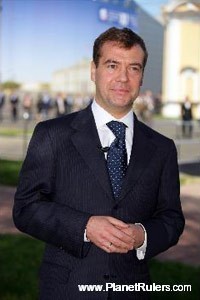 Born September 14, 1965, in Leningrad. Graduated from the Faculty of Law of Leningrad State University in 1987 and completed his post-graduate studies at Leningrad State University in 1990. Holds a PhD in law and the title of associate professor. 1990-1999: Lectured at St Petersburg State University. At the same time, between 1990-1995, was an adviser to the Chairman of the Leningrad City Council and an expert consultant to the St Petersburg City Hall’s Committee for External Affairs. 1999: Deputy Government Chief of Staff. 1999-2000: Deputy Chief of Staff of the Presidential Executive Office. 2000-2003: First Deputy Chief of Staff of the Presidential Executive Office. 2000-2001: Chairman of the Board of Directors of OAO Gazprom, in 2001 – Deputy Chairman of the Board of Directors of OAO Gazprom, from June 2002 – Chairman of the Board of Directors of OAO Gazprom. October 2003-November 2005: Chief of Staff of the Presidential Executive Office. In November 2005, appointed First Deputy Prime Minister. March 2, 2008: Elected President of the Russian Federation. Married to Svetlana Vladimirovna Medvedeva. The Medvedevs have a son, Ilya (born 1995). Source: http://eng.kremlin.ru/articles/D_Medvedev.shtml ADDRESS Ilinka Str, No 23 103132, Moscow, Russia