
Hassan Sheikh Mohamud, President of Somalia
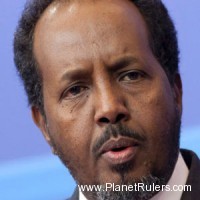 Hassan Sheikh Mohamud (Somali: Xasan Sheekh Maxamuud; born 29 November 1955) is a Somali politician who has served as the President of Somalia since 15 May 2022. This is his second, non-consecutive term in office: he previously served as president from 2012 to 2017. He was indirectly elected by the Federal Parliament of Somalia, defeating the incumbent Mohamed Abdullahi Mohamed (“Farmajo”) in the second round of voting.
Early life and academic career
Hassan Sheikh Mohamud was born in Jalalaqsi in the Hiran region of central Somalia. He studied in Mogadishu and India, and built an academic career spanning three decades as a university lecturer and education specialist. He co-founded SIMAD University in Mogadishu in 1999, later serving as its dean. He was also a consultant to UN agencies, UNICEF and various NGOs on education and civil-society programmes in post-civil-war Somalia.
First presidency (2012–2017)
Mohamud was elected President of the Transitional Federal Government in September 2012, becoming the first internationally recognised head of state of Somalia since the fall of Siad Barre in 1991. His first term was marked by state-rebuilding efforts, recognition by the United States in January 2013 (ending over two decades of non-recognition), and the launch of the Union for Peace and Development Party. The term was also criticised for corruption, limited press freedom, and security setbacks against Al-Shabaab. He lost the 2017 indirect election to Mohamed Abdullahi Mohamed.
Second presidency (since 2022)
Returned to power in May 2022, Mohamud has focused on a renewed military offensive against the Al-Shabaab insurgency in central and southern Somalia in coordination with local clan militias and African Union forces (ATMIS, succeeded by AUSSOM in 2025). His government has pursued accession to the East African Community, secured the lifting of a longstanding UN arms embargo, and navigated the political dispute with Ethiopia over the January 2024 Memorandum of Understanding between Addis Ababa and Somaliland.
Governance and human-rights record
Somalia remains one of the most fragile states in the world, ranked near the bottom of most governance indices. Freedom House classifies Somalia as “Not Free”. Human rights organisations have documented continuing abuses against journalists, women, and internally displaced people, and a large part of central and southern Somalia remains outside effective government control, administered by Al-Shabaab or contested. Presidential elections in Somalia have historically been indirect (parliamentarians voting), though a move to one-person-one-vote elections has been debated for years and has not yet been implemented nationally.
At a glance
| Full name | Hassan Sheikh Mohamud |
|---|---|
| Born | 29 November 1955, Jalalaqsi, Somalia |
| Office | President of the Federal Republic of Somalia |
| Current term since | 15 May 2022 (second term; first: 2012–2017) |
| Party | Union for Peace and Development |
| Predecessor | Mohamed Abdullahi Mohamed (“Farmajo”) |
| Principal challenge | Al-Shabaab insurgency |
| Human rights | Freedom House: Not Free |
Frequently asked questions
Click a question to expand the answer.
Who is the president of Somalia in 2026?
Hassan Sheikh Mohamud has been President of Somalia since 15 May 2022. This is his second non-consecutive term; he previously held the office from 2012 to 2017.
How is the president of Somalia elected?
Indirectly. Members of the Federal Parliament of Somalia elect the president by a two-thirds majority. Direct one-person-one-vote presidential elections have been debated for years but have not been implemented nationally.
How old is Hassan Sheikh Mohamud?
He was born on 29 November 1955, which makes him 70 in April 2026.
Is Somalia a dictatorship?
Somalia is a fragile federal republic rather than a dictatorship. It is classified “Not Free” by Freedom House due to weak institutions, insecurity, indirect elections, and limitations on press and assembly, but power is not concentrated in a single ruler.
Who controls Somalia today?
The internationally recognised Federal Government of Somalia controls Mogadishu and major urban areas. Al-Shabaab controls significant parts of central and southern Somalia. Somaliland in the north functions as a de facto independent state and Puntland operates with substantial autonomy.
What is Al-Shabaab?
Al-Shabaab is an al-Qaeda-aligned Islamist insurgent group that emerged in 2006. It holds territory in parts of central and southern Somalia, carries out frequent attacks in Mogadishu and across East Africa, and is designated a terrorist organisation by the UN, US, UK and EU.
When is the next Somali presidential election?
The Federal Parliament is expected to conduct the next presidential vote in 2026, at the end of Mohamud’s four-year term.
Mohamed Abdullahi Mohamed, Former President of Somalia
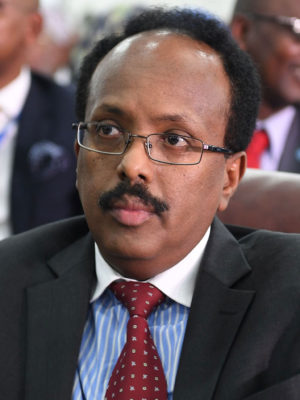 Mohamed Abdullahi “Farmajo” Mohamed (born 11 March 1962) is a Somali diplomat, and politician who is the 9th and current President of Somalia. He was previously Prime Minister of Somalia from November 2010 until June 2011 and is the founder and Chairman of the Tayo Political Party. He became the President of Somalia after winning the 2017 Somali presidential election with the votes of 184 of the total of 328 members of the Somali Parliament. Mohamed was born in Mogadishu to a Marehan family. Nicknamed “Farmajo”, he hails from the Gedo region in the south. Mohamed’s parents were activists affiliated with the Somali Youth League (SYL), Somalia’s first political party. During the 1970s, his father worked as a civil servant in the national Department of Transportation. Mohamed attended a boarding school in Somalia. Between 1989 and 1993, he completed a Bachelor’s degree in History from the State University of New York at Buffalo in Buffalo, New York. He followed in 2009 with a Master’s degree in Political Science (American Studies) from the University at Buffalo. His thesis was titled: “U.S. Strategic Interest in Somalia: From the Cold War Era to the War on Terror.” Mohamed holds both Somali and American citizenship. Source: https://en.wikipedia.org/wiki/Mohamed_Abdullahi_Mohamed
Sheikh Sharif Sheikh Ahmed, Former President of Somalia
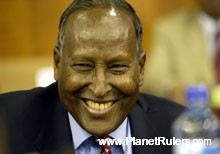 Sheikh Sharif Sheikh Ahmed (born July 25, 1964) is the 7th President of Somalia and former Commander in Chief of the Islamic Courts Union (ICU). Ahmed was born in the Shabeellaha Dhexe province of Somalia and studied at Libyan and Sudanese universities. He has worked as a secondary school teacher of geography, Arabic, and religious studies. He speaks Arabic, Somali, and English. Ahmed began his education at the Sheikh Sufi Institute, which was associated with the Al-Azhar University in Egypt. He then went to Sudan and entered Kordufan University in late 1992, where he pursued a Bachelor’s degree in the Arabic language (major) and geography (minor) in the city of Aldalanj. In 1994, the university was renamed to the University of Dalanj, and Sheikh Sharif left for Tripoli, the capital of Libya, after having completed only two out of the required four years. In Libya, he entered the Open University where he earned a Bachelor’s degree in Law and Islamic Shariah, graduating in 1998. A hafiz, Ahmed had memorized the Qur’an by heart as a child and spoke only standard Arabic shunning slang and local dialects. Thus, his religious upbringing and education allowed him to succeed his father as the spiritual leader of the Idriseeyah sect of Sufi Islam in Somalia. After returning from overseas, Ahmed became involved in the ICU and was elected to head a small local sub-clan court in Jowhar. A few years later, a local gang in Mogadishu, Somalia’s capital, kidnapped a young student and demanded a ransom from his family in return for the boy’s release. This incident was one of countless other kidnappings and killings perpetrated by armed groups in the Somali capital who exploited the disintegration of the central government. This event reportedly marked a turning point in the life of Sheikh Ahmed and propelled his further involvement with the ICU. By 2004, Sheikh Ahmed had become one the leading figures in the Mogadishu Islamic Courts. His closest friends and allies included Sheikh Hassan Dahir Aweys, one of the founders of the ICU, and Aden Hashi Farah “Eyrow”, a man whom Washington alleges has connections with the Al-Qaeda network and fought in Afghanistan in 2001. On September 9, 2006, under the auspices of Abdikasim Salad Hassan, the former President of the Somali Transitional National Government, Sheikh Ahmed and several colleagues attended an AU ceremony in Sirte, Libya, marking the seventh anniversary of a summit of African leaders. In an interview with Reuters and the BBC, Sheikh Ahmed suggested his delegation would seek the help of Libya and other African nations to bring about a rapprochement between the Islamists and the Somali Transitional Federal Government (TFG). However, he reportedly arrived in Khartoum, Sudan 48 hours before the start of the conference between the Somali government and the ICU only to leave 24 hours later. Sheikh Ahmed said Ethiopia had been hostile to Somalia for more than 500 years, and reiterated a long-standing Islamist accusation that Ethiopian forces were intervening in Somalia. Ethiopia denied any of its troops were fighting in Somalia. However, arrangements for an Intergovernmental Authority on Development (IGAD)-led peacekeeping force did not materialize. On December 28, 2006, after only six months in power and the defeat of the ICU’s army, he committed himself to fighting the Ethiopian forces in Somalia. After the ICU’s defeat in the Battle of Jilib and their abandonment of Kismayo, he fled towards the Kenyan border. He was detained, with three other Somalis, by Kenyan police on January 21, 2007 near the Hulugo border. He met the US Ambassador to Kenya for talks regarding cooperation with the TFG. He was under the protection of Kenyan authorities staying at a hotel in Nairobi. On February 1, 2007 Sharif Ahmed was released from Kenyan police authorities. By February 8, Sheikh Sharif Sheik Ahmed had gone to Yemen where other ICU members are thought to have also gone. Before fleeing, Sheikh Sharif lived with his wife and two children, Ahmad, aged 9 and Abdullah, who is a toddler, in a modest house in Mogadishu. As the first round of voting began, several candidates withdrew, increasing the speculation that the vote would largely be a choice between Nur Hassan Hussein and Sharif Ahmed. In the first round, Sharif Ahmed got 215 votes, Maslah Mohamed Said 60 and Nur Hassan Hussein 59; Nur Hassan Hussein then withdrew his candidacy, thus likely sealing the election of Sharif Ahmed as president. In the final round of the presidential election he prevailed with 293 votes. After winning the vote in the early hours of January 31, 2009, Ahmed was sworn in later in the day at the Kempinski hotel in Djibouti.
Abdullahi Yusuf Ahmed, Former President of Somalia
Abdullahi Yusuf Ahmed (Somali: Cabdullaahi Yuusuf Axmed) (b. December 15 1934) is a veteran Somali politician, and the current transitional President of Somalia. Ahmed was born in the town of Galkacyo, in the Mudug Region, and is a member of the Darod, one of Somalia’s largest clans. He was elected as President of the Transitional Federal Government (TFG), by a session of the Transitional Federal Parliament (TFP) held in neighbouring Kenya’s capital, Nairobi, on October 10 2004, and sworn in on October 14 2004. He was among the first cadet officials sent to Italy in 1957, together with General Mohamed Farah Aideed and others. Since then he remained in the Army and participated in the war of 1964 and the Ogaden War of 1977, and was decorated for bravery in both wars.[citation needed] In 1978 Col Yusuf together with a group of officials mostly from his own Majeerteen (Daarood) clan participated a failed coup attempt against regime of General Siad Barre. He escaped to Kenya, then to Ethiopia where he started the first rebel movement ever established in Ethiopia, known as SODAF which later became the SSDF. Later he became President of Puntland state. In the 2004 election he defeated all the notable leaders of Somalia including Abdiqasim Salad Hassan, Cadow and all the warlords of Mogadishu. His government, backed by considerable Ethiopian forces, successfully defeated the Islamic Courts Union (ICU) led by Hassan Dahir Aweys. The Ethiopian forces marched into Mogadishu on the last day of the year 2006. Career Somali Salvation Democratic Front (SSDF) In September 1978 Abdullahi Yusuf, as a former army officer in the Somali National Army (SNA), founded the Somali Salvation Democratic Front (SSDF) guerrilla movement aimed at ousting the Somali dictator Siad Barre. President of Puntland In the 1990s Ahmed emerged as the pre-eminent leader of his native Puntland region; he declared the territory autonomous in 1998. On July 23 1998 he became the President of Puntland and served in this position until his term expired on July 1 2001. However, after this he continued to declare himself to be the President of Puntland and started a military campaign against the new leadership, which had elected Jama Ali Jama in November 2001. In May 2002 he gained control of Puntland’s capital and was recognized as President of Puntland again, though rebellions continued until 2003. Ahmed then continued serving as President of Puntland until October 2004 when he resigned to become President of Somalia. He is said to have an authoritarian approach to leadership. Implicated in extrajudicial killings The U.S. Department of State, in its 2002 Country Report on Human Rights Practices, identifies milita members loyal to Ahmed as being responsible for at least two deliberate killings of non-combatants while he was president of the disputed regional state of Puntland: * On January 11 2002, Garah Mohammed Said Gom’ad, a prominent businessman, was reportedly killed by forces of Yusuf Ahmed in a deliberate attack in which Yusuf’s militia reportedly stopped his car and Gom’ad was fatally shot. * On August 17 2002, Sultan Ahmed Mohammed Hurre, a British citizen, was killed by bodyguards in the employ of Yusuf Ahmed as their respective convoys passed each other approximately two miles south of the Puntland town of Garowe. Hurre was known for opposing the extension of Ahmed’s presidency in the state of Puntland; according to the press reports, he was targeted by Ahmed for arrest as a religious extremist. Ahmed later claimed that the killing was accidental, but witnesses claimed otherwise. The Country Report says that by the end of 2002 no action had been taken against those responsible for the killings. Militias associated with Yusuf Ahmed have also been implicated in the killings of Col. Farah Mohamed Said (“Farah Dheere”) in Garowe in 2002, and of traditional leader Malaaq Seemow Abdi Garuunin Baidoa, on June 9 2006. Transitional Federal Government (TFG) On October 10, 2004, Abdullahi Yusuf Ahmed was elected by the Transitional Federal Parliament to the position of President of Somalia. Abdullahi Yusuf got 189 votes from the TFG Parliament, while the closest contender got 79 votes. As President, he pledged to promote reconciliation and to set about rebuilding the country. However, his government has been plagued by internal disagreements and contentions with other power-holders in Somalia. For example, he was at loggerheads with some warlords and government members over where the administration should be based. The president and prime minister opposed a move to Mogadishu, citing security reasons. He helped to relocate the Transitional Federal Institutions (TFIs) along with his Prime Minister Ali Mohammed Ghedi and the Speaker of the Parliament Sharif Adan from Nairobi to the cities of Jowhar and mainly Baidoa, where the TFG resided until the government took control of Mogadishu. The make up of a possible foreign peacekeeping force – in particular the inclusion of Ethiopian troops – is another bone of contention. Ethiopia has been accused of backing rival Somali warlords in order to keep the country weak. The IGASOM mission therefore excludes countries neighboring Somalia from participating in peacekeeping. In May 2006, the Second Battle of Mogadishu started and CNN reported that there were Transitional government forces in action, but Abdullahi Yusuf told the BBC the alliance of warlords were not fighting on behalf of the government and threatened to fire them. Indeed, members of the government who were part of the warring Alliance for the Restoration of Peace and Counter-Terrorism (ARPCT) were sacked. Others left the government in disaffection after the victories of the Islamic Court Union. An arrangement was made with the Islamic Court Union in Khartoum on 5 September 2006. The interim-government of Yusuf Ahmed and the Islamic Court Union were to merge into a new transistory government of Somalia. The Islamic Court Union had the precondition that the Ethiopian army should leave the country. The rise of the Islamists damaged Yusuf’s dream of establishing central rule in Somalia for the first time in fifteen years. Assassination Attempt On September 18, 2006, a suicide car bomber smashed his vehicle into the President’s convoy outside the National Parliament in Baidoa. The attack killed four of the President’s bodyguards, as well as the President’s brother. Six attackers were also killed in the subsequent gun battle. The President’s life was most likely saved by the fact that he travelled in the second vehicle in the convoy rather than the front one, a decoy. The Islamic Court’s Union, which had recently taken control of much of the country were blamed for the attack. After the beginning of the War in Somalia on December 21, 2006, with the help of Ethiopia, the TFG forces took control of Somalia and the capital, Mogadishu, from the hands of the Islamic Courts Union. By 28 December the Transitional Federal Government captured Mogadishu as the ICU forces fled. On January 8, 2007 as the Battle of Ras Kamboni raged, TFG President Abdullahi Yusuf Ahmed entered Mogadishu for the first time since being elected. It was announced the government would be relocated to Villa Somalia, in Mogadishu, from its interim location at Baidoa. The first time a Somali government controlled the whole country since 1991.