
Guy Parmelin, President of the Swiss Confederation 2026
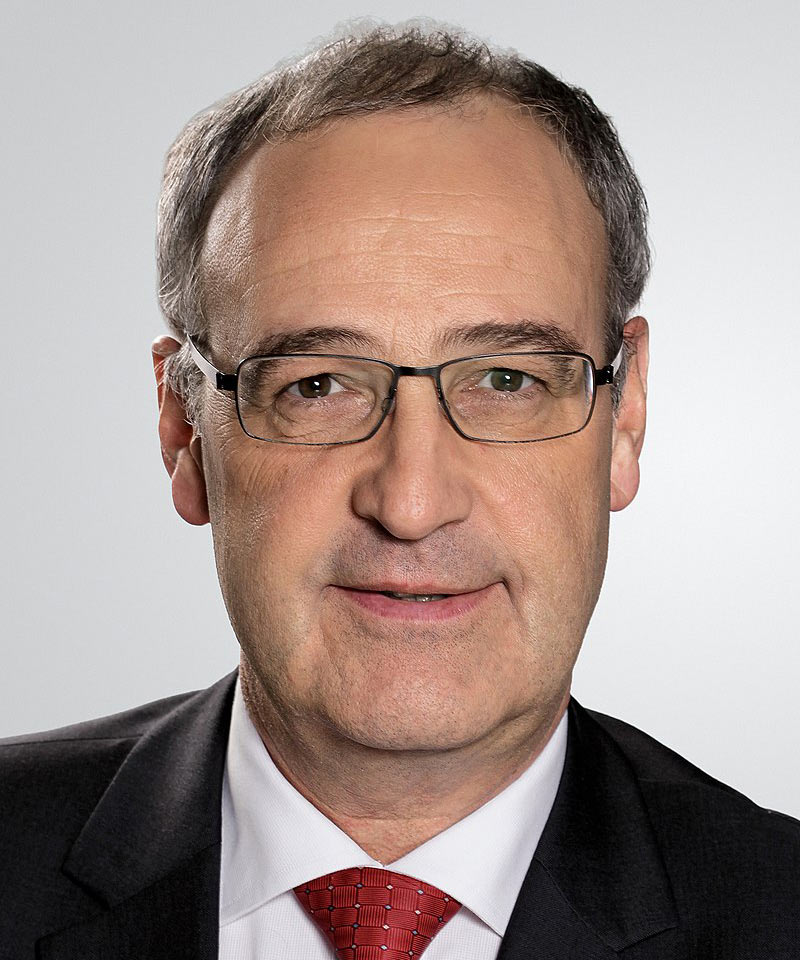
Guy Parmelin (Swiss People’s Party, SVP) is serving as President of the Swiss Confederation for 2026 — a rotating, one-year, largely ceremonial role within Switzerland’s seven-member collective executive, the Federal Council (Bundesrat / Conseil fédéral). The Swiss presidency is not a head-of-state office in the traditional sense; Switzerland has no single head of state. The Federal Council as a whole is the head of state and of government, and its seven members serve fixed four-year terms determined by the Federal Assembly. The annual presidency rotates by strict seniority among council members, with the vice presidency held by the incoming next president. This is Parmelin’s second turn in the presidency; his first was in 2021. The current Vice President is Finance Minister Karin Keller-Sutter (FDP), who will serve as president in 2027.
Parmelin was born on 9 November 1959 in Bursins, Vaud, into a Francophone farming family. He trained as a wine-grower and managed his family’s vineyards for three decades, simultaneously serving as mayor of Bursins (1995–2003) and member of the Federal Assembly for Vaud from 2003 to 2015. He was elected to the Federal Council on 9 December 2015 to replace outgoing SVP councillor Eveline Widmer-Schlumpf, and has headed the Federal Department of Economic Affairs, Education and Research (EAER / DEFR / WBF) since 1 January 2019. Before that, from 2016 to 2018, he was Minister of Defence.
The Swiss Federal Council in 2026
The current seven-member Federal Council is composed under the “magic formula” — the informal distribution rule maintained since 1959 — as follows: Karin Keller-Sutter (FDP-Liberals), Finance; Guy Parmelin (SVP), Economic Affairs and President 2026; Ignazio Cassis (FDP), Foreign Affairs; Viola Amherd retired at end-2024 and was succeeded by Martin Pfister (The Centre), Defence; Beat Jans (SP), Justice; Elisabeth Baume-Schneider (SP), Interior; Albert Rösti (SVP), Environment and Transport. The magic formula currently translates to 2 SVP, 2 SP, 2 FDP, and 1 Centre — reflecting the 2023 federal election in which the SVP recorded its best-ever result (27.9%).
Direct Democracy and Key 2025–2026 Votes
Switzerland held three federal popular-vote days in 2025 and one in March 2026, maintaining its world-leading direct-democratic practice. Key decisions: in March 2025 voters rejected a proposal to unify the three social insurance systems (60% no); in September 2025 they approved a major reform of the supplementary second-pillar BVG pensions (52% yes) but rejected environmental initiative “Water for All” (59% no); in November 2025 they narrowly approved revised EU framework-agreement mandates (51% yes). The 8 March 2026 vote approved Swiss Fourth Industrial Revolution AI governance rules.
Relations with the European Union
Switzerland, a non-EU member, has been negotiating a new package of bilateral agreements with the EU since 2024 to replace the stalled 2014 framework accord. A “Bilaterals III” package covering electricity, food safety, health, dynamic legal alignment and institutional dispute settlement was politically concluded in late 2024 and signed on 12 June 2025. Its ratification will require a 2027 referendum. The SVP strongly opposes elements of the framework it deems incompatible with Swiss sovereignty.
Foreign Policy and Neutrality
Swiss neutrality, reaffirmed by the 2022 “Ignazio Cassis doctrine” of “cooperative neutrality,” continues to evolve. Switzerland adopted all EU sanctions on Russia since February 2022 and banned Russian gold and luxury exports. It hosted the June 2024 Ukraine peace summit at Bürgenstock without direct Russian participation. Swiss exports of dual-use goods remain tightly screened and re-export licences for Swiss-origin munitions to third countries are still restricted — a point of Western frustration since 2022.
| Office | President of the Swiss Confederation (rotating, 1 year) |
|---|---|
| 2026 President | Guy Parmelin (SVP; Economic Affairs) |
| 2026 Vice President | Karin Keller-Sutter (FDP; Finance) — will be 2027 president |
| Parmelin born | 9 November 1959 · Bursins, Vaud (age 66) |
| Federal Council members | 7 (Parmelin, Keller-Sutter, Cassis, Pfister, Jans, Baume-Schneider, Rösti) |
| Magic formula | 2 SVP · 2 SP · 2 FDP · 1 Centre |
| Capital | Bern (federal city) |
| Human rights rating | Freedom House: Free (97/100) |
Frequently asked questions
Who is the president of Switzerland in 2026?
Guy Parmelin (SVP) is serving as President of the Swiss Confederation for 2026. The presidency is a one-year rotating role within the seven-member Federal Council; it is largely ceremonial and confers no powers beyond those of any federal councillor.
How does the Swiss presidency rotate?
The seven councillors take turns as President and Vice President for one year each, in strict seniority order. The incoming next president serves as Vice President the preceding year. For 2027 Karin Keller-Sutter (FDP) will be president; Parmelin was also president in 2021.
Who is Switzerland’s actual head of state?
Switzerland has no single head of state. The Federal Council as a whole — a seven-member collegial executive — is both the head of state and the head of government. The President is “primus inter pares” and chairs meetings.
Who sits in the Swiss Federal Council in 2026?
Karin Keller-Sutter (FDP, Finance); Guy Parmelin (SVP, Economic Affairs, President 2026); Ignazio Cassis (FDP, Foreign Affairs); Martin Pfister (Centre, Defence, since Jan 2025); Beat Jans (SP, Justice); Elisabeth Baume-Schneider (SP, Interior); Albert Rösti (SVP, Environment and Transport).
What are the Bilaterals III with the EU?
A package of bilateral agreements concluded between Switzerland and the EU on 12 June 2025, covering electricity, food safety, health, dynamic legal alignment and institutional dispute settlement. It replaces the stalled 2014 framework agreement and will require ratification in a Swiss referendum in 2027.