
Ahmed al-Sharaa, President of Syria
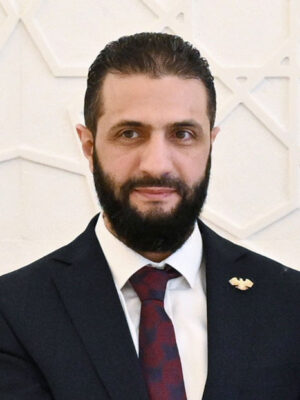 Ahmed Hussein al-Sharaa (Arabic: أحمد حسين الشرع; born 29 October 1982), known during the Syrian civil war by his nom de guerre Abu Mohammad al-Julani, has served as President of Syria since January 2025. He took de facto power on 8 December 2024, when the Islamist rebel coalition he led — headed by Hay’at Tahrir al-Sham (HTS) — captured Damascus and ended more than five decades of rule by the Assad family. Bashar al-Assad fled to Russia and was granted asylum in Moscow the same day.
From jihadist commander to president
Al-Sharaa was born in Riyadh, Saudi Arabia, to a Syrian Sunni family from the Golan Heights and grew up in Damascus. He joined al-Qaeda in Iraq in the early 2000s and was held by U.S. forces at Camp Bucca from 2006 to 2011. On his release he returned to Syria and founded the Al-Nusra Front in 2012 as al-Qaeda’s Syrian affiliate. In 2016 he publicly broke with al-Qaeda, and in 2017 he merged several factions to create Hay’at Tahrir al-Sham, which he led until 2025. From 2017 to 2024 he was the effective ruler of Idlib Province through the Syrian Salvation Government.
The fall of Assad and transition
In late November 2024, HTS and allied factions launched an offensive that, within eleven days, swept south from Idlib through Aleppo, Hama and Homs and into Damascus. The speed of the collapse surprised observers; Syrian army units dissolved in the face of the advance and Russia and Iran, Assad’s principal backers, did not intervene. Al-Sharaa was appointed President for a transitional period in January 2025, with a new constitutional declaration and the dissolution of the Ba’ath party apparatus. A full national election has not yet been held.
International recognition and sanctions
Al-Sharaa’s government has been engaged in extensive diplomatic talks with the United States, European Union, Turkey and Gulf states. HTS was designated a terrorist organisation by the UN, US, UK, EU and Turkey; some sanctions have been eased since 2025 to support reconstruction, though many individual and financial designations remain in place. The U.S. State Department in December 2024 removed its bounty on al-Sharaa after his forces entered Damascus.
Human rights and governance record
Syria under HTS rule in Idlib was criticised by human rights organisations for restrictions on women, religious minorities, and media. Since December 2024, the transitional government has committed publicly to protecting minority communities including Alawites, Christians and Druze, but reports of sectarian violence — notably on the Syrian coast in March 2025 — and pressure on civil society have continued. Freedom House continues to classify Syria as “Not Free”.
At a glance
| Full name | Ahmed Hussein al-Sharaa |
|---|---|
| Nom de guerre | Abu Mohammad al-Julani |
| Born | 29 October 1982, Riyadh, Saudi Arabia |
| Office | President of the Syrian Arab Republic (transitional) |
| In office since | 8 December 2024 (de facto); January 2025 (formal) |
| Previous role | Leader of Hay’at Tahrir al-Sham (HTS), 2017–2025 |
| Predecessor | Bashar al-Assad (fled to Russia) |
| Human rights | Freedom House: Not Free (2025) |
Frequently asked questions
Click a question to expand the answer.
Who is the president of Syria in 2026?
Ahmed al-Sharaa, formerly known by the nom de guerre Abu Mohammad al-Julani, has been President of Syria since January 2025. He took de facto power on 8 December 2024 when his rebel coalition, led by Hay’at Tahrir al-Sham (HTS), captured Damascus and ended Assad family rule.
What happened to Bashar al-Assad?
Bashar al-Assad fled Syria on 8 December 2024 as rebel forces entered Damascus. Russia granted him and his immediate family political asylum in Moscow. His 24-year rule, and 54 years of Assad family dominance in Syria, ended with his flight.
How did al-Sharaa come to power?
He led HTS in a lightning eleven-day offensive in late November and early December 2024 that captured Aleppo, Hama, Homs and Damascus in sequence. Syrian government forces largely disintegrated without fighting, and Assad’s Russian and Iranian backers did not intervene.
Is al-Sharaa a former jihadist?
Yes. He joined al-Qaeda in Iraq in the early 2000s, was imprisoned by U.S. forces at Camp Bucca 2006–2011, founded the al-Qaeda-aligned Al-Nusra Front in 2012, and led Hay’at Tahrir al-Sham from 2017. He publicly broke with al-Qaeda in 2016. Several Western governments formerly designated him and HTS as terrorists.
How old is Ahmed al-Sharaa?
He was born on 29 October 1982, which makes him 43 in April 2026.
Is Syria a democracy now?
No. The country is in a transitional period under a constitutional declaration. No nationwide free and fair presidential election has been held. Freedom House classifies Syria as “Not Free” and civil society, women’s groups, and minority communities have reported continuing pressure and incidents of sectarian violence.
Does the U.S. still consider al-Sharaa a terrorist?
The U.S. State Department removed its $10 million bounty on al-Sharaa in December 2024 following the fall of Damascus. HTS designations have been partially eased to allow humanitarian aid and limited engagement, though many financial and individual sanctions remain in force.
Bashar al-Assad, Former President of Syria (re-elected on May 26, 2021 with 95.1% of the vote. Turnout is 78.6%.; and on Jun 6, 2014)
 Assad is a politician who got in power much against his own will. Initially he was not thought of as his father, Hafez al-Assad’s successor. This was a role originally filled by his brother Basil who died in an accident in 1994. Then Bashar was called back to Syria, and was gradually trained to become a politician. Some reports describe him as not as strong and autocratic as his father (and his late brother). Friends have averred that he is a meek and awkward figure, while others say that he is a nice and friendly person and very polite. He is also reported to be a good listener. Some say that he is pragmatic and open for the modern society’s possibilities. He has also been very successful at making changes in the ranks in Syrian institutions, central in bringing computer technology and Internet access to Syria, as well as facilitating the introduction of mobile telephones. Bashar has struggled with inherited unresolved international political questions (water quarrels with Turkey, which controls the main sources of river water that streams through Syria; Lebanon, which has difficult relations to what still must be considered Syrian influence; Israel, which continues to occupy the Golan Heights; and a long-lasting animosity with the king of Jordan). New problems have occurred in his presidency, like the war in Iraq and change of leadership, Syria being accused of facilitating militant groups active in Iraq and a loss of Syria’s strong control over Lebanon. Internally, Syria is just as much divided into groups as before. There is the large Sunni majority in the country, there are all the people who are never touched by the nepotism of Hafez al-Assaf’s Syria, there are the Islamists, and then there are all of Bashar’s own enemies. Bashar has been quite effective in removing old officers from the ranks in the Syrian army. Still it is a fact that Bashar must not destroy the basis for his power, which are his father’s closest allies and the Alawite society. This is probably the major impediment to a democratization of Syrian politics and economics. Prior to becoming president, Bashar made himself well-known for some campaigns, like dealing with the introduction of different consumer technologies. The most respect, however, he earned from his anti-corruption campaign, which resulted in the fall of several leading personalities in the Syrian society, like former prime minister Mahmoud Zoubi. He has also declared that he will lift restrictions that have hindered Syrian media from employing the slightest form of critical journalism. He also acted as the personal representative for his father, when meeting with Jacques Chirac of France and Emile Lahoud of Lebanon. Bashar is still unmarried. BIOGRAPHY 1965 September 11: Born in Damascus as son of the commander of the Syrian Air Force, Hafez al-Assad. 1980’s: Bashar moves to London, United Kingdom, to study ophthalmology. 1994 February: As his brother Basil dies, Bashar returns to Syria. Although noone expects him to become Hafez’ successor, he takes over Basil’s position as commander of the Syrian army’s armoured division. Bashar uses this position to remove several of the old officers, and possible enemies. 1999: Bashar is appointed colonel, and becomes more involved in the state’s affairs. 2000 June 10: The same day as Hafez al-Assad dies, the People’s Assembly alters the constitution so that Syria’s president can be 34 (contrary to 40 earlier). The two top committees of the ruling party meet, and nominate Bashar for presidency and declare him commander-in-chief. — June 25: The parliament nominates him for presidency. — July 10: Bashar is elected president from a referendum.