
Anutin Charnvirakul, Prime Minister of Thailand

Anutin Charnvirakul is the 32nd Prime Minister of Thailand, in office since 7 September 2025. Leader of the Bhumjaithai Party since 2012 and concurrently Minister of the Interior since 19 September 2025, he took office after the Constitutional Court removed Prime Minister Paetongtarn Shinawatra on 29 August 2025 over the leaked phone call with Cambodian statesman Hun Sen. The Pheu Thai–Bhumjaithai coalition collapsed days later; a realigned House elected Anutin on 5 September 2025 with 311 of 491 votes, backed by the opposition People’s Party in exchange for a promised dissolution of parliament within four months.
A businessman-turned-politician from one of Thailand’s wealthiest construction families, Anutin is best known internationally for having spearheaded Thailand’s 2022 decriminalisation of cannabis — a controversial policy his own government partly reversed in 2025. He faces an immediate confidence test on debt-laden farmers, the ongoing Thailand–Cambodia border crisis, and a Thai economy that grew under 2% in 2024.
Early life and business career
Anutin was born on 13 September 1966 in Bangkok to Chavarat Charnvirakul — later himself briefly prime minister in December 2008 — and Bhunleun Charnvirakul. The family is of Teochew Chinese descent. Anutin holds a BEng from Hofstra University (New York) and an MBA from Thammasat University. He joined the family firm Sino-Thai Engineering and Construction (STECON), becoming president, and built a personal reputation as an aviator who holds multiple fixed-wing and helicopter ratings.
Early political career
Anutin entered politics with Thaksin Shinawatra’s Thai Rak Thai party in 1996, serving as Deputy Minister of Commerce and Deputy Minister of Public Health. After the 2006 coup dissolved TRT, he received a five-year political ban. He returned in 2012 to succeed his father as leader of the Bhumjaithai Party, a Buriram-province-based pragmatist force that has positioned itself as the deciding partner in every Thai coalition since.
Public Health Minister (2019–2023)
Under Prayut Chan-o-cha’s second premiership, Anutin served as Deputy Prime Minister and Minister of Public Health from 10 July 2019. He oversaw Thailand’s COVID-19 response (criticised early for anti-foreigner comments, later praised for the vaccine rollout) and the June 2022 removal of cannabis from Thailand’s controlled-substance schedule — making Thailand the first Asian country to decriminalise the plant. Bhumjaithai retained the seat after the 2023 elections in the Srettha Thavisin coalition.
Interior Minister and fall of Paetongtarn
Anutin was appointed Deputy PM and Minister of the Interior under Paetongtarn Shinawatra in September 2024. The Pheu Thai–Bhumjaithai coalition unravelled in June 2025 over cannabis re-regulation. When Paetongtarn was removed on 29 August 2025 by the Constitutional Court, Bhumjaithai broke formally with Pheu Thai and — in an unprecedented parliamentary move — struck an agreement with the opposition People’s Party (successor to the dissolved Move Forward) to back Anutin for PM in exchange for his promise to dissolve parliament within four months and deliver electoral reform.
Thailand–Cambodia border crisis
Armed skirmishes along the 800 km Thai–Cambodian border escalated between February and May 2025, particularly around the Preah Vihear and Ta Moan temple complexes. At least 30 soldiers on both sides were killed. A leaked phone call between Paetongtarn and Cambodian statesman Hun Sen — released by Hun Sen on 18 June 2025 — was the proximate trigger for her removal. An ASEAN-mediated ceasefire stabilised the frontier in May 2025; final demarcation remains unresolved.
Human rights and political system
Thailand is constitutionally a parliamentary monarchy under King Vajiralongkorn. Freedom House rates the country “Partly Free” (33/100). Lèse-majesté (Article 112 of the Criminal Code, up to 15 years per count) remains the most-cited free-speech concern; over 280 activists have been charged since the 2020 student protests. The 2017 military-drafted constitution remains in force; the People’s Party and Pheu Thai have both called for replacement.
| Full name | Anutin Charnvirakul (nickname “Noo”) |
|---|---|
| Born | 13 September 1966 · Bangkok (age 59) |
| Office | Prime Minister of Thailand (32nd) |
| In office since | 7 September 2025 |
| Predecessor | Paetongtarn Shinawatra (removed 29 August 2025) |
| Monarch | King Vajiralongkorn (Rama X) |
| Also serving as | Minister of the Interior (since 19 September 2025) |
| Party | Bhumjaithai (leader since 2012) |
| Father | Chavarat Charnvirakul (briefly PM December 2008) |
| Children | 2 |
| Education | Hofstra University (BEng) · Thammasat University (MBA) |
| Parliament vote | 311 of 491 MPs (5 September 2025) |
| Human rights rating | Freedom House: Partly Free |
Frequently asked questions
Who is the current Prime Minister of Thailand in 2026?
Anutin Charnvirakul has been Prime Minister of Thailand since 7 September 2025. He leads the Bhumjaithai Party and also serves as Minister of the Interior.
How old is Anutin Charnvirakul?
Anutin was born on 13 September 1966 in Bangkok and is 59 years old as of April 2026.
How did Anutin become Prime Minister?
The Constitutional Court removed Prime Minister Paetongtarn Shinawatra on 29 August 2025 over her leaked phone call with Cambodian statesman Hun Sen. Bhumjaithai left the Pheu Thai coalition and struck a deal with the opposition People’s Party to back Anutin; he won the PM vote 311–… on 5 September 2025.
What happened to Paetongtarn Shinawatra?
Paetongtarn Shinawatra, the Pheu Thai PM since August 2024 and daughter of Thaksin Shinawatra, was removed by the Constitutional Court on 29 August 2025 on ethics grounds linked to the Hun Sen phone-call leak. She has remained active as Pheu Thai leader.
Did Anutin decriminalise cannabis in Thailand?
Yes. As Minister of Public Health under Prayut Chan-o-cha, Anutin removed cannabis from Thailand’s controlled-substance schedule in June 2022 — making Thailand the first Asian country to decriminalise the plant. The policy has since been partly reversed by re-regulation in 2025.
When is the next Thai election?
Under Anutin’s agreement with the People’s Party, parliament is to be dissolved within four months of his taking office, with fresh general elections expected in the first half of 2026.
Is Thailand a democracy?
Thailand is a parliamentary constitutional monarchy under King Vajiralongkorn. Freedom House rates the country Partly Free (33/100). The lèse-majesté law remains a key free-speech concern, with 280+ activists charged since 2020.
Chuan Leekpai, Former Prime Minister of Thailand (since May 28, 2019)
 Chuan Leekpai (born 28 July 1938) is a Thai politician who is the current President of the National Assembly of Thailand as well as the incumbent Speaker of the Thai House of Representatives. Previously he served as the Thai prime minister from 20 September 1992 to 19 May 1995 and again from 9 November 1997 to 9 February 2001. Chuan is ethnic Hokkien, coming from a third-generation Thai Chinese family. His father’s name was Niyom Leekpai and his mother’s name was Tuan Leekpai. Chuan Leekpai has nine siblings and is the third child in the family. At a young age, Chuan moved to the temple school at Wat Amarintraram in Bangkok where he lived for six years. He went on to study law at Thammasat University, Bangkok and later became a barrister-at-law of the Thai Bar Association. As the leader of the Democrat Party, Chuan was elected in 1992 after the abortive coup by General Suchinda Kraprayoon, thus becoming Thailand’s first prime minister to come to power without either aristocratic or military backing. His first administration consisted of a five party coalition of the Democrat, New Aspiration, Palang Dhamma, Social Action, and Social Unity Parties until he was defeated in the 1995 election, but assumed power in late-1997 following the fall of the Chavalit Yongchaiyudh administration, which was held responsible for the economic crisis that beset Thailand in 1997. Although criticised as a slow actor and allowing numerous corruption scandals, Chuan managed to meet factional demands and extend Thailand’s social security system. He has one son, Surabot Leekpai, with Pakdiporn Sujaritkul (his common-law wife). Source: https://en.wikipedia.org/wiki/Chuan_Leekpai
Prayut Chan-o-cha, Former Prime Minister of Thailand (since May 22, 2014)
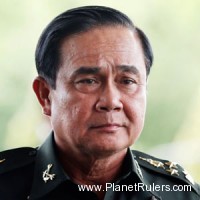 Prayut Chan-o-cha (previously spelt Prayuth Chan-ocha; Thai: ประยุทธ์ จันทร์โอชา; IPA: [prà.jút tɕān.ʔōː.tɕʰāː]; born 21 March 1954) is a retired Thai army officer who is now (2015) the Prime Minister of Thailand and head of the National Council for Peace and Order (NCPO), a military junta that has the power to control the prime minister. Prayut is a former Commander in Chief of the Royal Thai Army, the post he held from October 2010 to October 2014. After his appointment as army chief, Prayut was characterised as a strong royalist and an opponent of former prime minister Thaksin Shinawatra. Considered a hardliner within the military, he was one of the leading proponents of military crackdowns on the “Red Shirt” demonstrations of April 2009 and April–May 2010. He later sought to moderate his profile, talking to relatives of protesters who were killed in the bloody conflict, and co-operating with the government of Yingluck Shinawatra who won parliamentary election in July 2011. During the political crisis that began in November 2013 and involved protests against the caretaker government of Yingluck, Prayut claimed that the army was neutral, and would not launch a coup. However, in May 2014, Prayut unexpectedly launched a military coup against the government and then assumed control of the country as NCPO leader. He later issued an interim constitution granting himself sweeping powers and giving himself amnesty for staging the coup. In August 2014, a military-dominated national legislature, whose members were handpicked by Prayut, elected him as the new prime minister. After seizing power, Prayut launched crackdowns on dissent. He required all students in Thai schools to recite the “twelve values” as formulated by him. He has also banned public discussion about democracy and any criticism of his government. Source: https://en.wikipedia.org/wiki/Prayut_Chan-o-cha
Yingluck Shinawatra, Former Prime Minister of Thailand (since August 5, 2011)
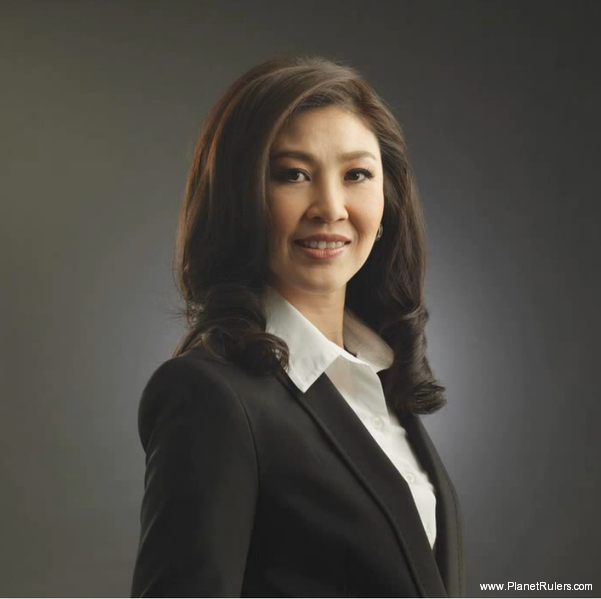 Yingluck Shinawatra (born 21 June 1967), or nickname Pu, is a Thai businesswoman and politician, member of the Pheu Thai Party, and the 28th Prime Minister of Thailand following the 2011 general election. Yingluck is Thailand’s first female Prime Minister. Born in Chiang Mai province, Yingluck Shinawatra earned bachelor’s degree from Chiang Mai University and master’s degree from Kentucky State University, both in public administration. She became an executive in the businesses founded by her elder brother, Thaksin Shinawatra, and later became the president of property developer SC Asset and managing director of Advanced Info Service. Meanwhile, her brother Thaksin became Prime Minister, was overthrown in a military coup, and went into self-imposed exile after a tribunal convicted him of abuse of power. In May 2011, the Pheu Thai Party, which maintained close ties to Thaksin, nominated Yingluck as their candidate for Prime Minister in the 2011 general election. Preliminary election result indicated that Pheu Thai won a landslide victory 265 out of 500-seat House of Representatives of Thailand, making it only the second time in Thai political history that a single party won a parliamentary majority. Yingluck’s great-grandfather, Seng Saekhu, was a overseas Chinese from Guangdong who arrived in Siam in the 1860s and settled in Chiang Mai in 1908. His eldest son, Chiang Saekhu, was born in Chanthaburi province in 1890 and married a Thai woman, called Saeng Somna. Chiang’s eldest son, Sak, adopted the Thai surname Shinawatra (“routinely appropriate action”) in 1938. The Khu/Shinawatra later founded Shinawatra Silks and then moved into finance, construction and real estate development. Yingluck’s father, Lert, was born at Chiang Mai in 1919 and married Yindi Ramingwong (a daughter of Princess Jantip Na Chiang Mai). In 1968, Lert Shinawatra entered politics and became an MP for Chiang Mai and deputy leader of the now-defunct Liberal party. Left quit politics in 1976 and opened a coffee shop, grew oranges and flowers in Chiang Mai’s San Kamphaeng district, and opened two movie theatres, a gas station, and a car and motorcycle dealership. Yingluck Shinawatra is the youngest of nine children of Lert and Yindee. She was given the nickname Pou (Thai: ปู, meaning “crab”). Yingluck grew up in Chiang Mai and attended Regina Coeli College, a girls school, at the lower secondary level and then Yupparaj College, a co-ed school, at the upper secondary level.[8] She graduated with a BA degree from the Faculty of Political Science and Public Administration, Chiang Mai University in 1988 and earned a MPA degree (specialization in Management Information Systems) from Kentucky State University in 1991. Yingluck started her career as a sales and marketing intern at Shinawatra Directories Co., Ltd., a telephone directory business founded by AT&T International. She later became the director of procurement and the director of operations. In 1994, she became the general manager of Rainbow Media, a subsidiary of International Broadcasting Corporation (which later became TrueVisions). She left as Deputy CEO of IBC in 2002, and became the CEO of Advanced Info Service (AIS), Thailand’s largest mobile phone operator. After the sale of Shin Corporation (the parent company of AIS) to Temasek Holdings, Yingluck resigned from AIS, but remained Managing Director of SC Asset Co Ltd, the Shinawatra family property development company. She was investigated by Thailand’s Securities and Exchange Commission regarding possible insider trading after she sold shares of her AIS stock for a profit prior to the sale of the Shin Corporation to Temasek Holdings. No charges were filed.[10] Yingluck Shinawatra is also a committee member and secretary of the Thaicom Foundation. She has one son, Supasek, with her common-law husband, Anusorn Amornchat. Anusorn was an executive of the Charoen Pokphand Group and managing director of M Link Asia Corporation PCL. Her sister, Yaowapa Wongsawat, is the wife of former prime minister Somchai Wongsawat. Source: Wikipedia
Abhisit Vejjajiva, Former Prime Minister of Thailand
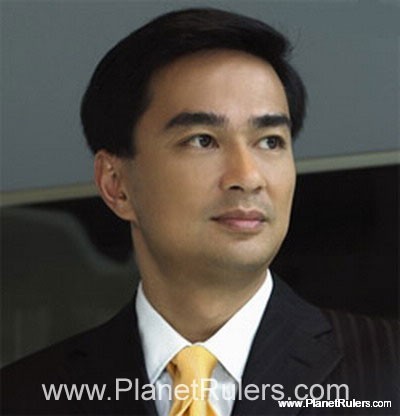 Abhisit Vejjajiva, born (3 August 1964) is the incumbent Prime Minister of Thailand. He has been the leader of the Democrat Party since February 2005, first serving as opposition leader in the House of Representatives of Thailand, which on 15 December 2008, elected him the 27th Prime Minister of Thailand. Vejjajiva, was formally endorsed by King Bhumibol Adulyadej as Prime Minister on 17 December 2008.Abhisit was born in Newcastle-upon-Tyne, England to a family of Thai physicians. He was educated at Eton and Oxford and successfully ran for MP of Bangkok under the Democrat Party following the 1991 NPKC military coup. He quickly rose through party ranks before failing in a bid to become party leader in 2001. He was appointed party leader after the Democrat Party’s overwhelming defeat in the 2005 elections. During the 2005-2006 Thai political crisis, Abhisit called for King Bhumibol to find a replacement for then Prime Minister Thaksin Shinawatra. Under Abhisit’s leadership, senior Democrat Party members accused Thaksin of what they called the Finland Plot, a supposed plan by Thaksin to overthrow Bhumibol. Abhisit boycotted the 2006 elections and by-elections, claiming that the elections were just a means to “divert public attention” from the Shin Corp scandal. Abhisit voiced displeasure at the 2006 coup that overthrew Thaksin, but otherwise did not protest it or the military junta that ruled Thailand for over a year. A fact-finding panel at the Attorney-General’s Office found that the Democrat Party bribed other parties to boycott the 2006 elections to force a constitutional crisis, and voted to dissolve the party. A junta tribunal acquitted Abhisit and the Democrats of the vote fraud charges, while banning Thaksin’s Thai Rak Thai party for similar charges. Abhisit supported the junta’s 2007 Constitution, calling it an improvement on the 1997 Constitution. He promised to amend any constitutional deficiencies if he won junta-administered elections in December 2007. However, despite a new populist policy platform, the Democrat Party lost the 2007 election to the People’s Power Party. In the crisis that followed, several senior members of the Democrat Party became leaders of the People’s Alliance for Democracy, which seized Government House, Don Muang Airport, and Suvarnabhumi Airport, while engaging in violent clashes with police and anti-PAD protesters. Abhisit voiced displeasure at sieges, but did not stop his Democrat Party deputies from their roles in the PAD. At the height of the airport sieges, the PAD openly said that the only person they would accept as Premier was Abhisit. The sieges ended when the Constitutional Court banned the People’s Power Party. Several members of the PPP defected to the Democrat Party, allowing Abhisit to form a government and become Prime Minister of Thailand. Army commander and co-leader of the 2006 coup, General Anupong Paochinda, was widely reported to have encouraged or coerced MPs to defect. PAD leader Khamnoon Sitthisamarn and junta-appointed Senator called Abhisit’s premiership a “genuine PAD victory” and a “Anupong-style coup d’etat.”The circumstances of his ascent to power closely linked Abhisit to the Bangkok elite, the Army and the Royal Palace.
Mr. Somchai Wongsawat, Former Prime Minister of Thailand
Date of Birth August 31, 1947 Marital Status Married Address 100/159 Soi 23/2 Chonlada Village, Bangkruay – Sainoi Rd., Bangbuathong, Nonthaburi Educational Background 2002 Master of Public Administration (Public and Private Management (MPPM)), National Institute of Development Administration 1996 National Defense College of Thailand 1973 Barrister-at-Law, the Thai Bar 1970 Bachelor of Laws, Thammasat University Work Experience February 6, 2008 – Present Minister of Education 2008 Committee Member of the Thai Bar under the patronage of His Majesty the King 2007 Member of the House of Representatives (Party List) 2007 Deputy Leader of People Power Party March, 8-September, 2006 Permanent Secretary, Ministry of Labour November 11, 1999 – March, 2006 Permanent Secretary, Ministry of Justice 1998-1999 Deputy Permanent Secretary, Ministry of Justice 1997 Chief Justice, Court of Appeal Region II 1993 Justice, Court of Appeal Region III 1990 Chief Justice, Thonburi Criminal Court 1989 Chief Justice, Nonthaburi Court 1988 Chief Justice, Chonburi Court 1987 Chief Justice, Rayong Juvenile Court 1986 Chief Justice, Pang-nga Court 1983 Judge, Chiangrai Court 1977 Judge, Chiangmai Court 1976 Judge, Chiangmai-Kwaeng Court 1975 Judge, Ministry of Justice 1974 Assistant Judge, Ministry of Justice Other experience 1999-2006 Chairman of Committee (Laws field), National Research Council of Thailand Member of Board, Electricity Generating Authority of Thailand Member of Board, Electricity Generating Public Company Limited Member of Board, Krung Thai Bank Public Company Limited Member of Board, PTT Public Company Limited Member of Board, Airport of Thailand Company Limited Member of Board, Thai Oil Public Company Limited Member of Committee, Office of the Narcotics Control Board Member of Committee, Anti Money Laundering Board Member of Committee, the Council of State Member of Committee, Board of Royal Thai Police Member of Committee, the Civil Service Commission Member of Committee, Attorney Commission Member of Committee, Judiciary Commission Member of Committee, the Government Lottery Office Decorations 1999 Chakrabarti Mala Medal 1997 Knight Grand Cordon (Special Class) of the Most Exalted Order of the White Elephant 1992 Knight Grand Cordon (Special Class) of the Most Noble Order of the Crown of Thailand 1989 Knight Grand Cross (First Class) of the Most Exalted Order of the White Elephant 1986 Knight Grand Cross (First Class) of the Most Noble Order of the Crown of Thailand 1984 Knight Commander (Second Class) of the Most Exalted Order of the White Elephant 1980 Knight Commander (Second Class) of the Most Noble Order of the Crown of Thailand Surayut Chulanon, Former Prime Minister of Thailand Date of Birth + 28 August 1943 Marital Status + Married to Colonel Khunying Chitravadee Chulanont, WRTA Education + Royal Thai Military Academy (B.S.) + Infantry Center School + Joint Staff College, Thailand + Joint Staff College, USA + Resource Management Program, Ministry of Defence, USA + National Defence College (1993) Previous Position # Privy Councillor (from 14 November 2003) # Member of the Executive Committee of the Anandamahidol Foundation (2003) # Supreme Commander # Commander in Chief, Royal Thai Army # Commanding General, Second Army Area # Commanding General, Special Warfare Command Thai Decorations # Knight Grand Commander (Second Class, higher grade) of the Most Illustrious Oder of Chula Chom Kloa (2001) # Knight Grand Cordon (Special Class) of the Most Exalted Order of the White Elephant (1995) # Knight Grand Cordon (Special Class) of the Most Noble Order of the Crown of Thailand (1992) # Member of “The Rama Medal” of the Honorable Order of Rama (1990) # Freeman Safeguarding Medal (First Class) (1974)