
Recep Tayyip Erdoğan, President of Turkey
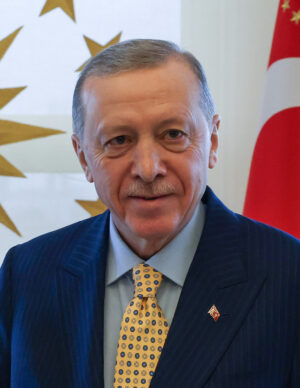
Recep Tayyip Erdoğan (born 26 February 1954) is a Turkish politician who has served as President of Turkey since 28 August 2014. He previously served as Prime Minister from March 2003 to August 2014, and as Mayor of Istanbul from 1994 to 1998. Combining his years at the head of government with his years as head of state, he has been Turkey’s dominant political figure for more than two decades, making him the longest-continuously-serving leader in modern Turkish history.
Early political career
Erdoğan was born in the Kasımpaşa district of Istanbul and studied business administration at Marmara University. He entered politics through the Islamist Welfare Party (Refah Partisi) and served as mayor of Istanbul from 1994 until 1998, when he was imprisoned for four months for reciting a poem judged to incite religious hatred. Following the ban of the Welfare Party, he co-founded the Justice and Development Party (AKP) in 2001, which won a parliamentary majority in 2002 and has governed Turkey continuously since.
Prime Minister and rise to the presidency
Erdoğan became Prime Minister in March 2003 and led the AKP to three successive general election victories in 2002, 2007 and 2011. His early tenure was associated with robust economic growth, major infrastructure investment, and progress in EU accession talks. From around 2011 onward his government drew increasing criticism for authoritarian drift, illustrated by the crackdown on the 2013 Gezi Park protests. He was directly elected President in August 2014 in Turkey’s first popular presidential election.
2016 coup and presidential system
On 15 July 2016 a faction within the Turkish Armed Forces attempted a coup against Erdoğan’s government. The coup failed and was followed by a sweeping purge: more than 150,000 civil servants, military officers, judges, academics and journalists were detained, dismissed or prosecuted. In a 2017 constitutional referendum, Turkey abolished the post of Prime Minister and adopted an executive presidential system, vastly expanding Erdoğan’s formal powers. He won the first election under the new system in 2018 and was re-elected in the 28 May 2023 run-off with 52.2% of the vote against Kemal Kılıçdaroğlu.
Human rights and governance record
Turkey under Erdoğan has seen a sharp decline in press freedom, judicial independence, and civil liberties. Freedom House downgraded Turkey from “Partly Free” to “Not Free” in 2018 and it has remained so since. The country routinely ranks near the bottom of the Reporters Without Borders World Press Freedom Index. Major ongoing issues include the continuing pre-trial detention of journalists and opposition politicians (including Istanbul mayor Ekrem İmamoğlu, imprisoned in March 2025), the imprisonment of former People’s Democratic Party (HDP) co-leader Selahattin Demirtaş in defiance of ECHR rulings, and tensions with the EU over rule-of-law backsliding.
Foreign policy
Erdoğan has pursued a more assertive foreign policy characterised as “neo-Ottoman”. Turkey is a NATO member and a long-standing EU accession candidate, but relations with the West have been strained by the country’s 2019 purchase of Russian S-400 air-defence systems, intermittent clashes with Greece in the Aegean, interventions in Syria and Libya, and the multi-year block on Sweden’s NATO accession (eventually approved in January 2024). Turkey has also played a mediating role in the Russia-Ukraine war, notably brokering the 2022 Black Sea Grain Initiative.
At a glance
| Full name | Recep Tayyip Erdoğan |
|---|---|
| Born | 26 February 1954, Istanbul, Turkey |
| Office | President of the Republic of Turkey |
| In office since | 28 August 2014 (Prime Minister 2003–2014) |
| Most recent election | 28 May 2023 — 52.2% (run-off) |
| Party | Justice and Development Party (AKP) |
| System | Executive presidential (since 2018) |
| Human rights | Freedom House: Not Free (since 2018) |
Frequently asked questions
Click a question to expand the answer.
Who is the president of Turkey in 2026?
Recep Tayyip Erdoğan has been President of Turkey since 28 August 2014. He was re-elected in the 28 May 2023 run-off with 52.2% of the vote. Combined with his years as Prime Minister (2003–2014) he has led Turkey for more than two decades.
How old is Recep Tayyip Erdoğan?
Erdoğan was born on 26 February 1954, which makes him 72 in April 2026.
When does Erdoğan’s term end?
His current term, won in May 2023, runs until 2028. Under the 2018 constitutional structure the president serves a five-year term renewable once, but legal scholars disagree on whether his 2023 election counts as a second term (which would make him ineligible) or a first term under the new system (which would allow one more).
Is Turkey a dictatorship?
Turkey is classified by Freedom House as “Not Free” and by The Economist Democracy Index as a “hybrid regime”. Elections remain competitive but the media, judiciary and civil society operate under severe constraints. Critics describe the system as a competitive authoritarian regime.
What happened in the 2016 Turkish coup attempt?
On the night of 15–16 July 2016, a faction within the Turkish Armed Forces attempted to overthrow Erdoğan’s government. It failed within hours. Erdoğan’s government declared a state of emergency and purged more than 150,000 civil servants, military officers, judges, academics and journalists. The government attributed the coup to the movement of U.S.-based cleric Fethullah Gülen.
Who is Ekrem İmamoğlu?
Ekrem İmamoğlu is the mayor of Istanbul and a leader of the opposition Republican People’s Party (CHP). He was jailed in March 2025 on corruption charges widely seen as politically motivated, triggering mass protests across Turkey and drawing condemnation from Western governments.
Is Turkey still in NATO?
Yes. Turkey has been a NATO member since 1952 and hosts the Alliance’s second-largest standing army. It has a complicated relationship with NATO, notably its 2019 purchase of Russian S-400 air-defence systems and its multi-year block on Sweden’s NATO accession (ratified January 2024).
Abdullah Gül, President of Turkey
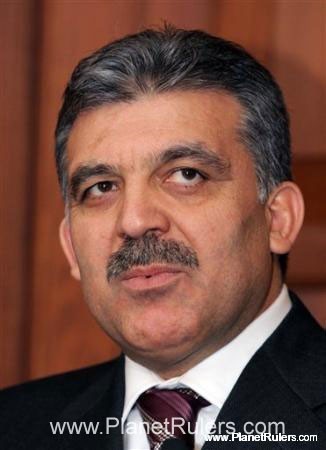 Sayin Abdullah Gül, GCB, Ph.D (born October 29, 1950) is the 11th President of the Republic of Turkey, serving in that office since 28 August 2007. He previously served for five months as Prime Minister (2002-2003), and as Foreign Minister from 2003 to 2007. Prime Minister Recep Tayyip Erdogan’s selection of Gül as a presidential candidate drew strong and highly vocal opposition from ardent supporters of secularism in Turkey. In May 2007, Gül’s first bid for presidency was blocked by the Constitutional Court, in a climate of secularist concern regarding views Gül had expressed during his Welfare Party years, and the fact that his wife, Hayrünnisa Gül, wears a headscarf, seen by some as a symbol of political Islam. However, following the parliamentary elections in July the same year, which were won by the AKP with 46.6% of the popular vote, he was eventually elected President on August 28, 2007 and was sworn in the same day, becoming the first former-Islamist President in the modern history of Turkey, which has been described as a “new era in Turkish politics”. In September 2008 he became the first Turkish leader to visit neighbouring Armenia, sparking a major debate in Turkey. Ahmet Necdet Sezer, Former President of Turkey
 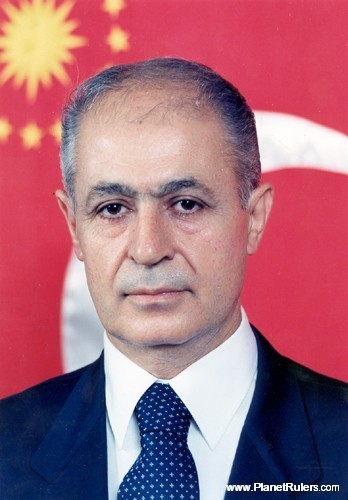 Ahmet Necdet Sezer was born on 13 September 1941 in Afyon. He graduated from Afyon High School in 1958. He graduated from the Ankara University Faculty of Law in 1962 and began his career as a judge in Ankara. Following his military service at the Military Academy, he served first as a judge in Dicle and Yerköy, and later as a supervisory judge in the High Court of Appeals in Ankara. In 1978 he received LL.M. in civil law in Ankara University Faculty of Law. On 7 March 1983, he was elected as a member to the High Court of Appeals. As he was a member in the Second Chamber of Law, Sezer was recommended to the president by the plenary assembly of the High Court of Appeals among the three candidates for appointment as member of the Constitutional Court. On 27 September 1988, he was appointed by the president as member of the Constitutional Court. On 6 January 1998, he was elected chief justice of the Constitutional Court. Ahmet Necdet Sezer was elected as the tenth president by the Turkish Grand National Assembly on 5 May 2000 and assumed his duties on 16 May 2000. President Sezer married Semra in 1964 and has three children.