
Shavkat Mirziyoyev, President of Uzbekistan

Shavkat Miromonovich Mirziyoyev is the 2nd President of Uzbekistan, in office since 14 December 2016. He succeeded Islam Karimov — who had ruled since 1990 and died in September 2016 — and was formally elected in December 2016 with 88.6%. He won a second five-year term in October 2021 (80.1%). An April 2023 constitutional referendum extended presidential terms from five to seven years and reset the term-count clock; Mirziyoyev then won a snap election on 9 July 2023 with an officially reported 87.05%, beginning a new seven-year term that runs until 2030. He may serve one further seven-year term, potentially extending his rule to 2037.
Rise and reform agenda
Mirziyoyev was born on 24 July 1957 in Jizzakh Region. He served as governor of Jizzakh (1996–2001) and Samarkand (2001–2003) regions before becoming Prime Minister in December 2003, a post he held for 13 years under Karimov. On Karimov’s death he was named Acting President over the constitutionally designated Senate Chairman Nigmatilla Yuldashev — an extralegal succession that nevertheless established his authority. In office he launched an ambitious reform agenda: market-based currency liberalisation in 2017, the release of most political prisoners from the Karimov era, abolition of the exit-visa system, and permitting some civil-society groups to operate. Uzbekistan has become the largest foreign-direct-investment recipient in Central Asia.
Karakalpakstan crisis
On 1 July 2022 draft constitutional amendments published by Mirziyoyev would have removed the autonomous status of Karakalpakstan. Protests in Nukus, the Karakalpak capital, escalated into several days of unrest in which official figures put the death toll at 21 (rights groups say higher). Mirziyoyev withdrew the offending clauses and the April 2023 referendum kept Karakalpakstan’s autonomy intact. At least 22 people were later sentenced to long prison terms for their role in the protests.
Foreign policy
Uzbekistan has revived the “Tashkent Principles” of active neutrality: it is not a member of the Russian-led CSTO or EAEU, maintains strong economic ties with Russia and China, and has rapidly expanded engagement with the EU, Turkey, South Korea, and the Gulf states. Mirziyoyev has normalised relations with all four Central Asian neighbours — Turkmenistan, Kazakhstan, Tajikistan, and Kyrgyzstan — including the September 2022 Qyrgyzstan–Uzbekistan border agreement that resolved the last major disputed section.
Human rights
Freedom House rates Uzbekistan “Not Free” (12/100) — an improvement from Karimov-era scores but still indicative of significant restrictions. Independent political parties remain effectively barred; all five legal parties backed Mirziyoyev’s 2023 candidacy. Forced cotton-harvest labour has been largely ended and Uzbekistan was removed from the Cotton Campaign boycott list in 2022. Religious-freedom restrictions on Muslim practice outside state-registered mosques remain tight.
| Full name | Shavkat Miromonovich Mirziyoyev |
|---|---|
| Born | 24 July 1957 · Jizzakh Region, Uzbek SSR (age 68) |
| Office | President of Uzbekistan (2nd) |
| In office since | 14 December 2016 (current 7-year term from 14 July 2023) |
| Predecessor | Islam Karimov (1990–2016, died in office) |
| Prime Minister | Abdulla Aripov (since December 2016) |
| Party | Uzbekistan Liberal Democratic Party (UzLiDeP) |
| Spouse | Ziroat Hoshimova |
| Children | 3 (daughters Saida and Shahnoza) |
| Education | Tashkent Institute of Irrigation and Melioration |
| 2023 result | 87.05% — 7-year term to 2030 |
| Human rights rating | Freedom House: Not Free (12/100) |
Frequently asked questions
Who is the current President of Uzbekistan in 2026?
Shavkat Mirziyoyev has been President of Uzbekistan since 14 December 2016 and is serving a seven-year term that runs until 2030.
How old is Mirziyoyev?
Mirziyoyev was born on 24 July 1957 in Jizzakh Region and is 68 years old as of April 2026.
How did Mirziyoyev come to power?
He served as Prime Minister under Islam Karimov for 13 years (2003–2016). On Karimov’s death in September 2016 he was named Acting President and formally elected on 4 December 2016 with 88.6%.
What was the 2023 constitutional referendum?
On 30 April 2023 Uzbekistan approved a new constitution that extended presidential terms from five to seven years and reset the two-term clock, allowing Mirziyoyev to stand again in July 2023.
What happened in Karakalpakstan in 2022?
Protests against draft constitutional amendments that would have removed Karakalpakstan’s autonomous status escalated into days of unrest in Nukus in July 2022. Official toll was 21 killed; Mirziyoyev withdrew the offending clauses.
Is Uzbekistan a democracy?
No. Uzbekistan has multi-party elections on paper but no genuine opposition. Freedom House rates the country Not Free (12/100).
When does Mirziyoyev’s term end?
His current seven-year term runs until 2030. He may serve one further term, potentially until 2037.
Islam Abdughanievich Karimov, Former President of Uzbekistan (re-elected on Mar 29, 2015 with 90.4% of the votes. Died on Sept 2, 2016)
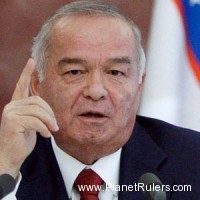 The words “first”, “for the first time”, “never before” have been used more often and insistently lately when talking about Uzbekistan. After 1989, the days of the republic were full of so many events and phenomena that it would be sufficient for dozens of years in other times. Among them was the declaration of independence of Uzbekistan, the establishment of the presidency and democratic election of the President of The Republic, first in its history, and formation of new law governed state. Islam Abdughanievich Karimov was born on the 30th of January, 1938 in Samarkand. His father was an office worker. After finishing school he entered the Central Asian Politechnical Institute and received the profession of a mechanical engineer. Later he graduated from the Tashkent Institute of National Economy. He has a number of scientific publications, a doctorate in Economics and also is the Honorary Doctor of a number of foreign universities. Islam Karimov’s working career started at the Tashkent Farm Machinery Plant where he worked as an assistant foreman and technologist foreman. A considerable part of his life is linked with the Tashkent Aircraft-Making Plant – a major manufacturer of cargo planes in the former USSR, where Islam Karimov worked as an engineer and leading design engineer. From 1966 on Islam Karimov works as a government employee, initially at the State Planning Committee of Uzbekistan where he went all the way through from leading specialist of a department to the first Vice-Chairman of the State Planning Committee. In 1983 Islam Karimov was appointed Minister of Finance of Uzbekistan, in 1986 – Vice-Chairman of the Council of Ministers – Deputy Head of Government – and simultaneously Chairman of the State Planning Committee. Till mid eighties few dared to assume that a simple State Planning Committee officer, albeit one with original opinions and approaches, referred to as a competent but rather uncomfortable person who was able to defend his ideas in front of his chiefs, would become a mighty generator of political and economical renovation of the Republic which led to the sovereignty of Uzbekistan. In June 1989 Islam Karimov actually headed the Republic after being elected First Secretary of the Uzbekistan Communist Party Central Committee. He deserves all merit for reformation of the Communist Party and its transformation into People’s Democratic Party (November 1991) with completely new ideology and policy. On the 24th of March 1990 Islam Karimov was elected President of the Republic at the Session of the Supreme Council of the Uzbek SSR. On the 29th of December 1991 Islam Karimov again won the mandate of the people at the first nationwide presidential elections held on an alternative basis. More than 86 per cent of the constituency voted in his favor. Of course President Islam Karimov is married. His spouse – Tatiana Akbarovna – is a researcher at the Institute of Economy under the Academy of Sciences of Uzbekistan. They have two daughters and three grandchildren. Detailed Biography: He began work in 1960 at Tashselmash. From 1961-66 he worked as an engineer, a leading engineer-constructor at the Chkalov Tashkent aviation production complex. In 1966 he started work at the State planning office of the UzSSR where he worked as chief specialist and later as first deputy chairman of the State planning office. In 1983 I. Karimov was appointed Minister of finance of the UzSSR, in 1986 – deputy chairman of the Council of Ministers of the UzSSR and chairman of the State planning office. In 1986-89 he was first secretary of the Kashkadarya provincial party committee. From June 1989 – first secretary of the Central committee of the Communist Party of Uzbekistan. On March 24, 1990, he was elected President of the Uzbek SSR. On August 31, 1991, he declared the independence of the Republic of Uzbekistan. On December 29, 1991 he was elected President of the Republic of Uzbekistan in multi-candidate elections. On March 26, 1995, in accordance with a national referendum, his period in office was extended to 2000. For his outstanding contribution to education in Uzbekistan, creation of a state based on democratic laws, guarantee of civil peace and national accord, and for courage, I. Karimov was awarded the title Hero of Uzbekistan and the awards Mustakillik (Independence) and Amir Timur. He has received awards from foreign states and international organizations. He is a full member of the Academy of sciences of Uzbekistan. For his contribution to economics, science, and education he was awarded honorary doctorates from 9 foreign institutions. He is the initiator and leader of historic transformations in our country. He has directly contributed to: -a program of independent development of the country, and the Constitution, meeting democratic demands and international criteria; -a new program of state and social construction, reform of administration, both central and locally, the realization of principles harmonizing the interests of the state, society and the individual; -a new respected model of economic development based on five principles: de-ideologization of the economy, supremacy of laws, step-by-step reform, state regulation during the transition period and strong social policy; -reform of the armed forces, border forces; I. Karimov has: -a strong will, self-confidence and courage, defending the honor and dignity of the Uzbek people. When he headed the Central committee of the Communist Party, others tried to blacken his name, producing lawlessness and persecution; -raised to the level of state policy respectful relations to the spiritual values of our nation, renewal and development of our sacred religion, traditions and customs, the priceless heritage of the people; -raised the international respect for Uzbekistan; -contributed to the formation in social awareness of the basis of national ideology and the value of traditions; -made a great contribution to establishing, preserving and strengthening peace and national accord; -been the author and initiator of ideas to create and execute the National program for preparing specialists; -done much to raise the authority of the makhalla (community) in social-political life, increasing its rights and authority; -been the initiator of construction of large enterprises, cultural buildings, communications networks, giving a strong impulse to economic development, transforming the face of many cities and villages, above all the capital Tashkent, and providing respectful places dedicated to the dignity of our great ancestors. Under his leadership, the basis of national sovereignty and civil society has been created, as well as conditions for strengthening peace, priorities for stable development and prosperity of multiethnic Uzbekistan in the new century.