
Delcy Rodríguez, Acting President of Venezuela

Delcy Eloína Rodríguez Gómez has served as Acting President of Venezuela since 5 January 2026, two days after the United States captured sitting president Nicolás Maduro in a military operation on Venezuelan territory and transferred him to Miami to face federal criminal charges. Rodríguez, a lawyer and long-serving PSUV loyalist, is the first woman in Venezuelan history to exercise the powers of the presidency. Her accession broke no new constitutional ground within Chavismo — as Vice President since 14 June 2018, she was the constitutionally designated successor — but it marked the abrupt end of the thirteen-year Maduro era and the opening of an uncertain transitional phase inside the ruling socialist bloc.
Rodríguez was born on 18 May 1969 in Caracas to Jorge Antonio Rodríguez, a prominent Marxist militant of the 1970s Liga Socialista who died in state custody in 1976, and Delcy Gómez. She studied law at the Central University of Venezuela and worked as an academic and diplomat before entering national politics alongside her elder brother, Jorge Rodríguez Gómez, now the long-serving president of the National Assembly. She served as Minister of Communication and Information (2013–2014), Foreign Minister (2017–2018), and Vice President of the Council of Ministers throughout Maduro’s second and third terms. In practice she ran much of the economic policy brief, including oil-sector relations with China, Russia, Iran and — from 2023 — the short-lived Barbados Agreement sanctions-relief track with the United States.
The 5 January 2026 Succession
On 3 January 2026, a US Joint Special Operations Command task force — operating under an executive order that designated the Cartel de los Soles a foreign terrorist organization — detained Maduro and his wife Cilia Flores after an armed operation at Fuerte Tiuna in Caracas and evacuated them by air to Homestead Air Reserve Base in Florida. The Venezuelan high command, fractured by months of defections, did not move to prevent the extraction. On 5 January 2026, the National Assembly’s governing bloc convened an emergency session and recognised Vice President Rodríguez as Acting President pending what it described as a “sovereign national consultation” — a referendum on early elections promised for no later than December 2026.
Government and Allies
Rodríguez has retained most of Maduro’s cabinet and the full PSUV apparatus led by Diosdado Cabello. Defence Minister Vladimir Padrino López, Interior Minister Remigio Ceballos and National Assembly president Jorge Rodríguez remain in place. The Venezuelan military continues to recognise her authority. The opposition Plataforma Unitaria Democrática, whose candidate Edmundo González was proclaimed winner of the July 2024 election by independent tallies, rejects the succession and continues to recognise González as president-elect under the transition statute passed in Panama in August 2024.
International recognition remains split. Cuba, Nicaragua, Russia, Iran, China, Belarus, Syria and Bolivia have formally recognised Rodríguez’s acting presidency. The United States, the European Union, the United Kingdom, Canada, most of the Lima Group and Argentina continue to recognise González. Brazil, Mexico and Colombia have taken ambivalent positions calling for fresh internationally supervised elections.
Nicolás Maduro: Thirteen Years in Power (2013–2026)
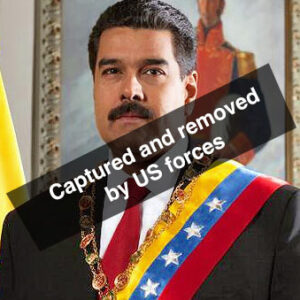 Nicolás Maduro Moros was born on 23 November 1962 in Caracas into a working-class family. He began his career as a Caracas Metro bus driver and in 1991 founded and led the metro workers’ union, SITRAMECA. His early political formation included a year of ideological training in Cuba in 1986. He entered formal politics through Hugo Chávez’s Bolivarian movement, winning election to the National Assembly in 2000. Chávez appointed him Foreign Minister in 2006 — a post he held until 2012 — then Vice President in October 2012 as the ailing leader’s health deteriorated. When Chávez died of cancer on 5 March 2013, Maduro became interim president and went on to win the April 2013 special election by just 1.5 percentage points against Henrique Capriles.
Authoritarian Consolidation and Economic Collapse
Over the following years Maduro consolidated control over Venezuela’s judiciary, military and electoral institutions. He was re-elected in May 2018 in a vote boycotted by the mainstream opposition and dismissed as illegitimate by some 60 countries. Hyperinflation peaked at roughly 130,000% in 2018; GDP contracted by more than three-quarters between 2013 and 2021. More than 7.7 million Venezuelans had left the country by end-2024, the largest displacement crisis in the Western Hemisphere. The Organization of American States and successive UN fact-finding missions documented systematic persecution of dissidents, torture of detainees and crimes against humanity.
The 2024 Contested Election
In the 28 July 2024 presidential election, the National Electoral Council (CNE) proclaimed Maduro re-elected with 51.2% without publishing disaggregated results. The opposition published scanned copies of more than 80% of voting-machine tallies showing opposition candidate Edmundo González ahead by roughly a two-to-one margin. Protests erupted across the country; more than 2,000 people were detained and at least 25 killed. Maduro was nonetheless sworn in for a third term on 10 January 2025.
US Indictment and Capture
Maduro was indicted in the Southern District of New York in March 2020 on charges of narco-terrorism, cocaine importation conspiracy, and illegal possession of machine guns. Prosecutors alleged that Maduro used state power to facilitate the export of thousands of tonnes of cocaine to North America in coordination with Colombia’s FARC guerrillas and the Cartel de los Soles network inside the Venezuelan military. The US State Department raised the bounty on his capture to US$50 million in early 2025. Following his 3 January 2026 capture and extradition, Maduro and Flores entered not-guilty pleas at a federal hearing in Miami. As of April 2026 he remains in US custody awaiting trial.
| Full name | Delcy Eloína Rodríguez Gómez |
|---|---|
| Born | 18 May 1969 · Caracas (age 56) |
| Office | Acting President of Venezuela |
| In office since | 5 January 2026 |
| Predecessor | Nicolás Maduro (captured, in US custody) |
| Previous post | 24th Vice President of Venezuela (2018–2026) |
| Party | United Socialist Party of Venezuela (PSUV) |
| Education | Central University of Venezuela (law) |
| Capital | Caracas |
| Human rights rating | Freedom House: Not Free (16/100) |
Frequently asked questions
Who is the current president of Venezuela in 2026?
Delcy Rodríguez has been Acting President of Venezuela since 5 January 2026, after US forces captured her predecessor Nicolás Maduro on 3 January 2026 and transferred him to Miami to face narco-terrorism charges. She is the first woman to exercise Venezuela’s presidential powers.
What happened to Nicolás Maduro?
Maduro and his wife Cilia Flores were detained on 3 January 2026 in a US Joint Special Operations Command operation at Fuerte Tiuna in Caracas and flown to Homestead Air Reserve Base in Florida. He has pleaded not guilty in federal court in Miami and remains in US custody awaiting trial.
Is Rodríguez’s presidency recognised internationally?
No. Cuba, Nicaragua, Russia, China, Iran, Belarus, Syria and Bolivia recognise her acting presidency. The United States, the European Union, the United Kingdom, Canada and most of the Americas continue to recognise opposition candidate Edmundo González — proclaimed the winner of the July 2024 election by independent tallies — as president-elect.
How old is Delcy Rodríguez?
She was born on 18 May 1969 in Caracas and is 56 years old as of April 2026.
When will Venezuela hold fresh elections?
Rodríguez’s government has promised a “sovereign national consultation” leading to early elections by December 2026. The opposition and most democratic governments argue that the 2024 election already produced a winner — Edmundo González — and reject the proposed new vote.