
Rashad al-Alimi, Chair of the Presidential Leadership Council of Yemen
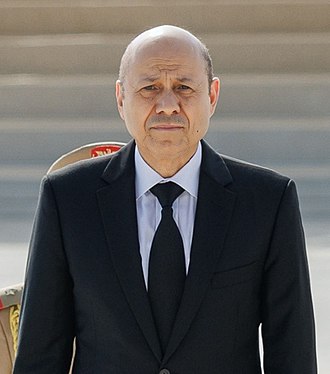
Rashad Muhammad al-Alimi has served as chair of Yemen’s Presidential Leadership Council (PLC) since 7 April 2022, functioning as the internationally recognised head of state of a country that has been partitioned by an ongoing civil war since 2014. The PLC — an eight-member collective executive based in the temporary capital Aden — was formed when President Abdrabbuh Mansur Hadi abruptly transferred his powers under Saudi and Emirati mediation at a summit in Riyadh. Al-Alimi represents the anti-Houthi government recognised by the United Nations, most Arab states, the United States, the EU and the United Kingdom. The Houthi movement (Ansar Allah), which has ruled Sana’a and the densely populated Yemeni highlands since 2014, governs its own parallel state under Mahdi al-Mashat as president of the Supreme Political Council.
Al-Alimi was born on 15 January 1954 in the village of Al-Aloom, Taiz Governorate, during the final years of the Mutawakkilite Kingdom. The son of a local judge, he completed secondary school at Nasser High in Sana’a in 1969, took a degree in military science from the Kuwait Police College in 1975, and subsequently a bachelor’s in arts from Sana’a University and a doctorate in sociology from Ain Shams University in Cairo in 1988. He joined Yemen’s security apparatus under Ali Abdullah Saleh, rising to Interior Minister (2001–2008) and Deputy Prime Minister for Security and Defence Affairs (2008–2014). After the Houthi takeover of Sana’a in September 2014, al-Alimi relocated to Riyadh, where he became one of the most senior civilian advisers to the exiled Yemeni government and a key interlocutor with Saudi intelligence.
The April 2022 Transfer of Power
On 7 April 2022, in a move widely understood to have been engineered by Saudi Crown Prince Mohammed bin Salman, President Hadi issued a decree transferring all of his executive powers to an eight-member Presidential Leadership Council and simultaneously dismissing his long-time vice president Ali Mohsen al-Ahmar. The PLC brings together leaders of every major anti-Houthi bloc: al-Alimi (General People’s Congress and a Saleh-era technocrat representing Riyadh’s interests); Aidarous al-Zoubaidi (the Abu Dhabi-backed Southern Transitional Council seeking southern independence); Tariq Saleh (Saleh’s nephew, commander of the National Resistance Forces on the Red Sea coast); and five other military and tribal figures. The council’s creation was accompanied by a Saudi-Emirati pledge of US$3 billion in budget support. The PLC has since steered a UN-mediated truce with the Houthis that held in formal terms from April to October 2022 and has continued informally, with localised violations, ever since.
The Houthi Red Sea Campaign and Ceasefire Talks
Beginning in November 2023, the Houthis launched a sustained campaign against commercial shipping in the Red Sea and Gulf of Aden in declared solidarity with Gaza, firing anti-ship missiles and drones at more than 100 vessels. US-UK air strikes against Houthi missile, radar and command sites began in January 2024. A December 2023 UN-mediated roadmap between al-Alimi’s government and the Houthis, sponsored by Oman and Saudi Arabia, collapsed in early 2024 as attacks intensified. As of April 2026 a fragile Omani-mediated bilateral contact between Riyadh and Sana’a continues; meaningful implementation of a political settlement, prisoner exchange and reopening of Sana’a airport awaits an overall Gaza truce.
Government, Territory and the Humanitarian Crisis
Al-Alimi’s PLC controls roughly 70% of Yemen’s territory by area — most of it sparsely populated — but only about 30% of its population. The Houthi-held north and west contain Sana’a, Hodeidah, Saada and the main agricultural zones. Yemen remains the world’s largest humanitarian emergency: approximately 18.2 million people need assistance in 2026 per UN OCHA, and 17.1 million are food-insecure. The Yemeni rial has split into two currencies — a stronger Houthi-issued banknote in the north and a depreciating Aden-issued one in the south — trading at roughly 2,100 Aden rials per dollar in early 2026 against 530 in Sana’a.
| Full name | Rashad Muhammad al-Alimi |
|---|---|
| Born | 15 January 1954 · Al-Aloom, Taiz Governorate (age 72) |
| Office | Chair of the Presidential Leadership Council |
| In office since | 7 April 2022 |
| Predecessor | Abdrabbuh Mansur Hadi (2012–2022) |
| Prime Minister | Salem Saleh bin Braik (since 3 May 2025; replaced Ahmed Awad bin Mubarak) |
| Party | General People’s Congress |
| Education | Kuwait Police College; Sana’a University; PhD, Ain Shams University (sociology) |
| Capital | Sana’a (de jure) · Aden (temporary seat of PLC) |
| Human rights rating | Freedom House: Not Free (9/100) |
Frequently asked questions
Who is the president of Yemen in 2026?
Rashad al-Alimi is chair of the Presidential Leadership Council (PLC), Yemen’s internationally recognised head of state, since 7 April 2022. His government is based in the temporary capital Aden. The Houthi movement controls Sana’a and the north, where Mahdi al-Mashat leads a parallel Supreme Political Council.
How old is Rashad al-Alimi?
Al-Alimi was born on 15 January 1954 in Al-Aloom village, Taiz Governorate, and is 72 years old as of April 2026.
What is the Presidential Leadership Council?
The PLC is an eight-member collective presidency created on 7 April 2022 when President Hadi transferred his powers under Saudi-Emirati mediation. It brings together the main anti-Houthi factions, with al-Alimi as chair, alongside Aidarous al-Zoubaidi of the Southern Transitional Council, Tariq Saleh and five other leaders.
Is the Yemen war over?
No. A UN-mediated truce held formally from April to October 2022 and has continued in broad outline ever since, but the Houthi Red Sea shipping campaign since November 2023 has triggered US-UK air strikes and derailed a political roadmap. Oman continues to mediate between Riyadh and the Houthis.
How bad is the humanitarian crisis?
Yemen remains the world’s largest humanitarian emergency: about 18.2 million people need assistance in 2026 and 17.1 million are food-insecure. The country’s currency has split in two, with black-market rates differing by a factor of roughly four between north and south.