
Mohamed bin Zayed Al Nahyan, President of the United Arab Emirates
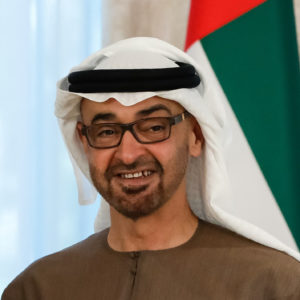
Sheikh Mohamed bin Zayed bin Sultan Al Nahyan (born 11 March 1961), commonly known as MBZ, has served as President of the United Arab Emirates since 14 May 2022 and as Ruler of Abu Dhabi, the UAE’s wealthiest emirate, since the same day. He had been the de facto leader of the country for several years before his formal elevation, owing to the extended illness of his elder half-brother, the late President Khalifa bin Zayed Al Nahyan.
Federal structure
The United Arab Emirates is a federation of seven emirates: Abu Dhabi, Dubai, Sharjah, Ajman, Umm Al Quwain, Ras Al Khaimah, and Fujairah. The Federal Supreme Council, comprising the seven hereditary rulers, elects the President from among its members. In practice the presidency has always been held by the Ruler of Abu Dhabi. The Vice President and Prime Minister is Sheikh Mohammed bin Rashid Al Maktoum, the Ruler of Dubai.
Background and career
MBZ is a son of Sheikh Zayed bin Sultan Al Nahyan, the founding father of the UAE, and his favourite wife Fatima bint Mubarak Al Ketbi. He graduated from the Royal Military Academy Sandhurst in 1979 and rose through the UAE Armed Forces to become Chief of Staff in 1993 and Deputy Supreme Commander in 2005. He served as Crown Prince of Abu Dhabi from 2004 until becoming Ruler in 2022, and during that period effectively directed the UAE’s foreign, security and economic policy, including the massive build-up of sovereign wealth funds such as Mubadala and ADIA.
Foreign policy
MBZ has been among the most consequential foreign-policy actors in the Gulf for two decades. Key initiatives include the UAE’s military participation in the Saudi-led coalition in Yemen from 2015; the 2020 Abraham Accords establishing diplomatic relations with Israel (the first Gulf state to do so); a 2023 restoration of ties with Qatar following the 2017–2021 blockade; hosting the COP28 climate summit in Dubai in November 2023; and a cautious neutrality on the Russia–Ukraine war. The UAE has invested extensively in artificial-intelligence infrastructure and has positioned itself as a neutral diplomatic hub.
Human rights and governance
The UAE is a hereditary federation with no elected national legislature. Freedom House classifies the country as “Not Free”. Political parties and independent trade unions are prohibited, criticism of rulers is a criminal offence, and migrant workers (who make up more than 85% of the workforce) face significant labour-rights restrictions under the kafala sponsorship system. Same-sex relations remain illegal. The country has, however, introduced a series of social liberalisations since 2020, including legalising alcohol consumption for non-Muslims and decriminalising cohabitation.
At a glance
| Full name | Mohamed bin Zayed bin Sultan Al Nahyan (MBZ) |
|---|---|
| Born | 11 March 1961, Al Ain, Abu Dhabi |
| Office | President of the UAE; Ruler of Abu Dhabi |
| In office since | 14 May 2022 |
| Vice President & PM | Mohammed bin Rashid Al Maktoum (Ruler of Dubai) |
| Predecessor | Khalifa bin Zayed Al Nahyan (his half-brother) |
| Education | Royal Military Academy Sandhurst (1979) |
| Human rights | Freedom House: Not Free |
Frequently asked questions
Click a question to expand the answer.
Who is the president of the UAE in 2026?
Sheikh Mohamed bin Zayed Al Nahyan (commonly known as MBZ) has served as President of the United Arab Emirates since 14 May 2022.
How old is MBZ?
He was born on 11 March 1961, which makes him 65 in April 2026.
What is the UAE’s political system?
The UAE is a federation of seven hereditary monarchies. The President is elected by the Federal Supreme Council (the seven rulers) and is in practice always the Ruler of Abu Dhabi. There is no elected national parliament.
Is the UAE a dictatorship?
The UAE is an absolute federal monarchy. Freedom House rates it “Not Free”. Political parties are banned and criticism of rulers is a criminal offence.
Who is the Prime Minister of the UAE?
Sheikh Mohammed bin Rashid Al Maktoum, the Ruler of Dubai, serves as Vice President and Prime Minister of the UAE.
What are the seven emirates?
Abu Dhabi, Dubai, Sharjah, Ajman, Umm Al Quwain, Ras Al Khaimah, and Fujairah. Abu Dhabi is the federal capital and the wealthiest emirate; Dubai is the largest commercial centre.
What was Khalifa bin Zayed’s role?
Sheikh Khalifa bin Zayed Al Nahyan was the second President of the UAE from 2004 until his death on 13 May 2022. MBZ succeeded him the following day.
Sheikh Khalifa bin Zayed Al Nahyan, Former President of the United Arab Emirates (died on May 14, 2022)
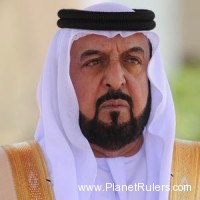 HH Sheikh Khalifa bin Zayed Al Nahyan, Ruler of Abu Dhabi, was elected as the new President of the United Arab Emirates on 3rd November, to succeed his father, the late HH Sheikh Zayed bin Sultan Al Nahyan. HH Sheikh Khalifa has committed himself to continue in the footsteps of his late father, a task that he has set himself for nearly thirty years, since he first became Crown Prince of Abu Dhabi in 1969.In a statement issued in 1990, Sheikh Khalifa said: “My father is my teacher. I learn something from him every day, follow his path and absorb from him his values, and the need for patience and prudence in all things.” Sheikh Khalifa was born in the inland oasis-city of Al Ain in 1948, where he went to school. On 18th September 1966, following his father’s assumption of the post of Ruler of Abu Dhabi, Sheikh Khalifa was appointed as Ruler’s Representative in the Eastern Region of Abu Dhabi and as Head of the Courts Department in Al Ain. On 1st February 1969, Sheikh Khalifa was nominated as the Crown Prince of Abu Dhabi, this being followed on 2nd February 1969 by his appointment as the Head of the Abu Dhabi Department of Defence, in which post he oversaw the building up of the Abu Dhabi Defence Force, ADDF, which later became the nucleus of the UAE Armed Forces. On 1st July 1971, as part of the restructuring of the Government of the Emirate, Sheikh Khalifa was appointed as Prime Minister of Abu Dhabi and Minister of Defence and Finance.On 23rd December 1973, Sheikh Khalifa assumed the post of Deputy Prime Minister in the second UAE Federal Cabinet. Shortly afterwards, when the Cabinet of Abu Dhabi Emirate was dissolved, as part of the process of strengthening the institutions of the UAE federation, Sheikh Khalifa was appointed, on 20th January 1974, as the first Chairman of the Abu Dhabi Executive Council, which replaced the Emirate’s Cabinet. Under his direction, and in accordance with the instructions of HH Sheikh Zayed, the Executive Council oversaw the implementation of a wide-ranging development programme in Abu Dhabi, including the construction of housing, water supplies and other essential services, roads and the general infrastructure that led to the emergence of the city of Ab uDhabi as the modern city that it is today. Of particular importance in terms of ensuring that citizens were able to benefit from the country’s increasing wealth was the establishment by Sheikh Khalifa in 1981 of the Abu Dhabi Department of Social Services and Commercial Buildings, charged with the provision of loans to citizens for construction. Over Dh 35 billion have so far been lent by this Department, with over 6000 multi-storey buildings being constructed throughout the Emirate. The establishment of the Department, popularly known as the ‘Khalifa Committee’, followed another decision taken by Sheikh Khalifa in 1979 to alleviate the burden on citizens of the repayment of loans from the commercial banks. This involved a fixing of the interest rate payable by citizens of loans for construction at 0.5 per cent, with the balance of the interest being charged by the banks being paid by Government. A further step to ensure that citizens were able to build the properties that they needed, both for residential and for investment purposes, came with the creation by Sheikh Khalifa of the Private Loans Authority, early in 1991. By July of that year, only a few months after the Authority was created, 11,034 citizens had received loans amounting to Dh 11.15 billion. The continuing growth of the population, and rising costs, led to a further step in September 2000, when Sheikh Khalifa instructed that the total amount of individual house-building loans should be raised from Dh 900,000 to Dh 1.2 million. President HH Sheikh Khalifa has also been involved extensively in other areas of the country’s development. In May 1976, following the unification of the armed forces of the Emirates, Sheikh Khalifa was nominated as Deputy Supreme Commander of the UAE Armed Forces. in this capacity, he devoted much attention to the building up of the country’s defensive capability, through the establishment of many military training institutions and through the procurement of the latest military equipment and training. Earlier this year, he noted: “the United Arab Emirates is keen that its armed forces are on a par with developments in the military sphere elsewhere in the world, in particular in terms of planning, organisation, weaponry and training. We shall continue to strive for this, so that our armed forces attain the maximum efficiency possible.” Sheikh Khalifa has held a number of other top posts in the Abu Dhabi Government. Since the late 1980s, for example, he has been Chairman of the Supreme Petroleum Council, in which capacity he has also sought to ensure that the country diversifies its economy away from reliance on oil and gas production. In particular, he has worked to develop the UAE’s downstream petrochemicals and industrial complex at Ruwais. He is also Chairman of the Abu Dhabi Fund for Development, ADFD, which overseas the country’s overseas aid programme, from which over 40 countries have now benefited, the Abu Dhabi Investment Authority, ADIA, which manages the financial reserves and investment, and the Environmental Research and Wildlife Development Agency, ERWDA. Externally, Sheikh Khalifa is a strong supporter of the six-member Gulf Co-operation Council, believing that the success and achievements of this body reflect the depth of understanding reached amongst its leaders. A keen supporter of the regional policy of HH Sheikh Zayed, in particular in terms of promoting solidarity between the Arab states, Sheikh Khalifa is firmly committed to support of the Palestinian people and also of moves designed to promote and restore stability in Iraq. His key objectives as the new President of the United Arab Emirates, he says, will be to continue on the path laid down by his father. In particular, he says, he will continue with the ‘open door’ policy and with the practice of holding regular consultations with the country’s citizens, so that he may become aware of, and follow up on, their needs and concerns.