
Tô Lâm, President of Vietnam

Tô Lâm is the 15th President of the Socialist Republic of Vietnam, elected by the National Assembly on 7 April 2026. He is also the General Secretary of the Communist Party of Vietnam (CPV) — the country’s most powerful office — a post he has held since 3 August 2024 following the death of long-time party boss Nguyễn Phú Trọng. This makes Tô Lâm one of only two figures in modern Vietnamese history (after Nguyễn Phú Trọng in 2018–2021) to hold both the party’s top job and the largely ceremonial presidency simultaneously.
His tenure has been defined by the completion of Trọng’s “blazing furnace” anti-corruption campaign — now extended to officials previously considered untouchable — and by an unprecedented pace of diplomatic re-engagement: Vietnam welcomed U.S., Chinese, Japanese, Russian and Indian leaders in 2024–2025, and in October 2025 formally upgraded ties with Washington and Tokyo to comprehensive strategic partnership status.
Early life and public security career
Tô Lâm was born on 10 July 1957 in Nghĩa Trụ commune, Văn Giang District, Hưng Yên Province. He joined the Communist Party of Vietnam in 1981. He graduated from the People’s Police Academy and holds a doctorate in law. He rose through the Ministry of Public Security — Vietnam’s domestic security and intelligence agency — for four decades, reaching the rank of Senior Lieutenant General by 2012 and full General by 2019.
Minister of Public Security (2016–2024)
Tô Lâm served as Minister of Public Security from April 2016 until May 2024. In that role he became the operational engine of General Secretary Trọng’s “đốt lò” (blazing furnace) anti-corruption drive, which prosecuted hundreds of senior officials, business figures, and two sitting presidents — Nguyễn Xuân Phúc (resigned January 2023) and Võ Văn Thưởng (resigned March 2024). Tô Lâm was himself at the centre of the infamous January 2022 “salt-encrusted gold-leaf steak” episode at Salt Bae’s London restaurant — widely seen in Vietnam as a political embarrassment.
Ascension in 2024
On 22 May 2024 the National Assembly elected Tô Lâm to the vacant state presidency following the resignation of Võ Văn Thưởng. Two months later, on 19 July 2024, General Secretary Nguyễn Phú Trọng died in office at age 80 after a long illness. On 3 August 2024 the CPV Central Committee unanimously elected Tô Lâm as General Secretary — the party’s supreme leader. He transferred the state presidency to Lương Cường on 21 October 2024, apparently signalling a return to separate office-holders. When Lương Cường resigned on 7 April 2026 — officially for “personal reasons,” reportedly tied to political factional manoeuvring ahead of the CPV’s 14th Congress in January 2026 — the National Assembly again elected Tô Lâm to the presidency, restoring the dual role.
Power structure and 14th Party Congress
Vietnam is governed by the CPV’s “four pillars”: the General Secretary, the President, the Prime Minister (Phạm Minh Chính, since 2021), and the Chairman of the National Assembly (Trần Thanh Mẫn, since May 2024). The CPV’s 14th National Congress, held in January 2026, confirmed Tô Lâm in office and ratified the current Politburo. Under CPV rules, Tô Lâm will be 73 at the next congress in early 2031 — above the usual 65-year age limit, though exceptions have been made for General Secretaries in the past.
Foreign policy and economy
Vietnam maintains its “bamboo diplomacy” balancing posture — “deeper friendships with more friends, fewer rivals.” Under Tô Lâm, Vietnam elevated its relations with the United States (comprehensive strategic partnership, September 2023; reaffirmed October 2025), Japan (upgraded 2023), South Korea (upgraded 2022), and Australia (upgraded 2024), while maintaining the highest-level “comprehensive strategic partnership” with China and Russia. GDP growth rebounded to around 7% in 2024 and 2025; Vietnam remains a top-5 global electronics exporter and an alternative manufacturing base to China.
Human rights and political system
Vietnam is a one-party state; the CPV is constitutionally the “sole leading force” of Vietnamese society. Independent political parties are banned. Freedom House rates Vietnam “Not Free.” The anti-corruption campaign has intersected with political factional manoeuvring; HRW and Amnesty have documented the imprisonment of journalists, bloggers, and labour activists under Penal Code Articles 109 and 117.
| Full name | Tô Lâm |
|---|---|
| Born | 10 July 1957 · Hưng Yên Province, Vietnam (age 68) |
| Office | President of Vietnam (15th) |
| Also serving as | General Secretary of the Communist Party of Vietnam (since 3 August 2024) |
| In office since | 7 April 2026 (earlier term: May–October 2024) |
| Predecessor | Lương Cường (resigned 7 April 2026) |
| Prime Minister | Phạm Minh Chính |
| NA Chairman | Trần Thanh Mẫn |
| Party | Communist Party of Vietnam |
| Education | People’s Police Academy · Doctorate in Law |
| Previous role | Minister of Public Security (April 2016 – May 2024) |
| Rank | General (Công An Nhân Dân) |
| Human rights rating | Freedom House: Not Free |
Frequently asked questions
Who is the current President of Vietnam in 2026?
Tô Lâm has been President of Vietnam since 7 April 2026, elected by the National Assembly after his predecessor Lương Cường resigned. He also serves as General Secretary of the Communist Party of Vietnam — Vietnam’s most powerful office — since 3 August 2024.
How old is Tô Lâm?
Tô Lâm was born on 10 July 1957 in Hưng Yên Province and is 68 years old as of April 2026.
Who really runs Vietnam?
Vietnam’s supreme authority is the General Secretary of the Communist Party of Vietnam. Since 3 August 2024 that office has been held by Tô Lâm, who is now simultaneously the state President — making him Vietnam’s most powerful leader since Hồ Chí Minh to combine both roles for an extended period.
What happened to Lương Cường?
Lương Cường, a career general, served as the 14th President from 21 October 2024 until his resignation on 7 April 2026 for “personal reasons” — reportedly tied to political manoeuvring ahead of and after the CPV’s 14th Congress in January 2026.
What was the “blazing furnace”?
Đốt lò (“firing up the furnace”) is the anti-corruption campaign launched by General Secretary Nguyễn Phú Trọng in 2016 and continued aggressively under Tô Lâm. It has forced the resignation of two presidents, a chairman of the National Assembly, and hundreds of senior officials.
Is Vietnam a democracy?
No. Vietnam is a one-party socialist state under the CPV, which is constitutionally the “sole leading force” in Vietnamese society. Independent parties are banned. Freedom House rates Vietnam “Not Free.”
Who is Vietnam’s Prime Minister?
Phạm Minh Chính has been Prime Minister of Vietnam since 5 April 2021, making him one of the four top officials in Vietnam’s “four pillars” structure alongside President, General Secretary, and National Assembly Chairman.
Võ Văn Thưởng, Former President of Vietnam (March 2023 – 2024)
 Võ Văn Thưởng served as President of Vietnam beginning in March 2023, following the resignation of Nguyễn Xuân Phúc. A long time Communist Party cadre, he previously sat on the Politburo and served as the Party’s standing secretary of the Secretariat, as well as holding senior roles in Ho Chi Minh City and Quảng Ngãi.
Born in 1970, he rose through the Communist Youth Union before moving into national leadership. He is married and has children. His period in office reflected the Party’s focus on discipline and anti-corruption.
Source: https://en.wikipedia.org/wiki/V%C3%B5_V%C4%83n_Th%C6%B0%E1%BB%9Fng
Nguyễn Phú Trọng, Former President of Vietnam (since Oct 23, 2018)
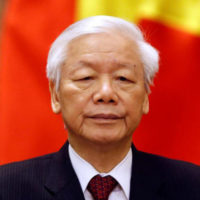 Nguyễn Phú Trọng (born 14 April 1944) is a Vietnamese politician who is the current General Secretary of the Communist Party of Vietnam, in office since 19 January 2011. He is also the President of Vietnam, de jure head of state of Vietnam, in office since 23 October 2018. Nguyễn Phú Trọng was also Chairman of the National Assembly from 2006 to 2011. He currently serves as General Secretary of the Communist Party of Vietnam, in office since January 2011. He was elected General Secretary of the Communist Party of Vietnam at the party’s 11th National Congress on 19 January 2011 and was re-elected at the 12th National Congress in 2016. As General Secretary, Nguyễn Phú Trọng heads the party’s Secretariat and is the Secretary of the Central Military Commission in addition to being the de facto head of the Politburo, the highest decision-making body in Vietnam, which currently makes him the most powerful person in Vietnam. On 3 October 2018, the Central Committee of the Communist Party of Vietnam formally nominated Nguyễn Phú Trọng to be the next President of Vietnam to be voted on the next session of the National Assembly where the party holds an overwhelming majority, making him the third person to simultaneously head the party and the state after Ho Chi Minh (in North Vietnam only) and Trường Chinh. On 23 October 2018, Nguyễn Phú Trọng was elected as the 9th President of the Socialist Republic of Vietnam in a meeting of the sixth session of the National Assembly. Source: https://en.wikipedia.org/wiki/Nguy%E1%BB%85n_Ph%C3%BA_Tr%E1%BB%8Dng
Dang Thi Ngoc Thinh, Former Acting President of Vietnam
 Born 25 December 1959, is a Vietnamese politician who is currently serving as Acting President of Vietnam after the death of President Trần Đại Quang on 21 September 2018. Thịnh is the first woman in Vietnamese history to become President or Acting President of Vietnam. She is the first female head of state in a communist country since Sabine Bergmann-Pohl of East Germany. Thịnh was elected Vice President of Vietnam on 8 April 2016 after winning 91.09% of votes (450 votes) in the National Assembly, continuing the recent norm of having a woman holding this position. She was a member of the 11th and 13th National Assemblies. She became a member of the Communist Party of Vietnam on 19 November 1979.
Tran Dai Quang, President of Vietnam (elected with 452 out of 481 votes on Apr 2, 2016; dies on Sept 21, 2018)
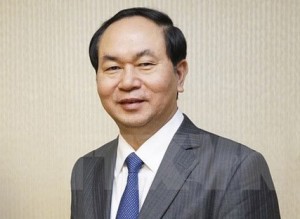 Tran Dai Quang (born 12 October 1956) is the President of Vietnam, in office since 2 April 2016. Previously he served as Minister of Public Security from 2011 to 2016. He is a member of the 12th Politburo of the Communist Party of Vietnam, in which he is ranked second, after General Secretary Nguyễn Phú Trọng. He attended the People’s Police School in 1972. From 1972 to 1975 he was a student at the School of Foreign Languages Department of Cultural Affairs (now the Ministry of Public Security). In 1975-1976 he served as an Officer in Political Protection Department I at the Ministry of Public Security. Beginning in 1978 he was an Officer II in the Political Protection Department at the Ministry of Public Security. From 1982 to 1987 Quang served as Deputy Secretary, political Protection Department II, Ministry of the Interior; and was at the Security University from 1981 to 1986. From 1987 to 1990 he was Chief of Staff, Head of Business, political Protection Department II, Ministry of the Interior. At the same time, he did advanced theoretical study at the Academy of Nguyen Ai Quoc (1989-1991). From 1990 to 1996 Quang served as Deputy Secretary of Party Committee, Deputy Director of Staff for Security and Deputy Director General in charge of Security Staff Department, General Department of Security. He was also enrolled in the Hanoi University of Law (1991-1994). From 1996 to 2000, he was a Member of the Standing Committee of the Party Committee of General Security, Party Secretary, Director of Staff for Security. He was a graduate student at Ho Chi Minh National Academy of Politics and Public Administration (1994-1997). From 2000 to 2006 he was Deputy Secretary of Party Committee, Deputy General Director of the General Security, the Ministry of Public Security. Promoted to Major General in 2003; he was appointed associate professor in 2003 and he was appointed professor in 2009. Promoted to Lt. General in April 2007, from 2006 through 2011, Quang was a member of the Standing Central Police Party Committee, Deputy Minister of Public Security. In 2011 he was Commissioner of Police Standing Party Central Committee, Deputy Minister of Public Security. In Congress 11th National Party was elected to the Party Central Committee, the Central Government is elected to the Political Bureau. At the first session of the 13th National Assembly ratified the Prime Minister’s proposals on appointing the new cabinet. Lieutenant General Tran Dai Quang, a Politburo member, Deputy Minister of Public Security, was appointed as the new Minister of Public Security, replacing General Le Hong Anh. August 30, 2011: Tran Dai Quang was appointed Secretary of the Central Police Party Committee December 5, 2011: The Minister of Public Security, Lieutenant General Tran Dai Quang, was promoted to the rank of Colonel General by President Truong Tan Sang. December 29, 2012: The Minister of Public Security, Colonel General Tran Dai Quang, was promoted to the rank of General by President. January 2016: The 14th Conference of the Party Central Committee XI was nominated as the new President. At the Congress of the 12th National Party was elected to the Party Central Committee, the Central Government is elected to the Politburo. Source: https://en.wikipedia.org/wiki/Tr%E1%BA%A7n_%C4%90%E1%BA%A1i_Quang
Truong Tan Sang, Former President of Vietnam (since July 25, 2011)
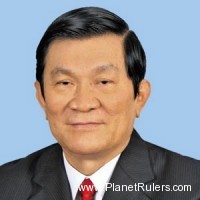 Trương Tấn Sang (born on 21 January 1949) is the current president of Vietnam and the senior member of the politburo, the executive committee of the ruling Communist Party. He was ranked as the party’s number one leader following the 11th National Congress held in Hanoi in January 2011. He became state president following a vote of the National Assembly in July. Sang has been a member of the politburo since 1996. He was party secretary for Ho Chi Minh City from 1996 to 2000. He was promoted to the national party’s number two slot in October 2009. To get the top slot, he had to outmaneuver Prime Minister Nguyen Tan Dung. Sang was born January 21, 1949 in Mỹ Hạnh, Đức Hòa, Long An. His nickname is “Tư Sang”. He joined the Communist Party in 1969. He was taken prisoner by the South Vietnamese government in 1971 and released under the Paris Peace Treaty in 1973. He has a bachelor of law. In 1992, he became party chairman for Ho Chi Minh City, the number two position in the city government. He joined the politburo in 1996 as its 14th ranking member. He was party secretary for Ho Chi Minh City, the top position in the city government, from 1996 to 2000. He was promoted to 10th position in the national party at a congress in April 2001. He was also appointed head of the party’s economic commission at this time. In 2003, he was reprimanded for failing from to act in the Nam Cam corruption scandal when he headed the city government. He was promoted to fifth position in the party at a congress in April 2006. At this congress, he was also appointed head of the party’s Secretariat, which supervises the membership and internal structure of the party. In an unusual move, Sang was promoted to the party’s number two slot between congresses in October 2009. His authority soon “eclipsed” that of General Secretary Nong Duc Manh, the only person nominally above Sang in the party hierarchy, according to a leaked diplomatic cable by U.S. Ambassador Michael Michalak. Sang “assumed many of Manh’s normal responsibilities,” Michalak wrote. At diplomatic meetings, Sang could, “comment authoritatively, in detail and without notes”, whereas Manh “appeared disengaged” while he read a 30-minute prepared statement “verbatim and in a monotone.” To get the top slot at the 2011 congress, Sang had to outmaneuver Prime Minister Dung. Michalak described both Sang and Dung as “pragmatic” and “market-oriented”. Both are southerners, but traditionally the party’s top slot has gone to a northerner. Nguyen Phu Trong, a northerner, was selected secretary general at the Congress. In the past, the office of general secretary was the party’s top position, but Trong is ranked only No. 8 on the leadership list. The National Assembly elected Sang as state president on 25 July 2011. This position is merely ceremonial compared to that of senior politburo member, which Sang already holds.
Nguyen Minh Triet, Former President of Vietnam
Nguyen Minh Triet was re-elected State President of the Socialist Republic of Viet Nam at the on-going first session of the 12th National Assembly on July 24. Following is his brief biography: – Born on October 8, 1942. – Native land: Phu An Commune, Ben Cat District, Binh Duong province – Admitted to the Communist Party of Viet Nam on March 30, 1965. Became full Party member on March 30, 1966. – Education: Bachelor of Science in Mathematics.Summary of his career: – 1960 to November 1963: Student majoring in Mathematics at university, took part in the Sai Gon Students’ Movement, assumed tasks at the revolutionary base in charge of the Sai Gon-Gia Dinh area. – December 1963 to 1973: Cadre of the Central Committee of the People’s Revolutionary Youth Union and the Inspection Section of the Party Central Committee’s Department for South Vietnam , and Secretary of the Agency’s Youth Union, and battlefield in My Tho province. – 1974 to August 1979: Deputy Director of General Affairs Department of the Youth Union , Deputy Chief of the Youth Union Central Committee’s Board for Voluntary Young People. – September 1979 to July 1981: Trainee at the High-level Nguyen Ai Quoc Party School. – July 1981 to December 1987: Head of the Youth Union Central Committee’s Board for Voluntary Young People, Secretary of the Party Committee of the Youth Union Central Committee in HCM City, member of the Youth Union Central Committee’s Executive Board, Secretary of the Ho Chi Minh Communist Youth Union Central Committee, Deputy President and General Secretary of the Viet Nam Youth Union. – January 1988 to September 1989: Complementarily elected to the Party Committee of southern Song Be province. – October 1989 to December 1991: Permanent Deputy Secretary of the Party Committee of Song Be province, elected member of the Party Central Committee at the seventh National Party Congress (June 1991). – December 1991 to December 1996: Member of the Party Central Committee, Secretary of the Party Committee of Song Be province, elected to the Communist Party Central Committee at the eighth National Party Congress, and deputy to the ninth National Assembly. – January 1997 to December 1997: Member of the Party Central Committee, Deputy Secretary of the Ho Chi Minh City Party Committee. – December 1997 to January 2000: Elected to the Party’s Politburo at the fourth Conference of the eighth Party Central Committee, Chairman of the Central Party Committee’s Commission for Mass Mobilisation. – January 2000 to June 2006: Politburo member, Secretary of the Ho Chi Minh City Party Committee. -May 2002 to June 2006: deputy to the 11th National Assembly. -June 2006: elected State President of the Socialist Republic of Viet Nam at the ninth session of the 11th National Assembly. – (VNA)
Nông Đức Mạnh, Former President of Vietnam
 Nông Đức Mạnh (born on 11 September 1940 (age 66) in Cuong Loi, Na Ri District, Bac Kan province, Vietnam, Asia) is the General Secretary of the Communist Party of Vietnam (CPV). He has held that position since 22 April 2001 and was reappointed in April 2006. Mạnh’s official biography says that he was the son of peasants of the Tay ethnic group and that he was born on 11 September 1940 in Cuong Loi, Na Ri District, Bac Kan province. He began his career as a forestry worker and joined the revolution in 1958. From 1962 to 1963, Mạnh was working as forest supervisory technician in Bac Can Forestry Service. He was admitted to the CPV on 5 July 1963 and became an official member of the CPV on 10 July 1964. From 1963 to 1965, Mạnh was the deputy chief of the Bach Thong wood exploiting team. He then returned to studies, and was taught Russian language at Hanoi Foreign Languages College 1965-1966. He then travelled to Leningrad, Soviet Union, were he studied at the Forestry Institute until 1971. After returning to Vietnam, he became the deputy head of the Bac Thai provicial forestry inspection board. From 1973 to 1974, Mạnh served as director of the Phu Loung State Forestry Camp in Bac Thai province. From 1974 to 1976, Mạnh studied at the Nguyen Ai Qouc High-Level Party School. From 1976 to 1980, Mạnh served as the deputy director of the provincial forestry service and director of the construction company of the provincial forestry service. Rising with the party ranks, Mạnh was a member of the Bac Thai Provinicial Party Committee from 1976 to 1983. In 1984, Mạnh became the deputy secretary of the committee, and in November 1986, the secretary of the committee. At the 6th national party congress he was elected as an alternate member of the Central Committee. At the 6th party plenum in March 1989, he was elevated to full central committee member. Since 1991 he has been sitting in the politburo of the party. There have been persistent rumors that Mạnh is the son of Hồ Chí Minh. In April 2001, after he was selected to head the Communist Party, a reporter at a news conference asked him to confirm or deny the rumors. He said “All Vietnamese people are the children of Uncle Ho.” When asked again about the rumor in January 2002 by a Time Asia reporter, he denied the rumors but added that all Vietnamese people consider Hồ Chí Minh their spiritual father. Many view him as a modernizer, and he has announced that he wants Vietnam to become an industrialized country by 2020.