
Volodymyr Zelensky, President of Ukraine
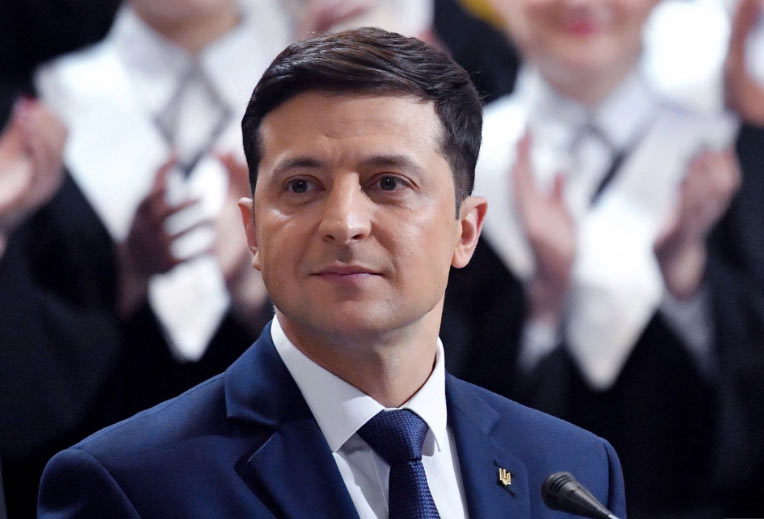
Volodymyr Oleksandrovych Zelensky is the sixth President of Ukraine, in office since 20 May 2019. His presidency falls into two sharply different phases: a first, pre-war peacetime period dominated by anti-corruption and oligarch reforms, and — from 24 February 2022 — the wartime presidency that began when Russia launched a full-scale invasion of Ukraine. Refusing an American evacuation offer in Kyiv with the now-iconic line “I need ammunition, not a ride,” Zelensky transformed overnight from a populist outsider into the global face of Ukraine’s resistance. More than four years later, he is still in office and still at war: Russia continues to occupy roughly 19% of Ukrainian territory, no presidential election has been held since the invasion as required under Article 83 of the Ukrainian Constitution during martial law, and Ukraine’s struggle to secure Western military, financial and diplomatic support has become the defining political relationship of his time in office.
Zelensky was born on 25 January 1978 in Kryvyi Rih, a Russian-speaking steel and mining city in south-eastern Ukraine, to a Jewish family. His father Oleksandr is a professor of cybernetics; his mother Rymma was an engineer. He graduated from the Kryvyi Rih Economic Institute of Kyiv National Economic University with a law degree in 2000 but never practised law. Instead he co-founded the Kvartal 95 entertainment studio in 2003, which became one of Ukraine’s most successful television and film production companies. In 2015 he starred in the satirical political drama Servant of the People, playing an idealistic history teacher who becomes president of Ukraine by accident. The show ran for three seasons; in March 2018 Kvartal 95 co-workers registered a political party under the show’s name, and on 31 December 2018 Zelensky announced his real presidential candidacy.
The 2019 Landslide and Pre-War Presidency
In the 21 April 2019 run-off Zelensky defeated the incumbent Petro Poroshenko with 73.22% of the vote — the largest margin in Ukrainian presidential history. His Servant of the People party followed up on 21 July 2019 with the first-ever single-party parliamentary majority in independent Ukraine (254 of 450 seats). The early Zelensky government delivered a sweeping land-reform law (March 2020), passed oligarch-restriction legislation (September 2021), and negotiated an IMF US$5 billion standby arrangement. His Steinmeier-formula effort to implement the Minsk II agreements on Donbas ended in a 2021 breakdown. His personal approval rating had fallen to around 25% by November 2021, just ahead of the events that would reshape his presidency.
The Full-Scale War
Russia launched its full-scale invasion at 05:00 Kyiv time on 24 February 2022. Moscow’s initial military aim, an attempted coup de main against the capital, failed within 72 hours as Ukrainian forces held at the Antonov Airport battle in Hostomel and Russian armoured columns stalled north of Kyiv. Zelensky remained in the capital, streaming nightly video addresses in combat fatigues from a green-screen office. By April 2022 Russian forces had withdrawn from Kyiv Oblast; mass graves and evidence of war crimes were uncovered in Bucha, Irpin and elsewhere. Ukrainian counter-offensives recaptured much of Kharkiv Oblast in September 2022 and the city of Kherson on 11 November 2022. A slower-going 2023 southern counter-offensive failed to breach Russia’s prepared defensive lines in Zaporizhzhia Oblast. Since 2024 the war has settled into a high-intensity attritional pattern, with Russia making grinding territorial gains in eastern Donetsk Oblast at heavy cost.
As of April 2026 Russia controls all of Crimea, roughly 85% of Luhansk, about 65% of Donetsk, and around 65–70% each of Zaporizhzhia and Kherson oblasts — approximately 108,000 km², or 18–19% of pre-war Ukrainian territory. Ukrainian military casualties are officially classified but widely estimated in Western assessments at roughly 80,000 killed in action and 400,000 wounded; the Russian figure is believed to be significantly higher. More than 10 million Ukrainians remain displaced, of whom around 6.7 million live outside the country. Zelensky’s personal wartime approval — which peaked at 90% in March 2022 — had fallen to roughly 60% by early 2026 but remains well above that of any other Ukrainian politician.
International Diplomacy: From Biden to Trump
Zelensky has been the most-travelled wartime leader in modern history. He addressed the United States Congress (December 2022), the UK Parliament (February 2023), European Parliament, the United Nations General Assembly, the G7, and successive NATO summits. His February 2022 EU candidate application led to formal accession negotiations opening on 25 June 2024. Relations with Donald Trump’s second US administration, which took office on 20 January 2025, have been formally cordial but substantively difficult. A 28 February 2025 Oval Office meeting between Zelensky, Trump and Vice President J. D. Vance descended into an unprecedented public argument over the shape of a possible settlement; a separate minerals-access agreement was signed on 30 April 2025. Since mid-2025 a European “Coalition of the Willing,” led by UK PM Keir Starmer and French President Emmanuel Macron, has committed to providing ceasefire guarantees and a “reassurance force” contingent on a durable settlement. A US-brokered 28-point framework proposal was discussed in Geneva in late November 2025 but rejected in its initial form by Kyiv. A partial ceasefire applying to energy infrastructure was negotiated in March 2025 and has been observed with intermittent Russian violations.
Martial Law, Elections and Succession Debate
Zelensky’s original five-year term would have ended at the inauguration of his successor on 20 May 2024. Under Article 83 of the Ukrainian Constitution and the 2015 Law on Martial Law, both presidential and parliamentary elections are suspended for the duration of martial law, which has been continuously extended since 24 February 2022. Ukraine’s Constitutional Court, the Verkhovna Rada and the EU’s Venice Commission have all confirmed that Zelensky’s continuation in office under these circumstances is constitutional. The Rada has repeatedly declared that holding elections under wartime conditions would be unsafe and illegal. Russia and parts of the US administration have at various points challenged Zelensky’s legitimacy; almost all of Ukraine’s partners recognise him as the lawful president.
Wife, Family and Personal Life
Zelensky married Olena Kiyashko, a fellow Kryvyi Rih native and Kvartal 95 co-worker, on 6 September 2003. They have two children: Oleksandra (born 15 July 2004) and Kyrylo (born 21 January 2013). First Lady Olena Zelenska has used the role to advocate internationally for mental-health support for war survivors, for return of Ukrainian children deported to Russia, and for cultural diplomacy. The family’s security arrangements are governed by standing protective orders and have not been detailed publicly.
| Full name | Volodymyr Oleksandrovych Zelensky |
|---|---|
| Born | 25 January 1978 · Kryvyi Rih, Ukrainian SSR (age 48) |
| Office | President of Ukraine (6th) |
| In office since | 20 May 2019 · term extended under martial law since 20 May 2024 |
| Predecessor | Petro Poroshenko (2014–2019) |
| Prime Minister | Yulia Svyrydenko (since 17 July 2025) |
| Party | Servant of the People |
| 2019 election | 73.22% run-off (record margin) |
| Next election | Not scheduled; will follow end of martial law |
| Capital | Kyiv |
| Human rights rating | Freedom House: Partly Free (45/100) |
Frequently asked questions
Who is the current president of Ukraine in 2026?
Volodymyr Zelensky has been President of Ukraine since 20 May 2019. He is serving his first term, which has been extended under martial law since the 24 February 2022 Russian full-scale invasion. His original term was due to expire on 20 May 2024.
How old is Volodymyr Zelensky?
Zelensky was born on 25 January 1978 in Kryvyi Rih and is 48 years old as of April 2026.
Is Zelensky still the legitimate president?
Yes. Under Article 83 of the Ukrainian Constitution, the 2015 Law on Martial Law, and rulings by Ukraine’s Constitutional Court, the president’s mandate extends until new elections can be held, which cannot occur during martial law. The Venice Commission, the EU, the UK, the G7 and most of Ukraine’s partners recognise him as the lawful head of state.
Why are there no elections in Ukraine?
Ukrainian law suspends both presidential and parliamentary elections during martial law, which has been continuously in force since 24 February 2022. Holding a vote under wartime conditions — with millions of voters displaced, territory occupied and frontline regions under fire — is not considered feasible or constitutional.
What percentage of Ukraine does Russia control?
As of April 2026, Russia controls approximately 18–19% of Ukrainian territory: all of Crimea, roughly 85% of Luhansk Oblast, 65% of Donetsk, and 65–70% each of Zaporizhzhia and Kherson oblasts. The cities of Zaporizhzhia and Kherson remain under Ukrainian control. See “Russian-Occupied Ukraine — Who Rules the Occupied Territories?” for details.
What was the 28 February 2025 Oval Office clash?
A meeting in the Oval Office between Zelensky, President Donald Trump and Vice President J. D. Vance descended into an unprecedented public argument over the terms of a possible Russia–Ukraine settlement. A scheduled signing ceremony for a US–Ukraine minerals agreement was cancelled; a modified version was signed on 30 April 2025.
Former Presidents of Ukraine
Petro Poroshenko (7 June 2014 – 20 May 2019)

Petro Oleksiyovych Poroshenko (born 26 September 1965) was the fifth President of Ukraine, in office from 7 June 2014 to 20 May 2019. A confectionery magnate whose Roshen group gave him the nickname “the Chocolate King,” he came to power in the snap election that followed the February 2014 Revolution of Dignity and the Russian annexation of Crimea. His presidency was defined by the first phase of the war in Donbas, the 2014–2015 IMF stand-by programme, visa-free travel for Ukrainians to the Schengen area (from June 2017), and the September 2018 establishment of an autocephalous Orthodox Church of Ukraine. He lost the 2019 run-off to Volodymyr Zelensky by 73.2% to 24.5%. Since 2022 Poroshenko has led the European Solidarity opposition faction in the Verkhovna Rada and remained in Ukraine despite occasional tensions with the Zelensky administration.
Oleksandr Turchynov (Acting, 23 February 2014 – 7 June 2014)
Oleksandr Valentynovych Turchynov (born 29 March 1964) served as Acting President of Ukraine for three and a half months following the flight of Viktor Yanukovych. As speaker of the Verkhovna Rada he constitutionally assumed the functions of the presidency during the transition and oversaw the immediate aftermath of the Russian annexation of Crimea and the outbreak of the Donbas war. From 2014 to 2019 he served as Secretary of the National Security and Defence Council under Poroshenko.
Viktor Yanukovych (25 February 2010 – 22 February 2014)
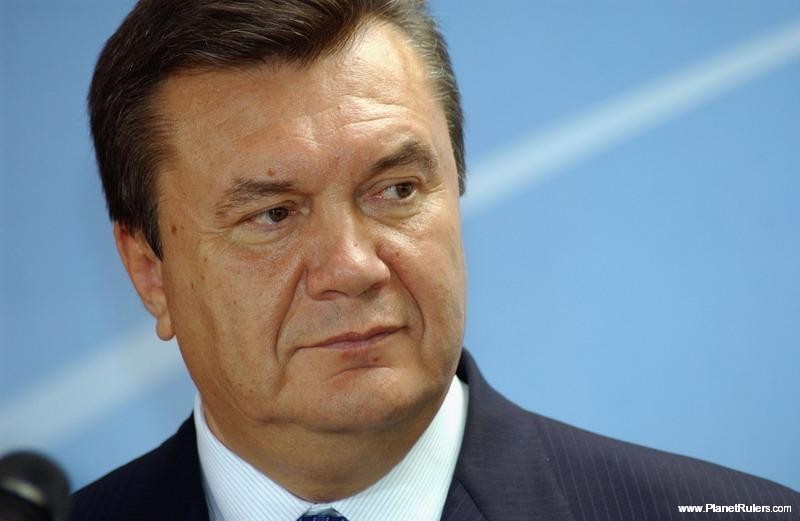
Viktor Fedorovych Yanukovych (born 9 July 1950) was the fourth President of Ukraine. A former governor of Donetsk Oblast and two-time prime minister, he won the 2010 run-off against Yulia Tymoshenko. His November 2013 decision to abandon the EU Association Agreement in favour of closer ties with Moscow triggered the Euromaidan protests. After sniper killings of protesters on 18–20 February 2014 left more than 100 dead, Yanukovych fled Kyiv for Russia on 22 February 2014 and was removed from office by parliament the same day. He has lived in Russia in exile ever since. The Ukrainian courts convicted him of treason in absentia in January 2019 and sentenced him to 13 years’ imprisonment.
Viktor Yushchenko (23 January 2005 – 25 February 2010)
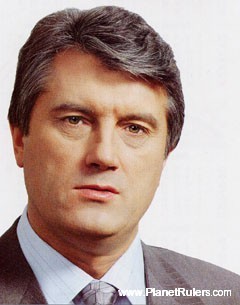
Viktor Andriyovych Yushchenko (born 23 February 1954) was the third President of Ukraine. A former chairman of the National Bank of Ukraine and prime minister under Leonid Kuchma, he led the pro-Western Our Ukraine bloc in the 2004 presidential election. After the November 2004 run-off was marred by large-scale fraud, the Orange Revolution mass protests forced a re-run which Yushchenko won against Viktor Yanukovych on 26 December 2004. During the campaign he was poisoned with dioxin, severely disfiguring his face. His presidency pursued EU and NATO integration and marked the first Holodomor recognition law (2006), but the “Orange” coalition collapsed in political infighting. He lost in the first round of the 2010 election with 5.5%.
Leonid Kuchma (19 July 1994 – 23 January 2005)
Leonid Danylovych Kuchma (born 9 August 1938) was the second President of Ukraine and the country’s longest-serving elected head of state (10 years). A former director of the Yuzhmash missile plant and prime minister (1992–1993), he was elected in 1994 defeating incumbent Leonid Kravchuk, and re-elected in 1999. His presidency delivered the 1996 Ukrainian hryvnia currency introduction, the 1996 constitution, and large-scale privatisation — but was marred by the Kuchmagate tapes scandal (2000–2001), the November 2000 disappearance and killing of investigative journalist Georgiy Gongadze, and the Kolchuga affair. His second term ended with the Orange Revolution that installed his long-standing rival Yushchenko. Since 2014 Kuchma has led successive Ukrainian delegations to the Trilateral Contact Group on the Donbas peace process.
Leonid Kravchuk (5 December 1991 – 19 July 1994)
Leonid Makarovych Kravchuk (10 January 1934 – 10 May 2022) was the first President of independent Ukraine. A former ideological secretary of the Communist Party of Ukraine, he declared Ukrainian independence on 24 August 1991 and won the first presidential election on 1 December 1991 with 61.6%. As one of the three Belovezha Accords signatories on 8 December 1991, he formally dissolved the Soviet Union together with Boris Yeltsin and Stanislav Shushkevich. His single term delivered Ukraine’s 1992 accession to the CSCE and the 1994 Budapest Memorandum under which Ukraine surrendered its Soviet nuclear arsenal in exchange for security assurances from the United States, United Kingdom and Russia. Kravchuk died on 10 May 2022, eleven weeks into the Russian full-scale invasion.