
Xi Jinping, Paramount Leader of China
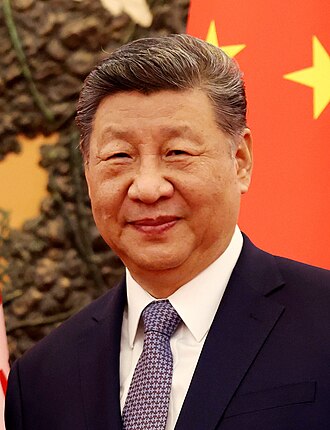
Xi Jinping (born 15 June 1953) is a Chinese politician who has served as General Secretary of the Chinese Communist Party (CCP) since November 2012, Chairman of the Central Military Commission since November 2012, and President of the People’s Republic of China since March 2013. He is widely regarded as the most powerful Chinese leader since Mao Zedong and began an unprecedented third five-year term at the 20th Party Congress in October 2022.
Family and early life
Xi was born in Beijing to Xi Zhongxun, a revolutionary veteran who served as Vice Premier under Mao Zedong before being purged in 1962. During the Cultural Revolution the young Xi was “sent down” to the countryside in Shaanxi Province in 1969 and spent seven years there doing manual labour. He joined the CCP in 1974, studied chemical engineering at Tsinghua University, and later earned a doctorate in Marxist theory.
Rise to power
Xi built his political career in provincial posts in Hebei, Fujian, Zhejiang and Shanghai, cultivating a reputation as a competent and anti-corruption administrator. He joined the Politburo Standing Committee in 2007 and was designated successor to Hu Jintao. At the 18th Party Congress in November 2012 he became General Secretary; he assumed the presidency in March 2013.
Consolidation of power
Xi has presided over the most significant recentralisation of authority in China since Deng Xiaoping’s era. His signature anti-corruption campaign, launched in 2013, has investigated more than four million officials; critics note that it has also served to neutralise political rivals. “Xi Jinping Thought on Socialism with Chinese Characteristics for a New Era” was enshrined in the CCP constitution in 2017 and the state constitution in 2018, when the two-term limit on the presidency was abolished, clearing the way for Xi’s current third term.
Signature policies
Key initiatives under Xi include the Belt and Road Initiative (2013–), a global infrastructure and lending programme; the mass internment of Uyghurs in Xinjiang beginning in 2017, which the UN Office of the High Commissioner for Human Rights in 2022 said may constitute crimes against humanity; the 2020 imposition of a National Security Law in Hong Kong following prolonged pro-democracy protests; a series of military exercises around Taiwan; and an ambitious military modernisation programme targeting a “world-class” People’s Liberation Army by 2049.
Human rights and governance
Under Xi, civil society, press freedom, and the space for political opposition have narrowed sharply. Freedom House classifies China as “Not Free” and The Economist Democracy Index places it among the most authoritarian regimes globally. Human Rights Watch, Amnesty International and the UN have documented mass surveillance, detention of lawyers and activists, restrictions on religious and ethnic minorities, and the export of surveillance technology through the Digital Silk Road.
At a glance
| Full name | Xi Jinping |
|---|---|
| Born | 15 June 1953, Beijing |
| Offices | General Secretary of the CCP; President of the PRC; Chairman, Central Military Commission |
| In office since | CCP General Secretary: Nov 2012 · President: March 2013 |
| Current term | Third (2022–2027); term limits abolished in 2018 |
| Party | Chinese Communist Party |
| Predecessor | Hu Jintao |
| Human rights | Freedom House: Not Free |
Frequently asked questions
Click a question to expand the answer.
Who is the president of China in 2026?
Xi Jinping has been President of the People’s Republic of China since March 2013 and General Secretary of the Chinese Communist Party since November 2012. He began an unprecedented third five-year term in October 2022.
How old is Xi Jinping?
Xi was born on 15 June 1953, which makes him 72 in April 2026.
Is China a dictatorship?
China is a one-party state ruled by the Chinese Communist Party. Freedom House classifies it as “Not Free” and The Economist Democracy Index calls it an authoritarian regime. Under Xi, power has been increasingly concentrated around his personal leadership.
When did Xi abolish term limits?
In March 2018 the National People’s Congress amended the state constitution to abolish the two-term limit on the presidency that had been in place since 1982. This cleared the way for Xi to begin a third term in March 2023.
What is Xi Jinping Thought?
“Xi Jinping Thought on Socialism with Chinese Characteristics for a New Era” is the ideological framework associated with Xi. It was written into the CCP constitution in 2017 and the state constitution in 2018, making Xi only the third CCP leader after Mao and Deng to have an eponymous doctrine enshrined during his lifetime.
How is China’s president chosen?
The President of China is elected by the National People’s Congress, which in practice ratifies the choice of the Chinese Communist Party leadership. The position is constitutionally distinct from the CCP General Secretary and Central Military Commission chair, but under Xi all three roles have been held by the same person.
Who is Xi Jinping’s successor?
No clear successor has been publicly designated. The Politburo Standing Committee elected at the 20th Party Congress in October 2022 is composed of Xi loyalists, and no figure of an earlier generation was retained. This is itself unusual for modern CCP succession practice.
Hu Jintao, Former President of China (2003–2013)
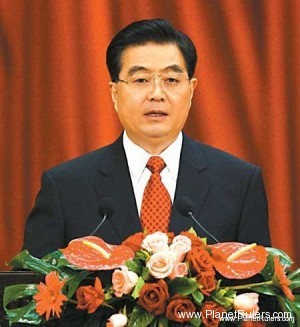
Hu Jintao (born 21 December 1942) served as General Secretary of the Communist Party of China from 2002 to 2012 and as President of the People’s Republic of China from 2003 to 2013. A member of the so-called fourth generation of Chinese leadership, his era was associated with the “Scientific Outlook on Development” doctrine and a public focus on a “Harmonious Society”. Hu oversaw the Beijing 2008 Summer Olympics, China’s rise to the world’s second-largest economy, and the handover of leadership to Xi Jinping in late 2012. He attracted international attention in October 2022 when he was escorted out of the 20th Party Congress in front of cameras, in a moment whose interpretation remains contested.